
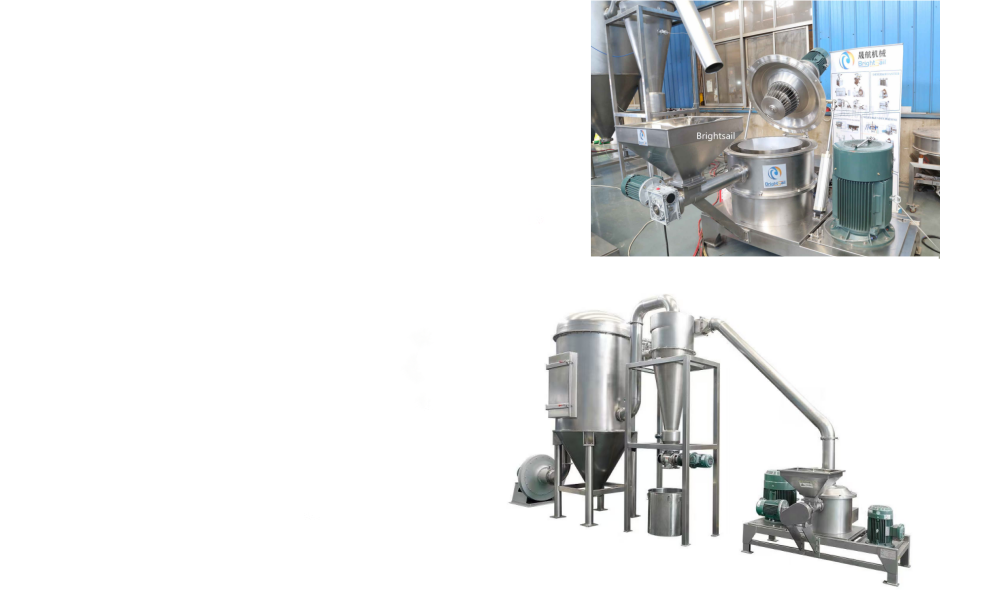
When selecting the ideal particle size reduction system for dry processing of powders and bulk solids, engineers and production managers often face a key strategic decision. This choice profoundly impacts product quality, process efficiency, operational costs, and capital investment. Two primary contenders dominate the landscape for achieving fine to ultra-fine particle sizes: Air Classifier Mills (often integrated or paired with classifiers) and Multi-stage Comminution Systems that combine different grinding technologies.
Understanding the Particle Size Spectrum
The “Particle Size Spectrum” refers to the target particle size distribution (PSD) and the path to achieve it. It ranges from coarse crushing (>1 mm) to fine grinding (10-100 microns) and ultra-fine or sub-micron milling (<10 microns). The choice of technology is dictated by the feed size, desired final PSD, material properties (hardness, abrasiveness, heat sensitivity, moisture content), and required throughput.
Air Classifier Mill Systems: Integrated Precision
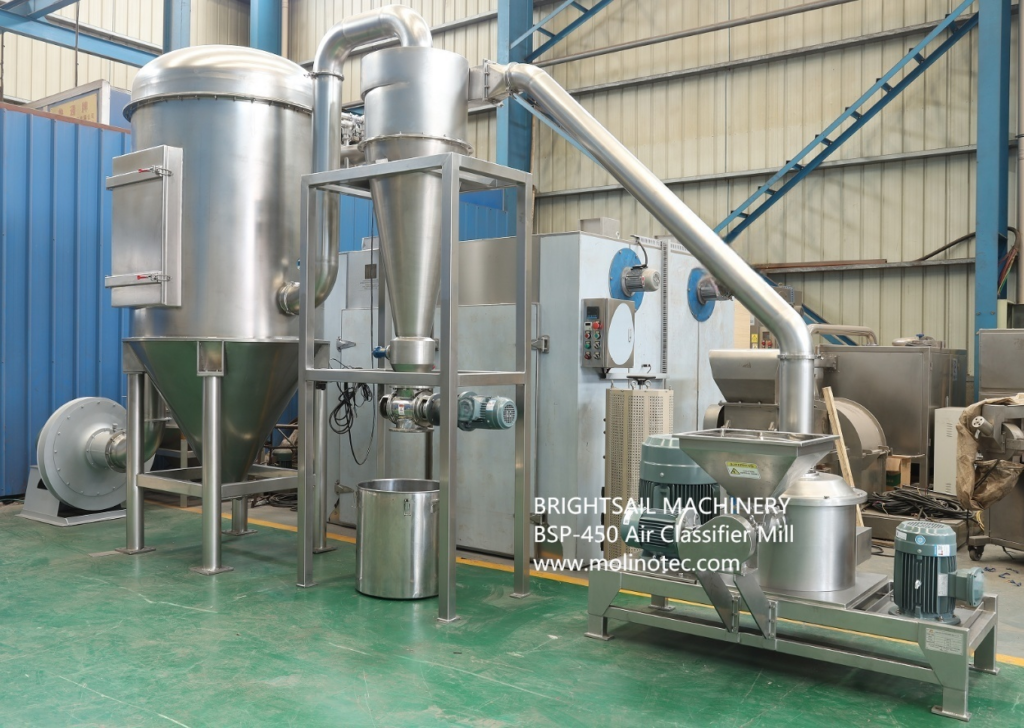
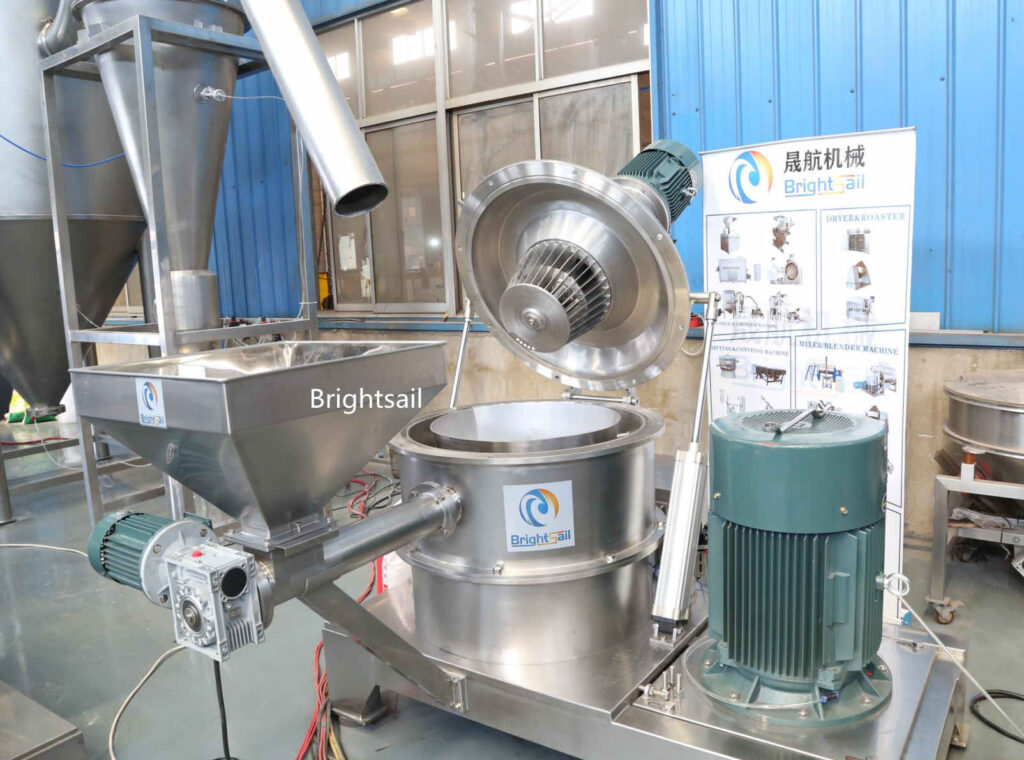
An Air Classifier Mill combines impact milling and dynamic air classification in a single unit or a tightly integrated loop. Material is fed into a grinding chamber where hammers or pins impart impact energy. The ground particles are entrained in an air stream and carried to an integrated classifier wheel. Coarse particles are rejected back to the grinding zone, while fines meeting the size cut pass through. This closed-loop system allows for precise control over the top particle size.
Key Characteristics & Ideal Positioning:
- Mechanism: Impact grinding coupled with instantaneous internal classification.
- Typical Particle Size Range: Capable of achieving a narrow distribution in the 10 – 150 microns range. Some advanced models can reach down to 5-10 microns (D97).
- Control: Excellent control over the top-size (coarse tail) of the distribution via classifier wheel speed.
- Efficiency: Highly energy-efficient for brittle to medium-hard materials (e.g., minerals, chemicals, foodstuffs, pharmaceuticals) when the target size is within its efficient range. It avoids over-grinding.
- Heat-Sensitive Materials: Suitable due to the cooling effect of the high air volume.
- Best For: Direct milling of pre-crushed feed (e.g., <10mm) to a specific, consistent fine powder in a single step. Ideal for products where a sharp, controlled top size is critical.
Multi-stage Comminution Systems: Sequential Power
A Multi-stage Comminution System is a process flow that employs two or more different types of size reduction machines in series. A common configuration is a jaw or cone crusher for primary crushing, followed by a coarse or fine grinding mill (like a ball mill or vertical roller mill), and finally an external air classifier (like a dynamic or static classifier) in a closed circuit. The classifier fines are the product, and the coarse stream is recycled.
Key Characteristics & Ideal Positioning:
- Mechanism: Sequential application of different forces (compression, impact, attrition) across dedicated machines.
- Typical Particle Size Range: Can be engineered to cover a vast spectrum, but is particularly powerful and efficient for producing high volumes of fines in the <45 – <10 microns range, even down to sub-micron levels.
- Control: Offers control over the entire shape of the PSD, including the fine end, through adjustments in mill parameters and classifier settings across stages.
- Efficiency: For very fine grinding of hard and abrasive materials (e.g., quartz, zircon sand, advanced ceramics), a staged approach with a tumbling ball mill or stirred media mill is often more robust and economical at large scale than trying to force a single ACM to do the same duty. Energy is optimally applied per stage.
- Flexibility: The system can be designed to handle a wider variety of feed materials and product specifications by adjusting or bypassing stages.
- Best For: High-tonnage applications requiring ultra-fine or narrowly distributed fine powders from hard/abrasive feeds, or when feed size is very large, necessitating true primary crushing.
Positioning on the Spectrum: A Decision Matrix
| Consideration | Air Classifier Mill (with integrated classifier) | Multi-stage Comminution System |
|---|---|---|
| Optimal Final Size (D97) | 10 – 150 microns | Can be finer: 1 – 45 microns (and beyond) |
| Feed Size | Smaller, pre-crushed (<6-10mm typical) | Can handle large, raw feed (e.g., 50mm+) |
| Material Hardness/Abrasiveness | Best for brittle to medium-hard, low to moderate abrasiveness | The preferred solution for hard, highly abrasive materials |
| Product PSD Control | Excellent top-size control, can produce narrow distributions | Superior control over the entire PSD, especially the fine tail |
| System Footprint | Compact, single-unit or integrated system | Larger, requires more space for multiple machines and conveying |
| Capital Investment | Generally lower for a given capacity within its range | Higher, due to multiple machines, conveyors, and complex controls |
| Operational Complexity | Simpler to operate and maintain (one main unit) | More complex, requires balancing multiple units |
| Energy Efficiency | High within its “sweet spot” range | Can be more efficient for very fine grinding of hard materials |

Conclusion
The choice is not about which technology is universally better, but about which is optimal for a specific point on the particle size spectrum and material profile.
- Choose an Air Classifier Mill when your process involves direct, efficient transformation of pre-crushed materials into a controlled fine powder (10-150 microns). It is the champion of single-step precision, offering a compact, lower-CAPEX solution for heat-sensitive, friable, or chemical products where consistent quality and simplicity are paramount.
- Choose a Multi-stage Comminution System when facing very hard/abrasive materials, very high throughput demands, or the need for ultra-fine products (<10 microns). It is the champion of sequential deconstruction, providing the robustness, flexibility, and often superior long-term economics for demanding mineral and advanced material processing. It excels where the application justifies a higher initial investment and system complexity.