
When it comes to equipment control systems, one of the most common dilemmas manufacturers and equipment buyers face is choosing between PLC (Programmable Logic Controller) control and traditional button control. After years of working in the equipment industry—observing client preferences, troubleshooting operational issues, and optimizing production lines—I’ve gained valuable insights that I want to share: there is no absolute “better” option between the two. The key lies in matching the control system to your specific needs, production scenarios, and even regional client preferences. The most expensive, advanced PLC isn’t always the optimal choice, just as a simple button control system might fall short for complex operations. This article breaks down six key sections to help you make an informed decision, drawing on real-world experience and practical considerations.
I. Introduction: The Core Dilemma in Equipment Control – PLC vs Traditional Button Control
In the world of industrial equipment, control systems are the “brain” that dictates how machines operate. PLC and traditional button control are the two dominant options, each with its own strengths and limitations. The biggest mistake many manufacturers make is assuming that a more advanced, costly system will always deliver better results. From my years of experience, this couldn’t be further from the truth. Whether you choose PLC or button control depends on a range of factors: the complexity of your equipment, your production scale, the technical capabilities of your team, and even the preferences of your target clients.
This article will guide you through the decision-making process by exploring regional client preferences, the suitability of each control system for different equipment types, real-world application examples, common pain points, and practical tips. My goal is to help you avoid overcomplicating your operations or wasting resources on unnecessary features—because the best control system is the one that fits your unique needs.
II. Regional Differences in Client Preferences
One of the most notable observations from my career is the clear regional divide in client preferences for control systems. This isn’t just a matter of personal preference; it’s often tied to regional production standards, automation levels, and operational habits.
European clients, in general, have a strong preference for PLC control. They value its precision, flexibility, and ability to integrate with other systems—all of which align with their focus on standardized, automated production lines. For European manufacturers, PLC control is seen as a long-term investment in efficiency and reliability, even if the initial cost is higher.
On the other hand, clients from many other regions tend to favor traditional button control. Their top priorities are simplicity, cost-effectiveness, and ease of use. They often operate smaller-scale production lines or standalone machines, where complex automation isn’t necessary. Button control systems are intuitive, require minimal training, and don’t demand specialized technical skills to operate or maintain.
A critical point to emphasize here: more expensive and advanced PLCs do not equal better performance. I’ve seen manufacturers invest in high-end PLC systems for simple, single-function machines—only to find that the extra features go unused, and maintenance becomes more complicated and costly. Always match the control system to your actual needs, not just the latest technology.
III. Traditional Button Control: Ideal for Simple, Single-Function Equipment
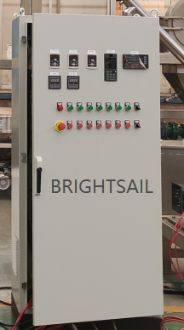
Traditional button control (also known as hardwired control) has been a staple in industrial equipment for decades, and it remains the best choice for specific scenarios—especially when equipment is simple and functions are straightforward.
The primary scenario for button control is equipment with a simple structure and single function, such as basic crushers, small-scale grinders, or standalone machines. A perfect example is the traditional hammer mill: it has a simple control process, uses only a few motors, and requires no complex automatic adjustments. For this type of equipment, button control actually simplifies operations and maintenance. It eliminates the need for programming or specialized training, allowing on-site workers to operate the machine with minimal effort.
The biggest advantage of button control is its low maintenance and repair costs. Buttons and switches are basic, low-cost components that are easy to replace. If a button fails, a worker with basic technical knowledge can swap it out in minutes, minimizing downtime. This is a huge benefit for factories with limited technical resources or teams with lower technical expertise.
Additionally, button control systems have a lower initial investment compared to PLCs. For small manufacturers or those operating on a tight budget, this cost savings can be significant. They’re also more reliable in harsh working environments, as they have fewer electronic components that can be damaged by dust, moisture, or vibration.
IV. PLC Control: Perfect for Complex Scenarios and Intelligent Operations
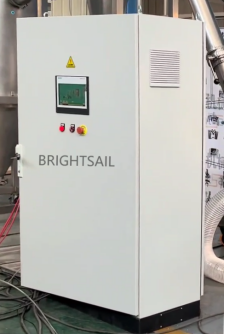
While button control excels in simplicity, PLC control shines when equipment is complex, requires coordination between multiple machines, or demands precise, automated adjustments. PLC systems are designed to handle complex control logic, making them ideal for large-scale production lines, multi-equipment collaborative operations, and machines with variable operating parameters.
One of the key advantages of PLC control is its intelligence and flexibility. Unlike button control, which is hardwired and fixed, PLCs can be programmed to adapt to changing production needs. For example, our air classifier mill— a machine that requires precise control to ensure optimal grinding efficiency—benefits greatly from PLC control in two key ways:
First, the feeding speed of the air classifier mill needs to be adjusted in real time based on the equipment’s current. Different raw materials have different grinding efficiencies, so a fixed feeding speed will either lead to inefficient grinding or overload the machine. PLC systems can monitor the current in real time and automatically adjust the feeding speed, ensuring stable operation and maximum grinding efficiency.
Second, the air classifier mill has multiple switches and components that need to be activated in a specific order. PLCs can be programmed to automatically execute the correct startup and shutdown sequences, avoiding equipment damage or malfunctions caused by human error. This not only improves operational safety but also extends the service life of the machine.
Another benefit of PLC control is its scalability. As your production needs grow, you can easily upgrade the PLC program to add new functions or integrate it with other equipment—without the need for major hardware modifications. This makes PLCs a smart long-term investment for manufacturers looking to expand or optimize their production lines.
V. Key Pain Points of PLC Control and Practical Solutions (Industry Experience Summary)
While PLC control offers significant advantages for complex equipment, it’s not without its challenges. Based on my years of experience, the most common pain point is related to program tampering:
In some factories, workers may tamper with the PLC program—either intentionally or accidentally—leading to equipment malfunctions, production downtime, or even safety hazards. This is a particular concern for European clients, who rely heavily on PLC control for their automated lines.
The solution? For European clients (and any client using PLC control in large-scale operations), I recommend adding a remote control module to the PLC system. Remote control not only allows you to monitor and debug the equipment from a distance but also prevents unauthorized access to the program. This ensures that the PLC operates as intended, reducing the risk of downtime and equipment damage.
It’s also important to note that PLC maintenance requires specialized programming skills. Unlike button control, which can be repaired by on-site workers, PLC issues often require a trained technician. This means higher maintenance costs and potentially longer downtime if a technician isn’t readily available. Additionally, the initial investment in a PLC system is higher than in a button control system—so it’s important to weigh these costs against the benefits before making a decision.
VI. Conclusion: How to Choose the Right Control System for Your Needs
Choosing between PLC and traditional button control doesn’t have to be complicated. The key is to focus on five core factors: equipment complexity, production needs, regional client preferences, maintenance capabilities, and budget. Here’s a simple framework to guide your decision:
Choosing between PLC and traditional button control doesn’t have to be complicated. The key is to focus on six core factors: equipment complexity, production needs, regional client preferences, maintenance capabilities, budget, and the situation of factory workers. Here’s a simple framework to guide your decision:
2. Complex equipment or multi-machine production lines (e.g., air classifier mills, large-scale grinding lines): Choose PLC control. It offers the intelligence, flexibility, and automation needed to optimize efficiency and ensure stability.
3. Client preferences: For European clients, prioritize PLC control with a remote control module to meet their automation and security needs. For clients in other regions, consider button control for simple equipment, or PLC control if their operations demand it—don’t push for advanced systems unnecessarily.
4. Factory worker conditions: This is an often-overlooked but crucial factor. We also need to consider the cultural level and quality of factory workers. In some countries, workers may even strike or hit the machine out of emotion during work. For such situations, traditional button control is often more robust and less likely to be damaged by improper operation or intentional strikes. PLC systems, with their more complex electronic components, are more vulnerable to damage from rough handling, which can lead to costly repairs and prolonged downtime. Conversely, if workers are well-trained and have a higher cultural level, PLC control can be more efficiently utilized to maximize production benefits.
At the end of the day, there is no “best” control system—only the one that fits your unique situation. Drawing on years of industry experience, I’ve found that the most successful manufacturers are those who prioritize practicality over prestige. By matching your control system to your equipment, team, and clients, you’ll not only reduce costs and downtime but also improve overall production efficiency.
If you’re still unsure which control system is right for your equipment—whether it’s a hammer mill, air classifier mill, or another type of industrial machine—feel free to reach out. We can help you evaluate your needs and recommend the optimal solution based on our years of experience in the field.