
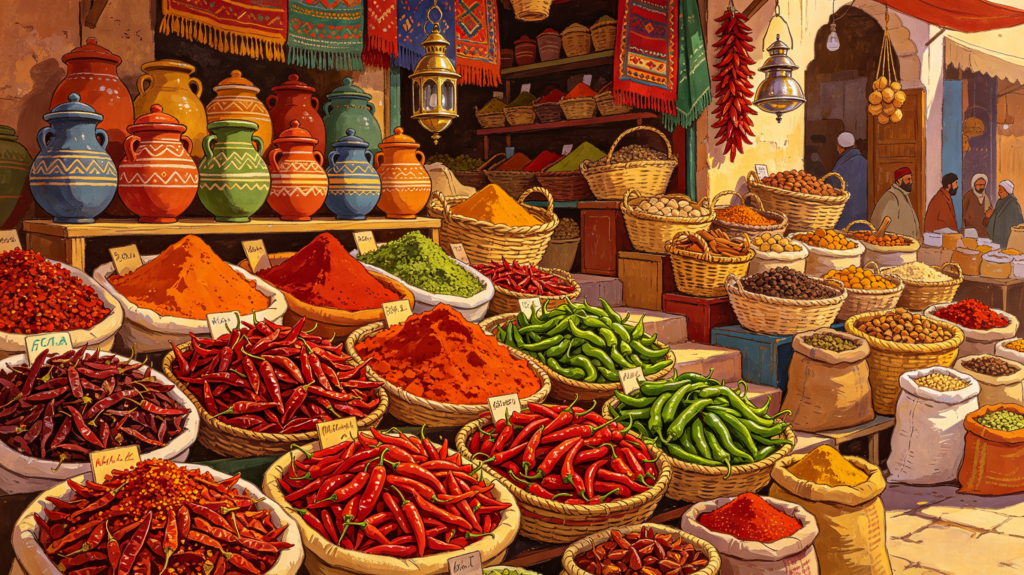
The demand for chili powder has maintained steady growth worldwide in recent years. Industry data shows that the domestic chili powder market grows at 5%–10% per year, while the global market maintains an annual growth rate of around 3%. As the downstream food processing industry expands, more and more food and spice manufacturers are building new production lines or upgrading their chili grinding machine capacity.
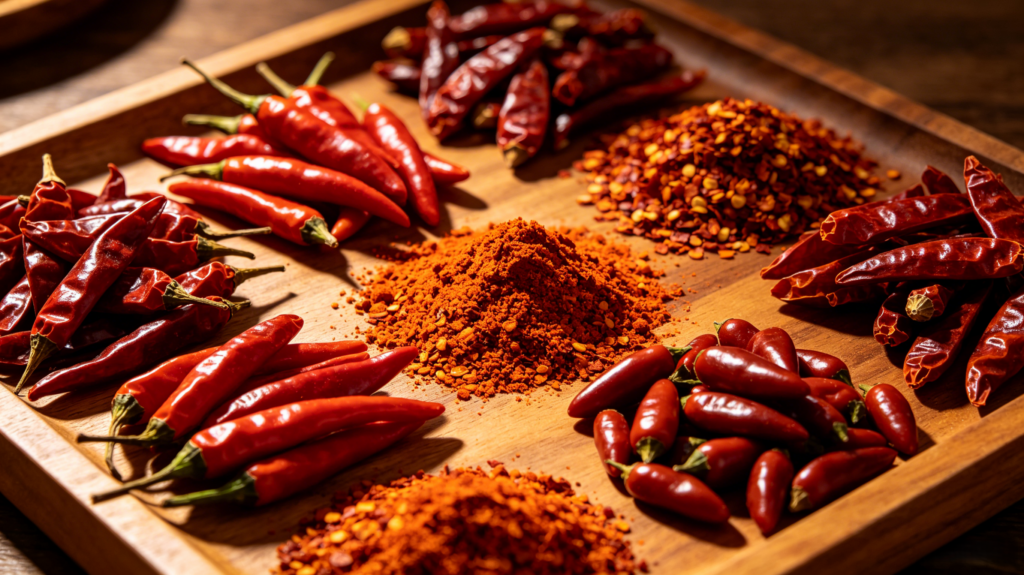
1. Why Chili Powder Demand Keeps Rising
The continuous market growth is driven by both industrial production upgrading and household consumption upgrading:
1. Explosion of pre-made food and industrial food production
The rapid expansion of pre-cooked dishes, compound seasonings, snack foods, and meat processing has greatly increased the demand for standardized chili powder and natural chili pigment materials. Industrial-grade chili powder has become an essential raw material, creating a large market gap for stable and high-quality production capacity.
2. Upgraded household consumption
Consumers are increasingly pursuing zero-additive, pure, fine, and bright-colored chili powder. High-quality fine chili powder brings much higher market premiums, pushing processing factories to upgrade their grinding technology and equipment.
2. Global Chili Powder Fineness Standards (Different Markets)
Many buyers misunderstand that chili powder has a unified fineness standard. In fact, chili powder fineness requirements vary greatly from country to country, which is a key factor for machine selection and export production:
- India & Mexico: 30–40 mesh, focusing on strong original chili flavor
- Malaysia: 40–60 mesh, finer texture for compound seasoning
- United States: 50–60 mesh, often blended with other spices for mixed seasonings
- China market: dual standard — coarse powder for local markets and fine powder for supermarket and industrial use
- European countries: no unified standard, customized fineness according to local food processing habits
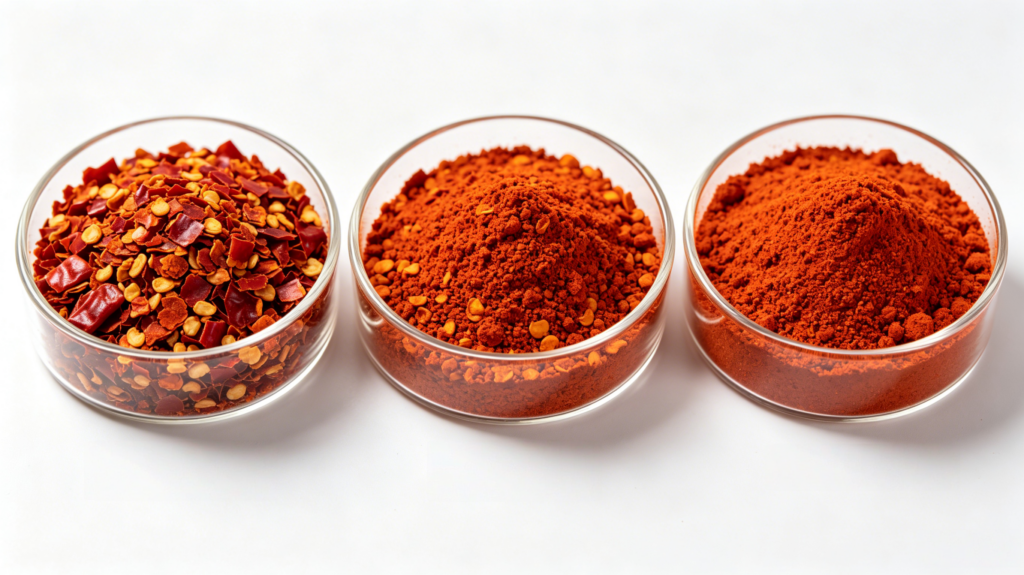
In addition, chili flakes are globally popular. The mainstream flake sizes are 5–10 mesh and 10–20 mesh, featuring clear particle shape and minimum fine powder for barbecue, marination, and seasoning purposes.
3. How to Choose Machines for Chili Flakes (Do Not Use Fine Grinders)
To produce clean and uniform chili flakes with low dust content, ordinary fine grinding machines are not applicable.
Traditional fine grinders produce excessive fine powder during high-speed grinding, resulting in turbid flake texture, high dust rate, and unqualified final products.
The best solution is a special coarse crusher. It produces uniform chili flakes without over-grinding, effectively controlling fine powder content. This machine is also versatile for tea leaf crushing and other spice coarse processing, achieving high cost performance.
A strict industry rule for mass chili flake production: dry chilies must be de-seeded before crushing. Chili seeds are hard and highly oily. If crushed together with chili flesh, they will produce black spots, fine dust, and bitter taste, seriously affecting flake appearance and market price. Meanwhile, unremoved seeds increase machine load and cause partial blocking, reducing production efficiency and finished product qualification rate.

4. Industrial Chili Grinding Machine Selection Guide
The selection of chili grinding machine depends on production capacity, fineness requirement, chili variety, moisture content, quality standard, and budget. Different production scales require completely different equipment solutions.
4.1 Small Capacity (50–100kg/h)
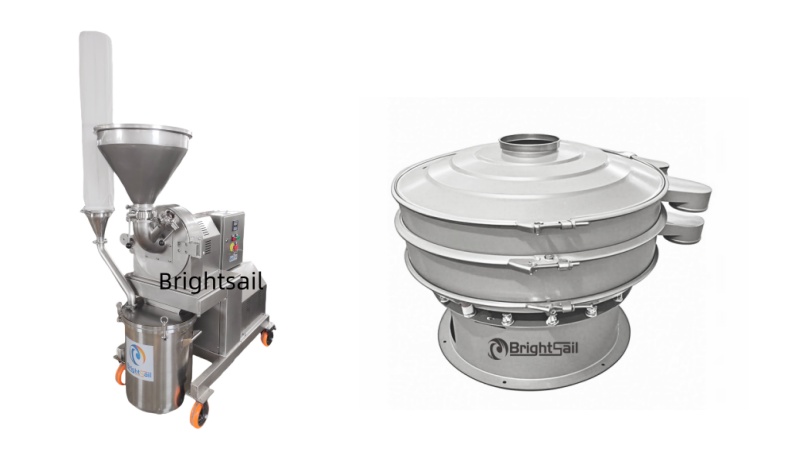
For small production lines, the classic solution is hammer mill + vibrating sieve. This cost-effective hammer mill features simple operation and easy maintenance. Coarse powder is sieved and re-ground automatically, fully meeting small-scale spice grinding machine production demands.
4.2 Medium Capacity (100–500kg/h)
For low-budget projects with ordinary fineness requirements, the traditional hammer mill with sieve machine remains a stable and economical chili grinding machine option.
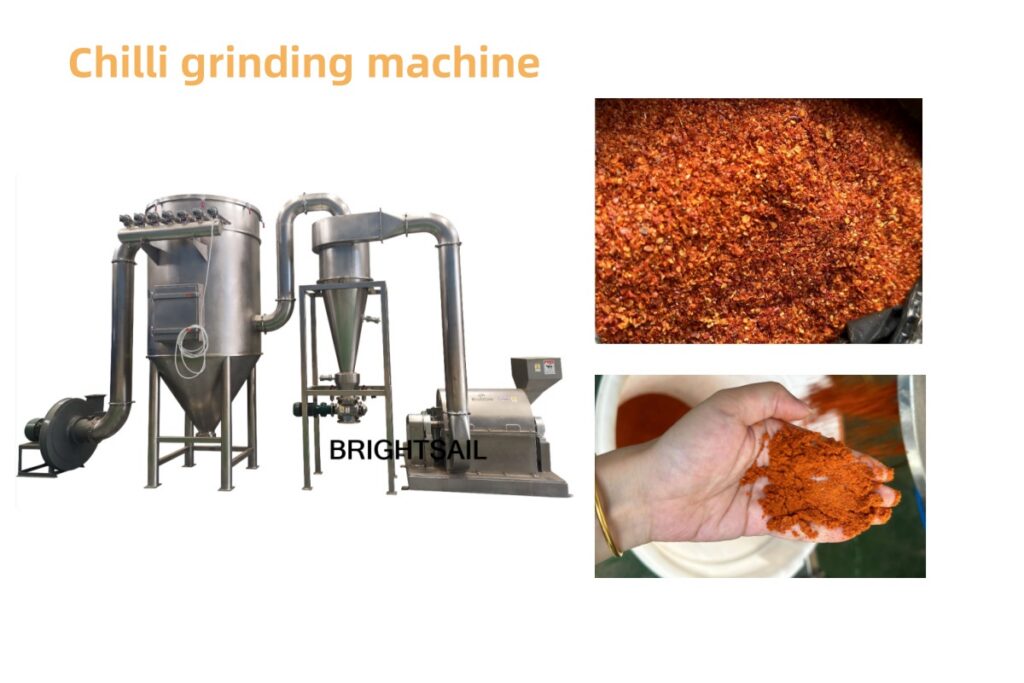
For customers requiring uniform 40–60 mesh fine powder, the BSDF multi-stage hammer mill is the optimal choice. Without traditional screen mesh, it is equipped with coarse, medium and fine blade groups. This structure effectively solves blocking problems caused by high oil and fiber content in chilies, delivering finer and more uniform powder for standardized spice production.
4.3 Large Capacity (Above 500kg/h)
For large-scale production, one-time ultra-fine grinding easily causes high temperature, over-grinding, flavor loss, and capacity attenuation. The professional solution is two-stage grinding process.
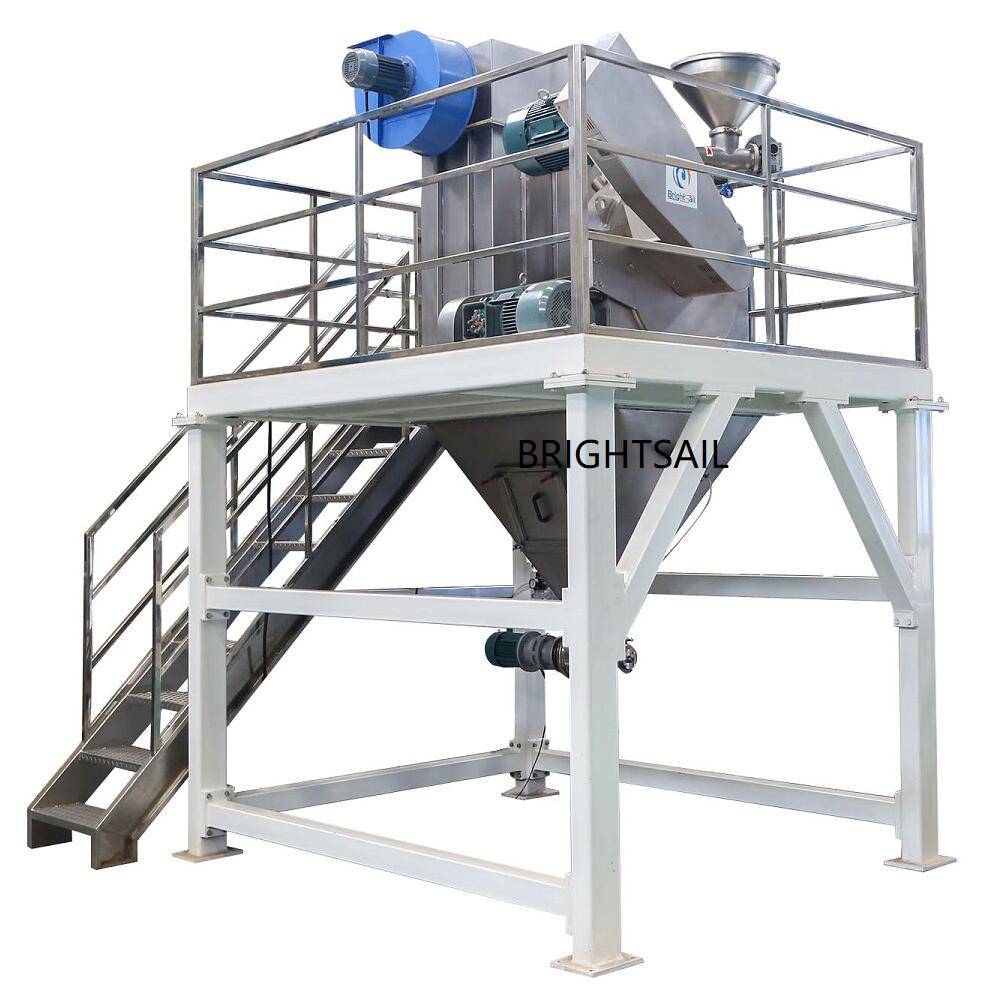
First, the hammer mill crushes dry chilies to about 20 mesh. Qualified fine powder is screened out in advance, and coarse particles are sent to the secondary multi-stage hammer mill for fine grinding. This process avoids high-temperature deterioration, reduces over-grinding loss, improves overall efficiency, and lowers equipment load, making it ideal for 24-hour continuous spice grinding machine mass production.
For large factories with limited budgets, we provide an economical single-unit circulation solution: one multi-stage hammer mill matched with a vibrating sieve and vacuum feeder. Qualified powder is discharged automatically, and coarse powder is conveyed back to the grinder for re-grinding, realizing fully enclosed circulating production without manual operation.
Note: For capacity above 1 ton/hour, two-stage grinding is strongly recommended. Single-machine circulation under high load easily causes overheating, blocking, insufficient capacity, and uneven powder fineness. Dual-stage processing ensures long-term stable operation and consistent product quality.
The top industrial solution is cryogenic spice grinding technology with the BSZ Contrapex pin mill system, which is widely recognized for high-end chili and spice processing.
Liquid nitrogen ultra-low temperature grinding is the highest-standardcryogenic spice grinding solution, which completely retains chili color, pungency and flavor. However, the high investment and operation cost only suits large-scale spice enterprises.
The top industrial solution is low-temperature grinding technology with the BSZ Contrapex pin mill system.
Liquid nitrogen ultra-low temperature grinding is the highest-standard solution, which completely retains chili color, pungency and flavor. However, the high investment and operation cost only suits large-scale spice enterprises.
Most medium and high-end factories choose the cost-effective solution: constant cold air grinding. Stabilizing the grinding environment at 0–5℃ effectively avoids thermal deterioration and flavor volatilization, achieving balanced quality and cost.
It is necessary to correct a common misunderstanding: water jacket cooling has very limited effect. The thick machine cavity stores heat strongly, and external circulating cooling water cannot reduce internal grinding temperature effectively, so it cannot support high-standard flavor preservation production.
5. Key Factors Affecting Chili Grinding Effect & Capacity
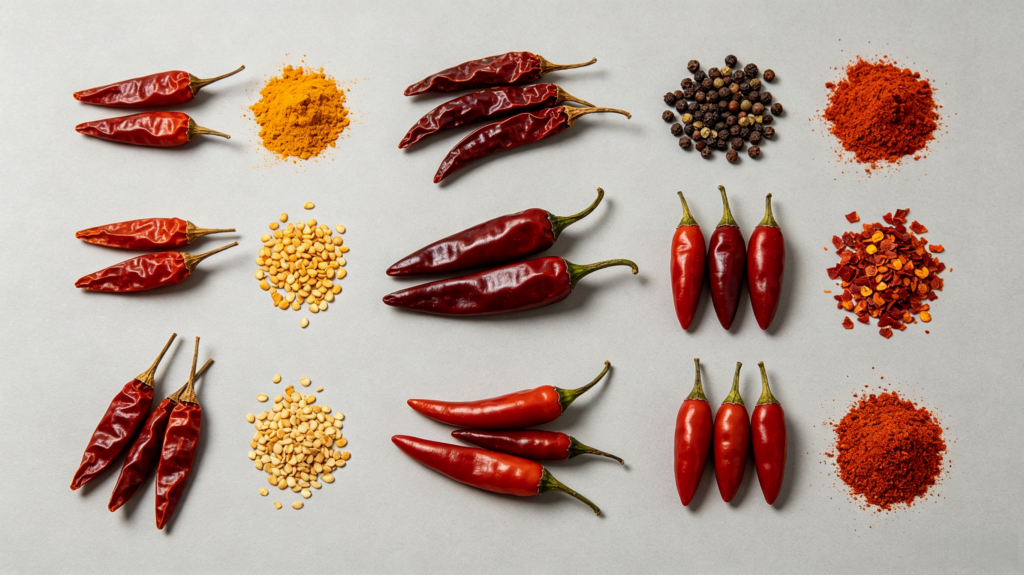
5.1 Chili Variety Determines Grinding Difficulty
Different chili varieties have different peel thickness, fiber toughness and hardness, leading to obvious differences in grinding difficulty and output. For example, Indian chilies have thick and tough fiber with low grinding efficiency, while Chinese chilies are thin and crisp with higher capacity. This is why all grinder parameters are given in a range instead of fixed values. As a professional spice grinding machine manufacturer, BRIGHTSAIL always informs customers of reasonable capacity and effect ranges truthfully, rather than promising exaggerated fixed data, to ensure consistent actual production results.
5.2 Raw Material Moisture (Capacity vs. Weight Trade-off)
Lower chili moisture means crispier texture, lower grinding resistance, higher capacity and better powder quality. Professional large factories equip drying systems to process semi-dry chilies before grinding.
However, many processors retain higher moisture to increase raw material weight and output quantity. This trade-off causes machine blocking, reduced capacity, sticky powder and poor appearance, sacrificing product quality for weight.
5.3 Workshop Temperature & Humidity
High temperature and high humidity soften chilies and increase viscosity, easily causing uneven grinding, blocking and capacity decline. This explains why the same equipment and materials show different production effects in different countries and workshop environments.
5.4 Southeast Asian Chili Powder Oil Coating Process
Many Southeast Asian processors adopt a mature formula: adding1%–5% edible oil into chili powder, which greatly improves final product performance:
- Lock aroma: Oil wraps spicy and flavor substances to avoid volatilization
- Prevent caking: Keep powder loose and improve discharging fluency
- Improve color: Form natural red oil luster for better appearance
- Reduce dust: Lower processing dust and material loss
- Enhance flavor penetration: Oil carrier improves seasoning adhesion
- Moisture-proof & extend shelf life: Isolate air and moisture
5.5 De-seeding Is Mandatory for Chili Flake Production
De-seeding is a standardized pre-process for qualified chili flake production worldwide. Hard and oily chili seeds cause black spots, fine powder residue, bitter taste and unstable particle size. Removing seeds before crushing guarantees clean, uniform, high-value chili flakes and stable machine operation.
6. Why Air Classifying Mill (ACM) Is Not Suitable for Chili Powder Production
Many customers find that air classifying mill can produce 60–100 mesh fine chili powder in trial tests and choose it blindly. However, long-term mass production will cause serious problems, which is a typical chili grinding machine selection mistake.
Chili is high in oil and fiber, which does not match the working condition of air classifying mill.
In long-term continuous production, chili grease adheres and accumulates on the ACM gear ring and classification system, causing blocking, overheating, continuous capacity attenuation and high maintenance cost, leading to unstable production.
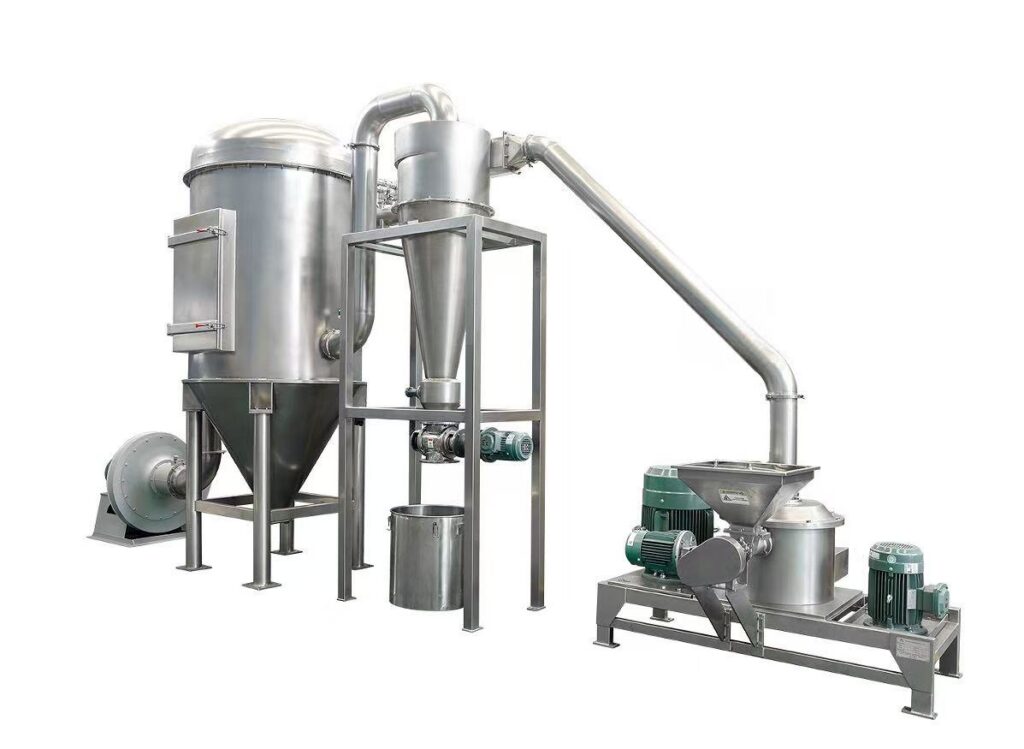
Under the same energy consumption, the professional hammer mill achieves much higher output and stability than the air classifying mill. Therefore, ACM is not a suitable spice grinding machine for oily spice materials such as chili.
Conclusion
Qualified chili powder production relies on correct equipment selection rather than blind fineness pursuit. Choose coarse crushers for chili flakes, hammer mill series for medium and standard fine powder, two-stage grinding for large capacity, and professional cryogenic spice grinding systems for high-end flavor-preservation production. Avoid air classifying mill mismatching risks. With professional chili grinding machine and process solutions, manufacturers can achieve stable, high-quality and cost-effective chili and spice powder production.