
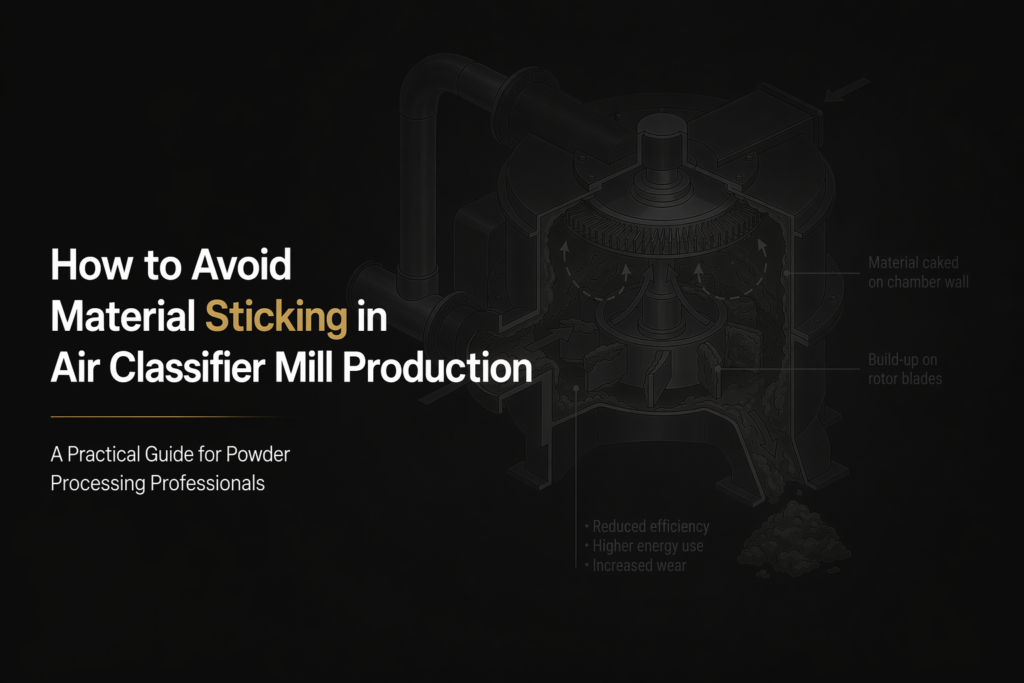
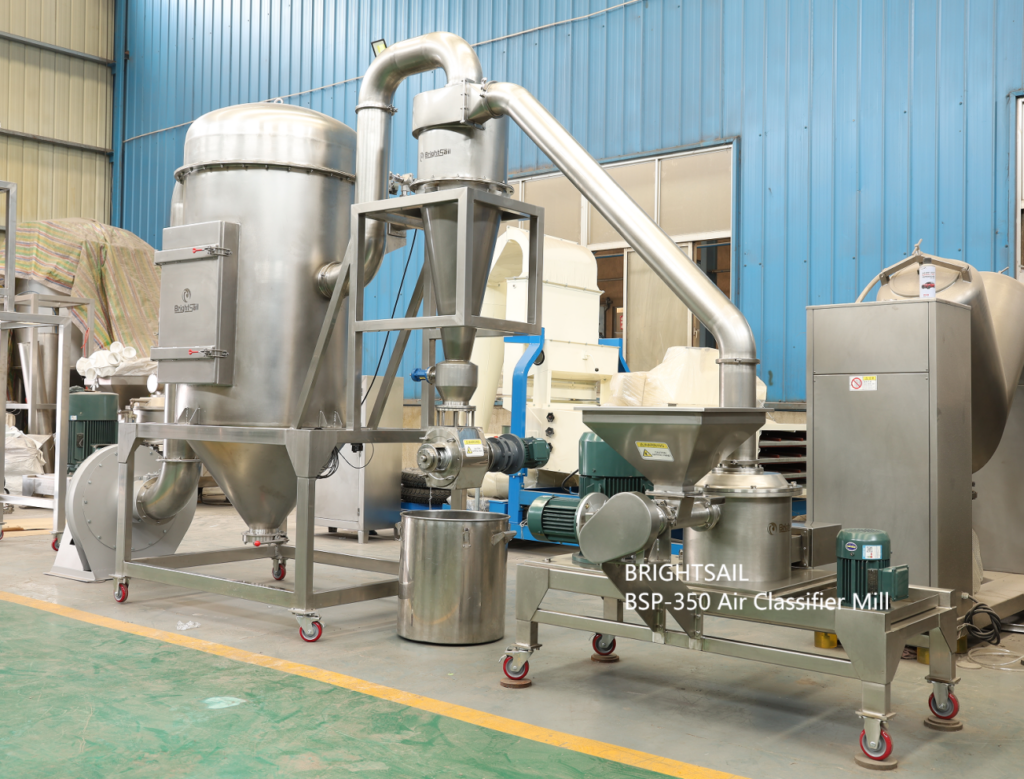
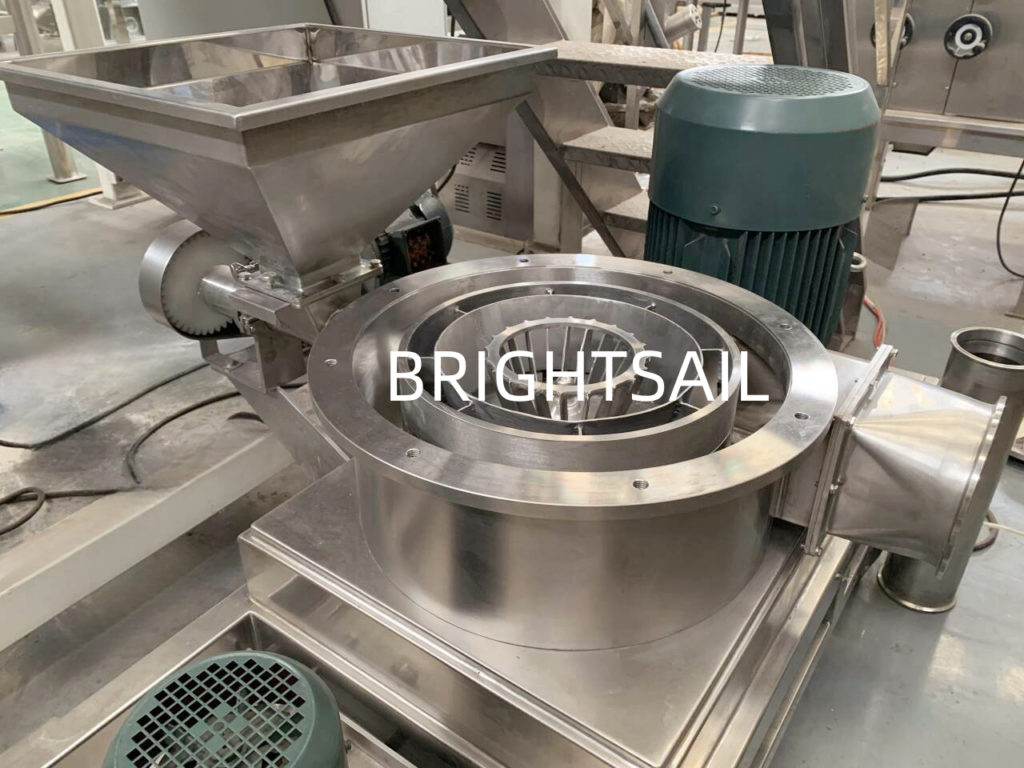
The Air Classifier Mill, also known as ACM ultra-fine pulverizer, is a highly versatile powder processing device. It supports a wide fineness range from tens of mesh to hundreds of mesh, covering most industrial materials including chemicals, food ingredients, herbal powders, and mineral fillers. This outstanding adaptability makes the Air Classifying Mill one of the most widely used grinding equipment in the powder manufacturing industry.
However, no grinding machine is suitable for all materials. In long-term mass production, one of the most common and troublesome failures is material sticking and caking. Powder often adheres to the inner walls of the grinding chamber, conveying pipelines, and rotary valves. Minor sticking leads to uneven particle size and reduced output, while severe adhesion causes blockages and unexpected shutdowns, seriously affecting continuous production efficiency.
Based on years of material testing data and abundant on-site operation experience, this article summarizes the core causes of material sticking on ACM pulverizer equipment and shares practical, actionable solutions to help manufacturers achieve stable long-term production.
1. Raw Material Testing Is Mandatory Before Mass Production
Most sudden sticking failures occur because customers skip pre-production testing and start mass grinding directly. Many materials have unique physical characteristics that cannot be judged by equipment parameters alone. Some special materials begin sticking to the chamber wall within just one minute of operation.
Professional pre-grinding testing is essential unless you have mature and verified production experience processing the exact same material on an Air Classifying Mill. Small-batch trial tests can effectively evaluate material viscosity, heat sensitivity, and moisture absorption risks, allowing engineers to formulate targeted processing solutions and avoid mass production losses.
2. Four Main Material Types That Easily Cause Sticking (With Targeted Solutions)
According to massive trial data, materials prone to sticking on an Air Classifier Mill fall into four major categories: high-sugar materials, high-oil materials, high-moisture materials, and low-flowability ultrafine powders. Each category has distinct sticking mechanisms and requires exclusive optimization methods.
- 2.1 High-Sugar Materials
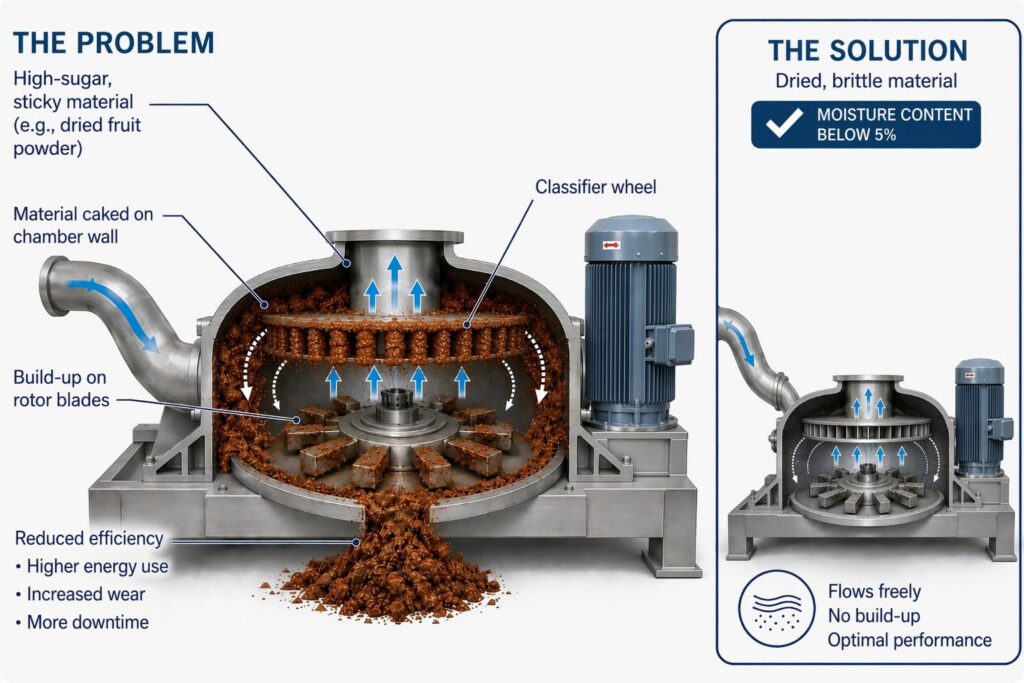
High-sugar materials are the most likely to cause instant sticking. Our actual tests show that dried jujubes and similar dried fruits adhere firmly to the grinding chamber immediately after grinding starts.
The most effective solution is strict moisture control. When the material moisture content is reduced below 5%, the raw material remains brittle and can be stably processed into fine powder on the ACM pulverizer without instant wall adhesion.
Nevertheless, ultra-fine high-sugar powder is highly hygroscopic. It easily absorbs moisture from ambient air, leading to softening, secondary agglomeration, and re-sticking. We recommend producing such materials in an independent, humidity-controlled workshop to maintain a dry production environment and eliminate moisture-related sticking risks.
- 2.2 High-Oil Materials
High-oil materials are divided into two distinct types. Spicy seeds such as cumin and coriander seeds can run normally in short-time grinding but gradually stick and block after long working hours due to heat-induced oil precipitation. In contrast, high-oil raw materials like coconut meat and soybeans cause obvious wall adhesion and blockage even in short-term operation on an Air Classifier Mill, because their free oil content is extremely high and quickly separates out under frictional heat.
It is worth noting that the Air Classifying Mill is not the optimal device for high-oil spice seeds. For premium oily spice powder processing, our BSZ contraxplex pin mill is more suitable. This screen-free grinding machine supports liquid nitrogen cryogenic grinding, perfectly solving oil-precipitation sticking problems for high-end spice powders.
Therefore, the only feasible solution for coconut meat and soybeans is pre-oil pressing treatment. After oil extraction, the residual cake material has significantly reduced oil content and becomes adaptable for stable ACM fine grinding. If customers cannot accept the pre-oil-pressing process for coconut meat, cryogenic grinding connecting with liquid nitrogen will be the only alternative solution to avoid instant oil precipitation and sticking. Even after deoiling, residual trace grease may still cause slight adhesion during long-term continuous operation. In this case, external cold air ventilation and chamber cooling can effectively relieve heat accumulation and avoid material sticking.
To tackle heat-sensitive and oily material processing pain points, Brightsail launched the 2025 new wide-chamber Air Classifier Mill. The enlarged grinding chamber significantly increases internal air circulation and heat dissipation area, lowering internal operating temperature and fundamentally mitigating thermal adhesion for oily and heat-sensitive powders.
- 2.3 High-Moisture Materials
Excessively high moisture is a universal taboo for all grinding equipment, not limited toACM pulverizer systems. During high-speed grinding, excessive water vapor mixes with fine powder and inevitably causes agglomeration and wall adhesion.
The only reliable solution is raw material drying. Reducing moisture content to a qualified level before grinding is the basic prerequisite for stable production and avoids all moisture-induced blockage issues.
- 2.4 Low-Flowability Ultra-Fine Powders
Another easily overlooked sticking cause is poor powder fluidity. Typical materials include creatine powder and icing sugar. These materials contain no sugar, oil, or excessive moisture and seem suitable for fine grinding.
However, ultra-fine and lightweight powders feature a large specific surface area and extremely poor fluidity. During Air Classifying Mill operation, these powders cannot flow and transport smoothly with negative-pressure airflow. They suspend and accumulate inside the grinding chamber and pipelines, gradually forming adhesive layers that lead to chamber blockage and capacity decline.
The most practical and industry-recognized solution is pre-mixing with anti-caking agents before grinding. Pre-modification effectively improves overall powder fluidity, allowing fine particles to be smoothly conveyed by the ACM negative-pressure air system without suspension or wall adhesion, ensuring continuous and stable mass production.
3. Why Short Trials Work Well But Long-Term Production Suffers From Sticking
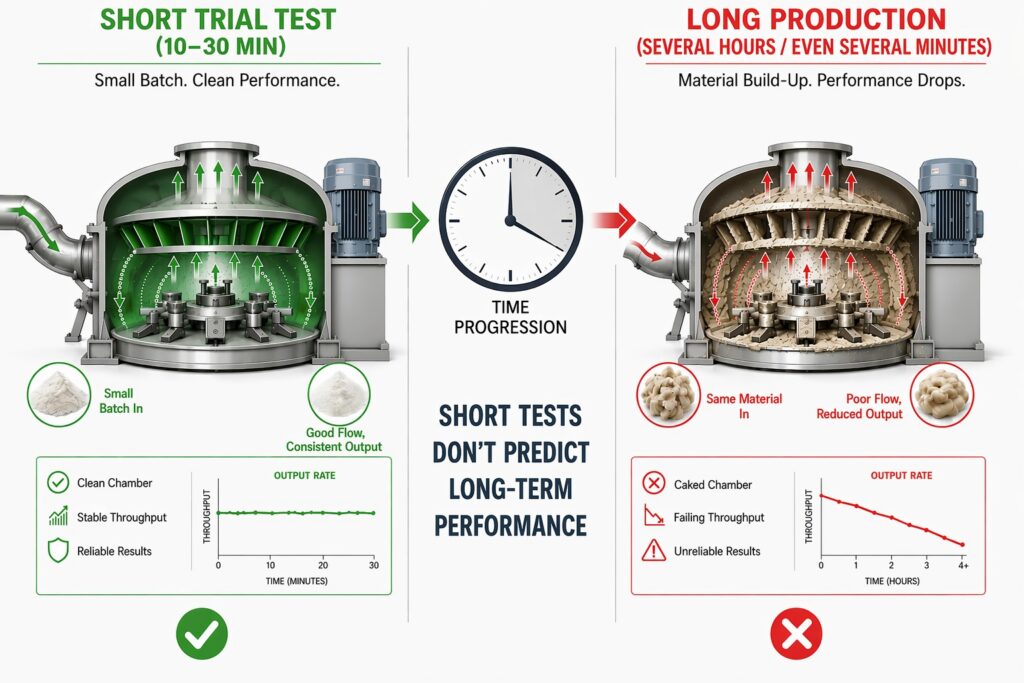
This is one of the most common misunderstandings among customers. Many materials run perfectly in 10-minute or 30-minute trial tests with stable fineness and output. However, severe sticking, caking, and capacity drops occur after several hours of continuous operation.
The core reason lies in the difference between short trial tests and real mass production. Factory trials only process a small quantity of material with limited heat accumulation, which cannot simulate the high-temperature, long-cycle working conditions of formal production. During prolonged operation, continuous frictional heat triggers sugar and oil precipitation, and minor powder accumulation gradually develops into severe blockage.
A typical example is chili powder processing. Short-time testing on an Air Classifier Mill shows good results, but long-term continuous production will inevitably cause heat accumulation and material sticking. Many customers only trust short-term visual effects and ignore professional experience, eventually facing unstable production and yield loss.
This fully reflects the value of professional manufacturer experience: short-term test results are only references, while long-term production risks require rich industry experience to predict and avoid.
4. Ultimate Optimization Solutions for High-Risk Sticky Materials
Some materials still carry sticking risks even after dehydration, deoiling, and pre-treatment, and can only be processed on ACM pulverizer equipment. For these high-difficulty materials, we provide a complete set of customized optimization solutions to completely eliminate adhesion and blockage:
1. Adopt the 2025 new wide-chamber quick-release Air Classifying Mill. The enlarged chamber enhances heat dissipation and maintains low-temperature operation to prevent material softening and adhesion;
2. Optimize pipeline layout with large-elbow pipes to reduce air resistance and avoid powder retention;
3. Upgrade the classification wheel structure and air circulation system to ensure fast and smooth powder discharging without internal retention;
4. Equip multiple pipeline air hammers to regularly shake off micro powder deposits and prevent layered accumulation;
5. Apply quick-release rotary valves with Teflon coating on inner walls to prevent adhesion and simplify daily cleaning;
6. Reserve water cooling jackets for auxiliary temperature reduction, matched with external cold air blowers to further lower grinding temperature for heat-sensitive and sticky materials.
5. Conclusion
The Air Classifier Mill (ACM) is a versatile and high-efficiency pulverizer for ultra-fine powder production. Nevertheless, it is restricted by material physical properties. High-sugar, high-oil, high-moisture, and low-flowability powders are the four main material types that cause wall sticking, blockage, and yield reduction.
Most sticking problems are not equipment failures, but mismatches between material characteristics and production conditions. Short-time trial performance cannot represent long-term production stability. Pre-production material testing and reasonable raw material pre-treatment are the foundation of stable operation. For high-risk sticky materials, systematic upgrades including wide-chamber design, optimized air paths, auxiliary cooling systems, and anti-sticking structures can completely solve production bottlenecks.
If you are facing material sticking, pipeline blockage, or unstable output during Air Classifying Mill production, feel free to contact Brightsail. We provide free material testing, working condition evaluation, and customized anti-sticking production solutions to help you achieve stable and high-efficiency ultra-fine powder manufacturing.