
1. Introduction
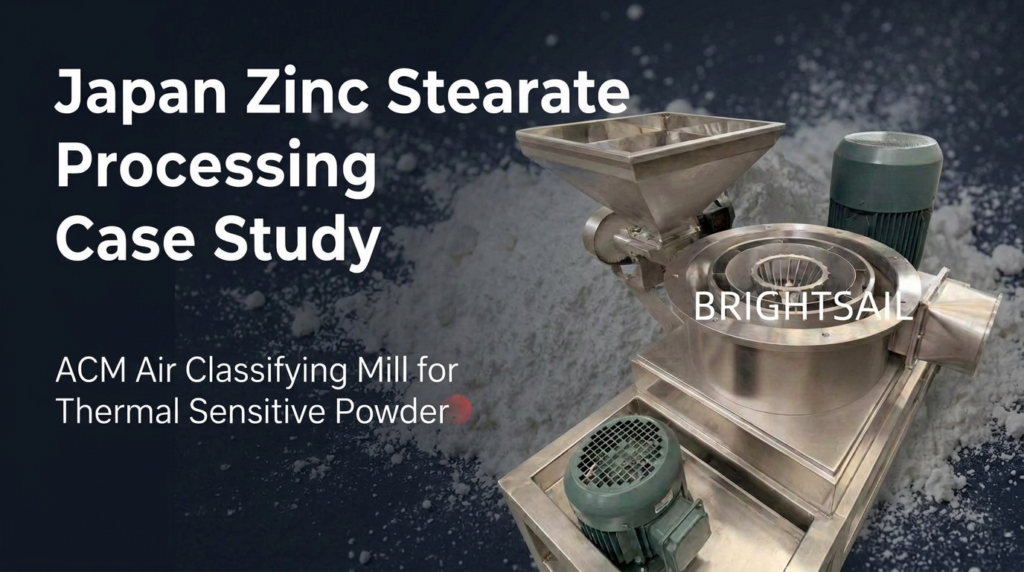
In recent years, Brightsail has witnessed a continuous rise in inquiries for thermal-sensitive chemical powder processing equipment, particularly for zinc stearate pulverizer, lead stearate grinding mill, and lithium stearate grinding mill. Among these devices, the zinc stearate grinding machine stands out as the most technically demanding yet highly sought-after solution, due to zinc stearate’s unique properties of low softening resistance and easy adhesion during milling.
Most powder processing manufacturers face recurring production bottlenecks, including frequent material sticking, inconsistent particle fineness, and low production yield when producing stearate powders. This article presents a complete, verified success story based on long-term cooperation with a high-standard Japanese fine chemical manufacturer. The client has placed two separate orders for our ACM air classifying mill in 2019 and 2024 for continuous zinc stearate and lithium stearate mass production, serving as a solid benchmark for replacing imported premium milling equipment with domestic high-performance zinc stearate grinder solutions. Client factory information is kept confidential; you may contact us privately for detailed project parameters and test reports.
2. Product Application & Market Growth of Stearate Powder
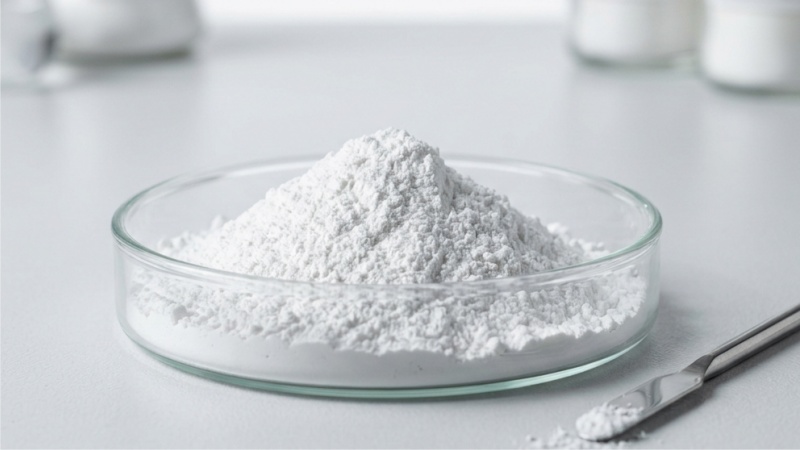
Zinc stearate, lithium stearate, and lead stearate are essential industrial powder additives with outstanding lubrication, demolding, stabilization, and dispersion capabilities. They are widely applied in plastic manufacturing, coating production, rubber processing, fine chemical synthesis, and new energy component manufacturing.
Zinc stearate: Primarily utilized as a plastic lubricant, release agent, coating dispersant, and anti-blocking agent for PVC materials, engineering plastics, and various rubber products.
Lithium stearate: Mainly adopted in high-end industrial lubricating grease, precision mechanical parts, and new energy equipment, requiring extremely strict powder purity and particle uniformity standards.
The booming market demand for high-purity stearate powder stems from continuous industrial upgrading. Modern high-end coatings, precision plastic products, and new energy industries have raised stringent requirements for powder fineness consistency, stable bulk density, and zero impurity content. Conventional universal grinding machines can no longer meet these upgraded standards, driving manufacturers to adopt precision air classifier mill production lines and professional zinc stearate crusher systems.
3. Project Background & Initial Production Pain Points (2019 Cooperation)
The Japanese client initially contacted Brightsail in 2019, seeking a stable and high-precision zinc stearate crusher to upgrade their outdated production line. Their clear production requirements included a 325-mesh finished fineness standard and a stable hourly output of 200kg, focusing on zinc stearate production while reserving compatibility for lithium stearate processing. After comprehensive comparison across multiple equipment suppliers, the client finally selected our ACM air classifying mill, recognizing its unique low-temperature milling advantages for heat-sensitive powder materials.
At that time, the industry generally regarded zinc stearate as a highly hygroscopic and heat-sensitive material that was difficult to process. The client’s original production equipment was a traditional hammer mill, which could only produce coarse, uneven powder that failed to meet their high-end product qualification standards. This critical defect prompted their urgent upgrade to a professional ACM zinc stearate grinding mill.
We always adhere to data-driven equipment selection. To avoid impractical generic configuration schemes, we provided free sample testing services for the client’s raw materials, delivering tailored equipment solutions entirely based on real milling test data rather than fixed industry templates.
4. Key Test Findings: Why Zinc Stearate Either Mills Smoothly or Sticks Severely
The client delivered two types of raw materials for testing: flake-shaped zinc stearate and pre-crude stearate powder. During repeated milling experiments, we discovered a significant quality difference: certain raw materials could be processed into fine, uniform powder smoothly, while some batches presented soap-like soft and slippery textures that were completely unprocessable via conventional milling methods.
Through temperature comparison tests and material component analysis, we identified the core cause of inconsistent processing effects. Although the standard melting point of qualified zinc stearate is 118–125°C, materials of different purity levels show vastly different low-temperature softening performances. This fundamental difference directly determines whether materials will stick, agglomerate, or block the zinc stearate pulverizer during continuous operation.
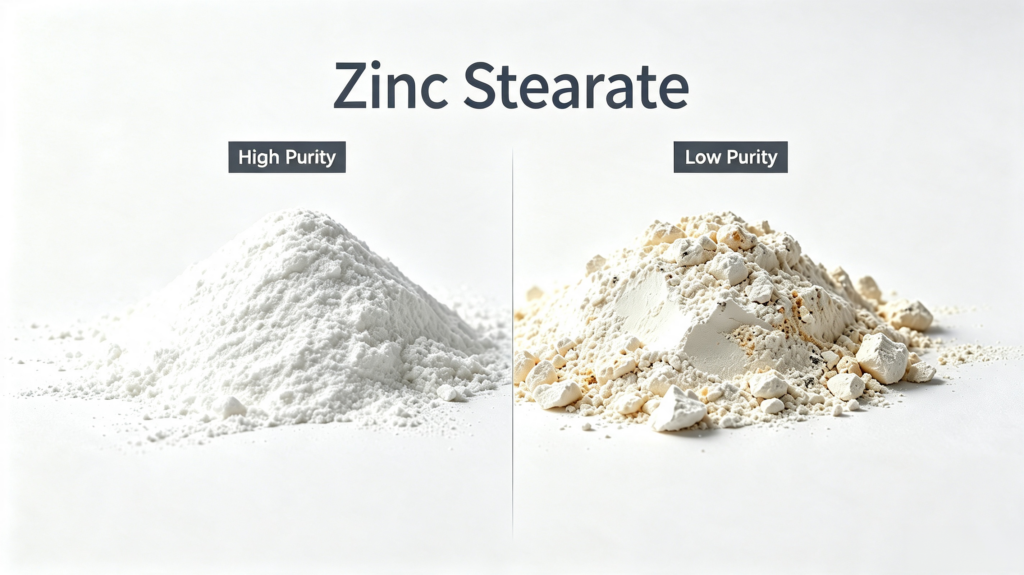
- 4.1 Low-Purity Zinc Stearate (Soap-Like Texture & Non-Millable)
Low-grade zinc stearate contains excessive free fatty acid, residual stearic acid, and unreacted zinc oxide impurities, resulting in an extremely low softening point of only 50–70°C. Such materials turn soft and sticky even at room temperature. Minor friction heat generated during milling will melt the powder surface, causing severe wall adhesion, material caking, and equipment blockage. These unqualified materials cannot be continuously produced by standard air classifier mill or ordinary grinding mill devices, and only high-cost liquid nitrogen cryogenic milling can process them, which is not feasible for mass production.
- 4.2 High-Purity Zinc Stearate (Suitable for Standard ACM Milling)
High-quality fully-saponified zinc stearate features ultra-low free acid content, maintaining stable rigidity and brittleness at room temperature. The instantaneous friction heat generated during operation by the ACM air classifying mill will not soften or melt the powder. Therefore, our professional zinc stearate grinder can achieve continuous stable production with no wall sticking, no material caking, and consistent fineness — exactly the qualified raw material adopted by our Japanese client for formal production.
We truthfully shared all test results, material differences, and potential production risks with the client. Our rigorous and transparent technical attitude won high recognition and established long-term mutual trust for subsequent in-depth cooperation.
5. Customized Solution: Optimized Large Wind System Instead of Standard Configuration
During sample testing, we confirmed that qualified zinc stearate fine powder is extremely light, fluffy, and prone to floating loss. Standard factory-equipped wind circulation systems cannot adapt to this low-density material, easily causing excessive powder loss, low recovery efficiency, and local heat accumulation inside the milling chamber.
Measured data shows obvious density differences: 300-mesh zinc stearate boasts a bulk density of 0.25–0.35 g/cm³, while ultra-fine 500-mesh powder drops to only 0.12–0.22 g/cm³. The ultra-light characteristics of fine stearate powder require an upgraded large-volume, high-efficiency wind circulation system.
Based on practical test data, we recommended the client abandon the standard machine configuration and upgrade the complete wind system. The client fully adopted our professional optimization plan:
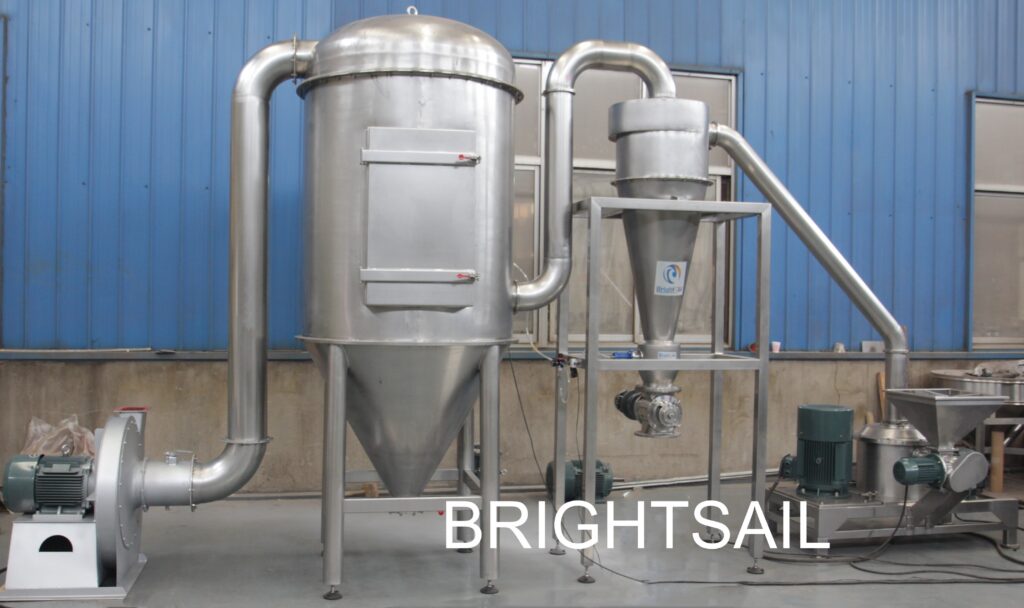
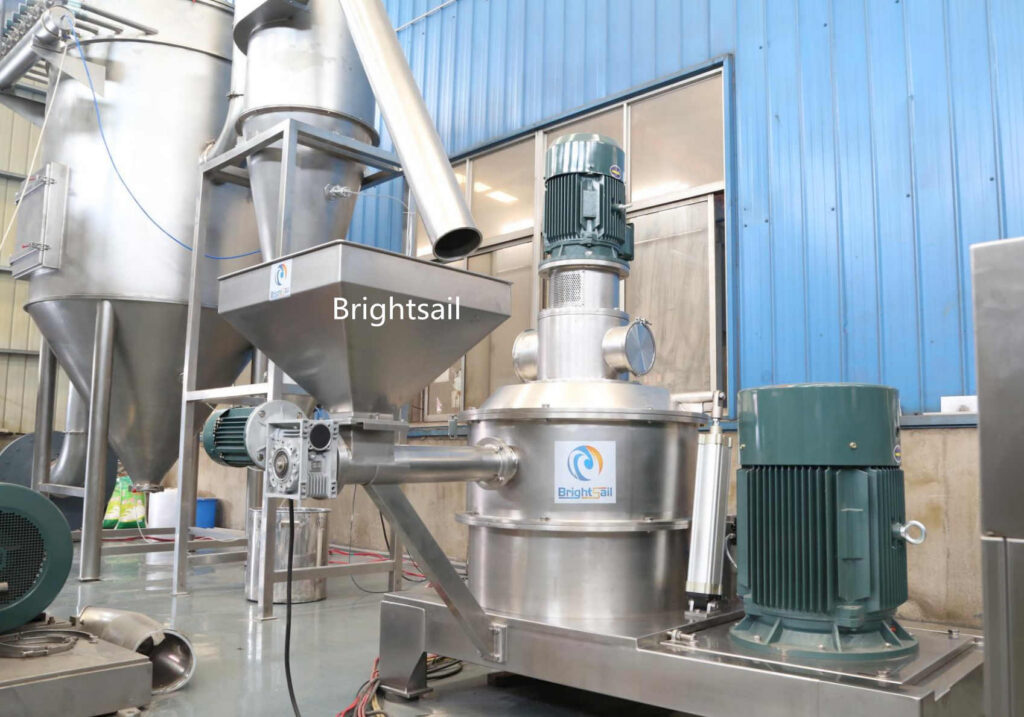
1. Upgraded enlarged cyclone separator: Effectively improve fine powder recovery rate, reduce system wind resistance, eliminate local heat accumulation, and ensure long-term stable operation of the zinc stearate crusher;
2. Enlarged high-efficiency bag dust collector: Build a powerful negative-pressure air circulation system, realize passive constant-temperature heat dissipation, and stabilize cavity temperature without additional cold-air auxiliary equipment.
The final confirmed configuration was the customized BSP-450 ACM air classifying mill, a dedicated zinc stearate grinding machine optimized for high-precision, low-loss mass production of zinc stearate and lithium stearate powder.
6. On-Site Commissioning Experience: Fine Details Determine Final Powder Quality
Most clients simply propose general 300–500 mesh fineness requirements, while actual industrial production standards are far more stringent. The Japanese client initially requested 325-mesh powder, yet their formal factory production standard is stricter: D50=12μm, almost 100% finer than 200 mesh.
In the early stage of equipment commissioning, the client encountered a typical debugging problem: simply adjusting the inverter frequency failed to reach the target fineness. Our technical team guided on-site staff to clean the dust collector bag and increase the fan valve opening, but the problem persisted.
After checking the full on-site operation video, we located the root cause: the client’s on-site team installed an additional elbow pipe at the fan outlet. The extra elbow drastically increased system wind resistance, destroyed the negative pressure balance of the air classifier mill, and directly impaired powder classification accuracy.
We immediately instructed the client to remove the redundant elbow pipe and standardized on-site piping specifications. For necessary pipeline extension, only straight pipelines are allowed; pipe diameter reduction is forbidden, while appropriate diameter expansion is permitted. After adjustment, the wind system returned to balanced operation, and the client quickly achieved ideal particle size parameters.
Beyond fineness requirements, Japanese manufacturers also maintain extremely strict standards for powder bulk density stability, which directly affects downstream product performance. We guided the client to synchronously match main host frequency and classification frequency for precise powder regulation. Equipping a dedicated fan inverter further improves parameter adjustment flexibility to meet diverse production standards.
This practical case fully proves that the ACM air classifying mill — our high-end zinc stearate grinding mill — has no fixed universal operating parameters. Accurate on-site debugging and professional technical guidance are indispensable according to actual material characteristics and production standards.
7. Long-Term Cooperation & Capacity Expansion: Second Repurchase in 2024
Benefiting from stable mechanical performance, reliable finished powder quality, and comprehensive after-sales technical support, the customized BSP-450 ACM air classifying mill delivered excellent production results at the client’s factory.
The client’s initial expected hourly output was 200kg, while the actual stable production capacity reached 300–350kg per hour, completely exceeding the pre-sale target. In 2024, facing growing market demand and production expansion plans, the client purchased a second air classifier mill professional zinc stearate grinder to build a dual-line production system for higher output.
Continuous repurchase and long-term cooperative partnership fully reflect Brightsail’s core philosophy: growing alongside customers and winning market recognition through reliable equipment quality and professional technical services.
8. High-Temperature Production FAQ: Is Cold Air Cooling Indispensable?
Most manufacturers worry that thermally sensitive zinc stearate will soften and adhere to the machine cavity during long-hour continuous high-temperature operation, requiring additional cold air or refrigeration auxiliary systems.
Verified by the Japanese client’s years of stable mass production experience,qualified configuration with matched operating speed and standard water cooling jacket requires no cold air assistance. The professionalzinc stearate grinding machine can operate continuously and stably without material sticking or thermal softening.
Technically speaking, the water cooling jacket of the air classifier mill only provides auxiliary temperature reduction, as cooling water cannot directly contact the grinding cavity, and the thick cavity wall limits rapid cooling effects. The core guarantee for long-term stable high-temperature production lies in the intrinsic low-heat milling principle of ACM equipment, combined with the strong active heat dissipation of the upgraded large wind system, which fundamentally avoids heat accumulation and material thermal deformation.
9. 2025 New Product Upgrade: Wide-Cavity ACM Milling Equipment
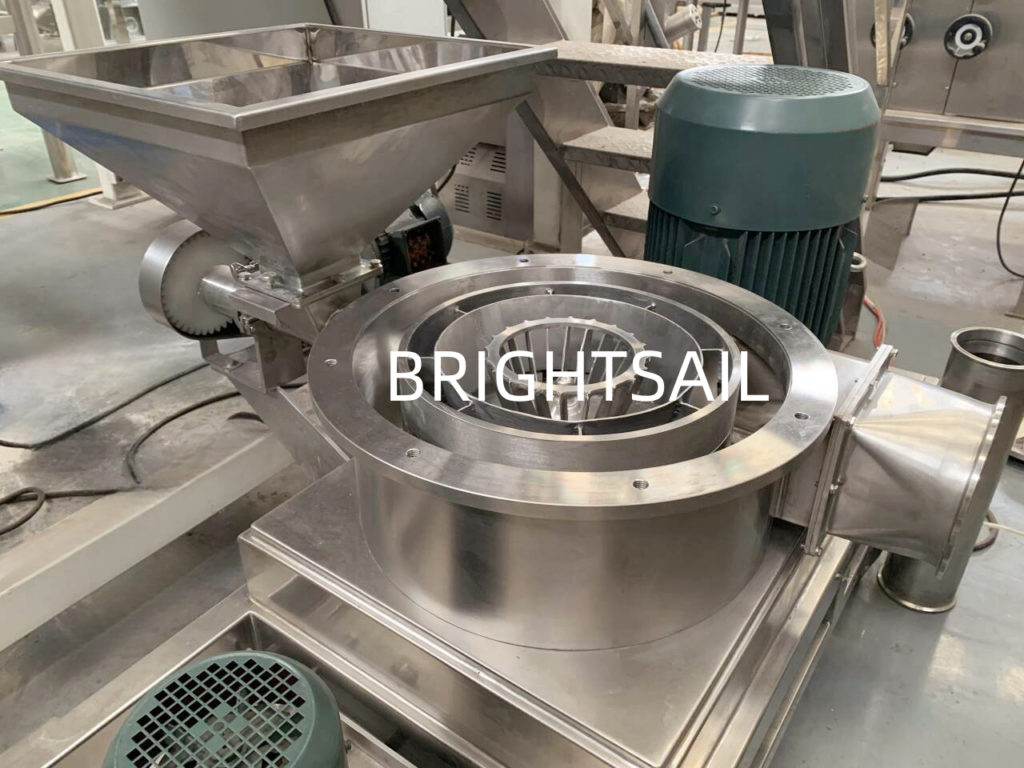
Based on years of accumulated stearate powder processing experience and pain points of thermally sensitive powder production, Brightsail launched the newly upgraded wide-cavity ACM air classifying mill in 2025. Optimized specifically for zinc stearate and lithium stearate processing, this upgraded zinc stearate milling machine solves traditional industry problems such as easy overheating, material adhesion, and difficult equipment cleaning.
First, the widened cavity structure increases internal grinding volume, effectively reducing cavity temperature and completely improving thermal softening and sticking issues of fine stearate powder. Second, the full quick-disassembly design simplifies daily disassembly and thorough cleaning, greatly improving production efficiency for multi-batch and multi-variety switching production. Third, the optimized tooth and ring structure extends the service life of wearing parts by twice, effectively reducing long-term operation and maintenance costs of the zinc stearate pulverizer.
10. Why 304 Stainless Steel Is Mandatory for High-End Stearate Powder Production
Many manufacturers consider carbon steel equipment to reduce procurement costs for industrial powder processing. However, high-standard fine chemical production, especially for Japanese high-purity stearate products, strictly requires 304 stainless steel grinding mill configuration.
Carbon steel milling equipment is prone to surface rusting and metal debris shedding during long-term continuous operation. Tiny rust impurities will mix into ultra-fine zinc stearate powder, causing color deviation and unqualified impurity indicators. Once contaminated, the entire powder batch will be scrapped, resulting in economic losses far exceeding the equipment price difference.
The 304 stainless steel machine body features rust resistance, smooth inner cavity wall, and no dead corners for material accumulation, ensuring zero impurity pollution throughout the milling process and fully meeting the strict purity standards of high-end fine chemical factories.
11. Core Technical Summary
Combined with the long-term stable operation data of our Japanese client, we have concluded key technical insights for processing thermally sensitive stearate powder via ACM air classifying mill series zinc stearate grinder:
1. Mass production of high-purity zinc stearate does not depend on cold air refrigeration or forced water cooling. The low-heat structural design and optimized large-volume wind system of professional zinc stearate grinding mill support stable normal-temperature continuous production.
2. Low-purity zinc stearate with high free acid content and soap-like texture is not suitable for conventional milling. It can only be processed through high-cost cryogenic freezing grinding, which is not applicable for industrial batch production.
3. The core competitiveness of high-end thermally sensitive powder production lies in professional wind system design, precise cavity temperature control, and high-precision classification technology of the air classifier mill, rather than simple low-temperature cooling auxiliary devices.
4. The ACM series zinc stearate milling machine features highly flexible adjustable parameters. Operators can independently match host speed, classification frequency, and air volume according to material characteristics, target fineness, and bulk density requirements to realize customized high-standard powder production.
12. Professional Customized Solution Consultation
If you are looking for reliable processing equipment for zinc stearate, lithium stearate, and lead stearate powder, and troubled by material sticking, unstable fineness, high powder loss, and impurity contamination problems, feel free to contact Brightsail. We provide free material testing and one-stop customized production solutions for zinc stearate pulverizer production lines. You can submit your material parameters, target fineness, hourly output, and on-site working conditions, and our technical team will tailor the most suitable high-grade wind system scheme based on ACM air classifying mill for your thermally sensitive powder production.