
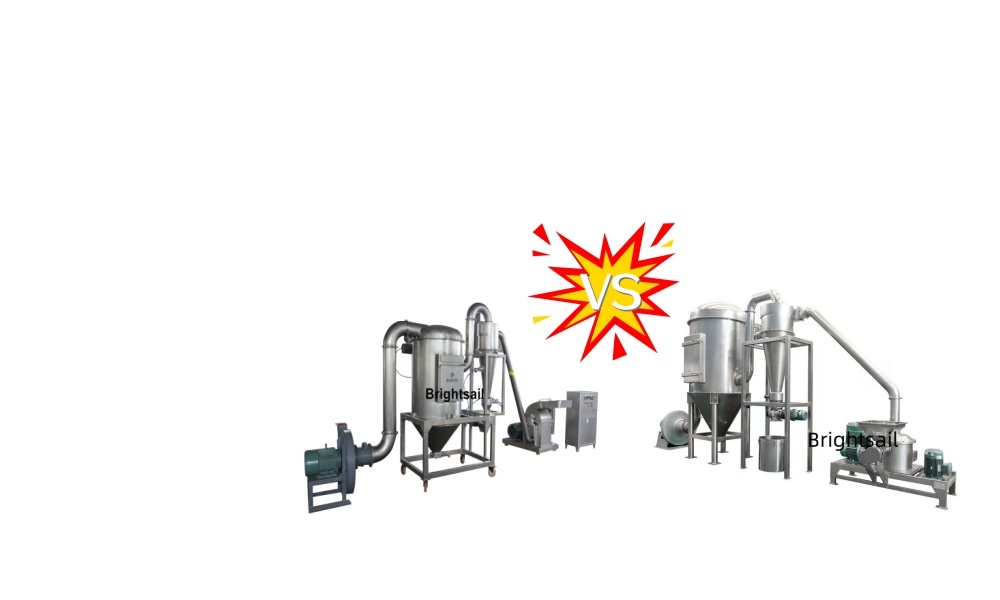
Choosing the right milling equipment is a critical decision that impacts product quality, production efficiency, and operational costs in the powder manufacturing industry. Both Air Classifier Mills and ordinary Hammer Mills are common particle size reduction machines, yet they differ significantly in their working principles, application scopes, and final outcomes.
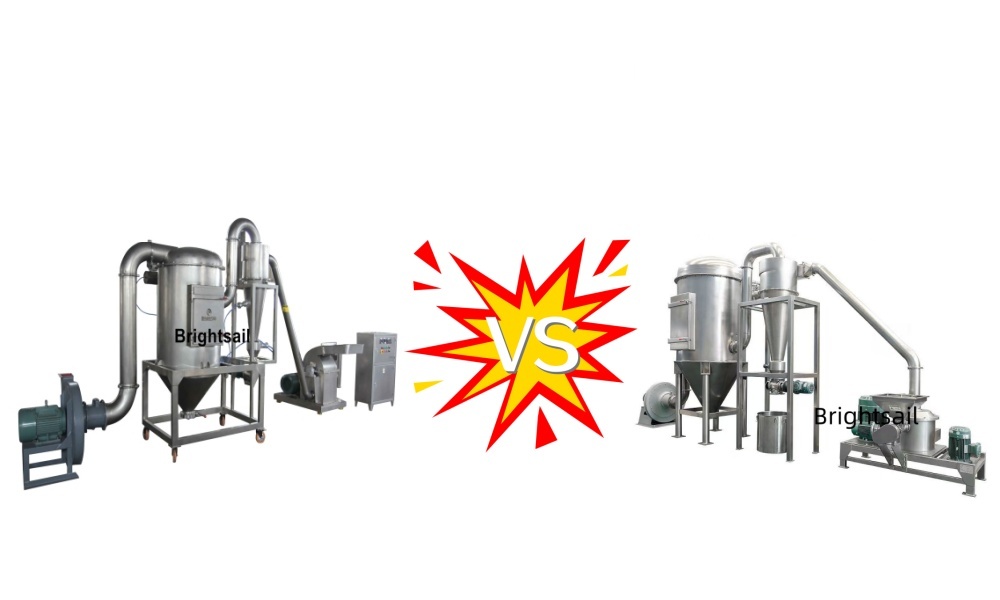
How They Work: A Technical Comparison
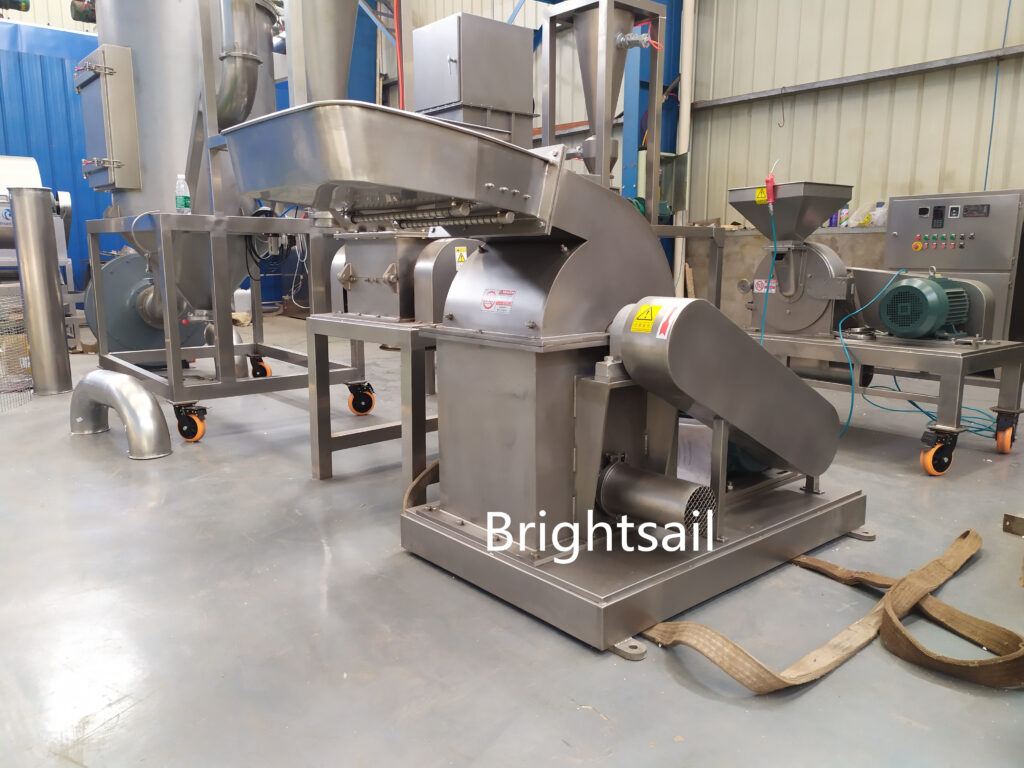
Ordinary Hammer Mill
The ordinary hammer mill operates on a relatively simple mechanical crushing principle:
- Impact Grinding: High-speed rotating hammers physically strike and shatter the material.
- Screen-Controlled Particle Size: Ground material exits through a bottom screen; final particle size is determined by the screen’s aperture size.
- Single-Stage Process: Grinding and sizing occur in a single step, with limited ability to separate fine particles during the process.
- High Energy Consumption for Fines: Achieving very fine powders often requires multiple passes, increasing energy use and heat generation.
Air Classifier Mill (ACM)
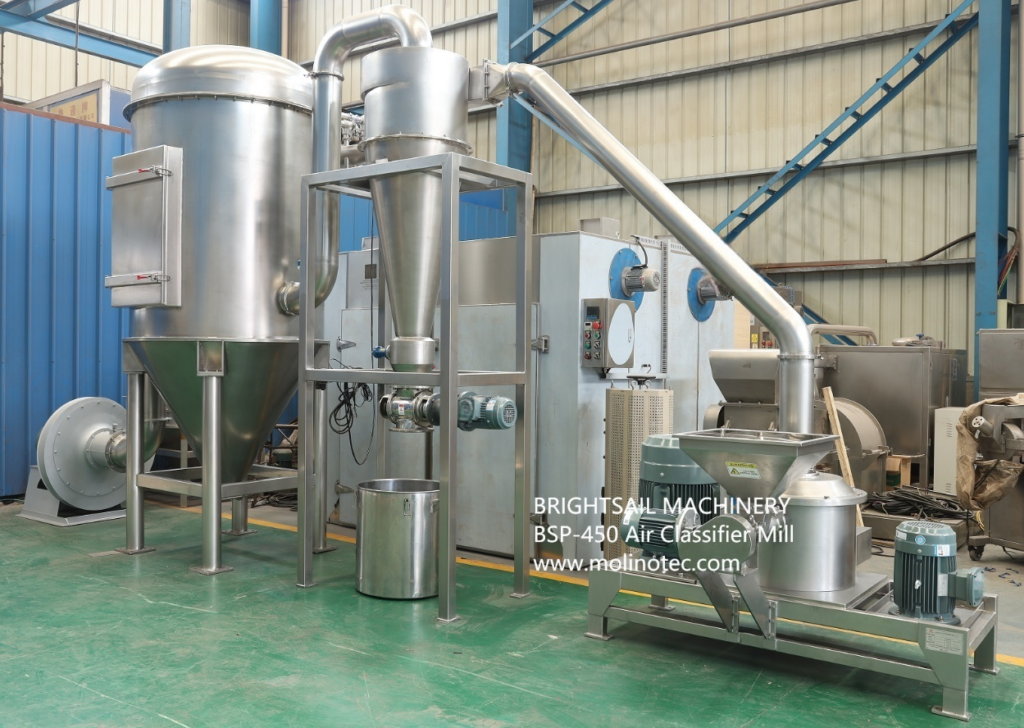
The Air Classifier Mill represents a more advanced, integrated system combining grinding and classification:
- Dual-Action Chamber: A grinding zone (with beaters or pins) reduces the material, while an integral air classifier wheel simultaneously separates particles.
- Dynamic Classification: The classifier wheel creates a precise centrifugal force. Fine particles that meet the target size are carried by the air stream to the collector, while coarse particles are rejected back to the grinding zone.
- Internal Recirculation: This closed-loop system allows for continuous re-grinding of oversized particles without manual intervention.
- Heat-Sensitive Friendly: The constant air flow helps dissipate heat, making it more suitable for heat-sensitive materials.
Conclusion: Making the Right Choice for Your Production Line
The “better” machine depends entirely on your specific product requirements and production goals.
Choose an Ordinary Hammer Mill if: Your primary need is for coarse to medium grinding, where a broad particle size distribution is acceptable. It is a robust, cost-effective solution for crushing, granulation, or the initial break-down of materials where precise fineness is not critical. Its simplicity and lower upfront cost are its main advantages.
Choose an Air Classifier Mill if: You require precise, fine to super-fine powders with a tight particle size distribution. If your materials are heat-sensitive, high-value, or require strict contamination control (GMP standards), the ACM is the superior choice. Its efficiency, flexibility, and ability to produce consistent, high-quality powder justify the higher initial investment for demanding applications.
In essence, the hammer mill is a powerful crusher, while the air classifier mill is a precision processor. Investing in the right technology optimizes your product quality, throughput, and long-term profitability.
Ready to Optimize Your Powder Production?
Selecting the correct mill is crucial for your success. Our experts are here to help you analyze your material, target particle size, and capacity requirements to recommend the perfect milling solution for your line.
Contact us today for a free consultation and product suitability assessment.
FAQ
Q: Is it possible to achieve a very coarse grind with an ACM?
A: While possible, it’s not the most efficient use of an ACM. Their strength lies in the fine to medium-fine range (10-150µm). For coarse grinding (>500µm), a hammer mill or other crusher type is typically more economical and effective.
Q: Which mill is easier to maintain?
A: Hammer mills have simpler mechanics but require frequent screen inspections, changes, and cleaning of clogged screens. ACMs have a more complex internal system but often run longer without intervention, with wear parts (pins, classifier wheel) designed for easy replacement. Total maintenance costs depend on the application.
Q: How significant is the energy cost difference?
A: For producing fine powders (<100 µm), the ACM is significantly more energy-efficient. Its internal classification prevents over-grinding and recirculates only oversize material. A hammer mill grinding to the same fineness would consume more energy by repeatedly grinding all particles, including those already at size, against a screen.
Q: Can I get a narrow particle distribution from a hammer mill by using multiple screens?
A: Using very fine screens and multiple passes can improve distribution, but it drastically reduces throughput, increases heat and energy use, and accelerates screen wear. It is an inefficient method compared to the inherent classification action of an ACM.