

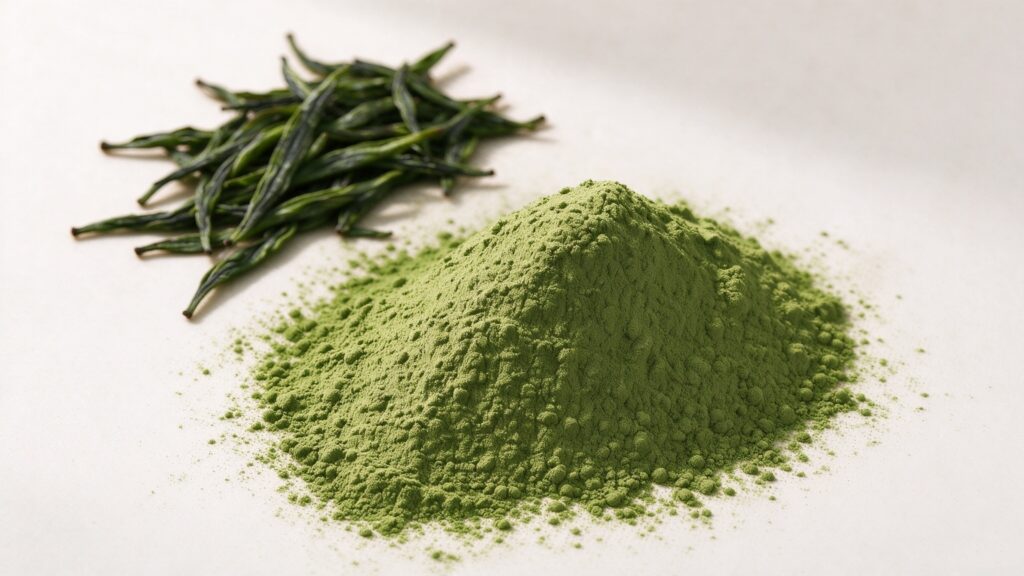
A customer came to us with a clear request: grind dried matcha leaves to around 500 mesh.
He had come looking for a matcha grinding machine — a single unit that turns dried matcha leaf into fine powder.
Our recommendation was a two-stage line — a hammer mill first, reducing the leaves to roughly 40 mesh, then an air classifier mill (ACM) to take them down to the target fineness.
He pushed back, and the question was fair:
“In your grinding test, you fed dry leaves straight into the ACM and the powder came out fine. Why do I need an extra machine in front?”
He was right about what he saw. It is just that a test run and a production line are two different things.
A test run is a small batch, a short run, and one question: does the powder hit the target fineness? A production line runs for hours or days, and asks several more: what does a ton cost in power, how hot does the material get, how much moisture is lost, and will the machine still be running smoothly next month?
Those five extra questions are exactly why we put a pre-crushing hammer mill in front of the ACM. Here they are, one by one.
1. How an Air Classifier Mill Works — and Why Chamber Volume Sets the Capacity
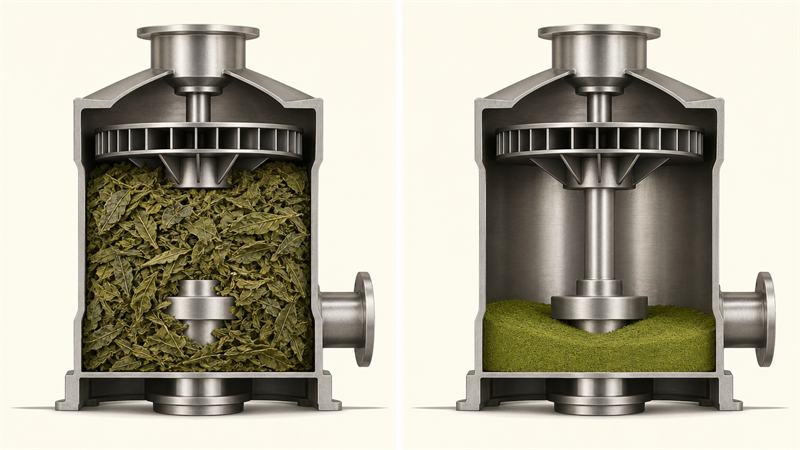
Inside an air classifier mill machine, grinding happens in a chamber: the rotor strikes the material, an air stream lifts it, the classifier wheel selects particles that are fine enough, and oversized particles are thrown back for more grinding.
That is why chamber volume matters so much — and why bulk density of the feed matters just as much.
Dried leaves are light and fluffy, with very low bulk density. Take a machine with a 100 L chamber: fluffy leaves fill that volume almost immediately. And a full chamber does not mean high output — it means the opposite:
- Effective grinding space is taken up, so particles interact less efficiently with the rotor;
- The classifier wheel is presented with far more material than it can sort, so fine particles are not pulled out in time;
- Oversized particles keep recirculating, and the circulating load climbs;
- The result: throughput drops and fineness becomes unstable.
Pre-crush the leaves to roughly 40 mesh first, and the picture changes. The same weight of material now takes up far less volume, so bulk density is much higher, the chamber is not packed out, and the material has room to be ground and classified properly.
Put simply: an ACM works by volume, while what you are feeding it is measured by weight.
2. Fluffy Leaves Do Not Feed Reliably
The second issue is feeding.
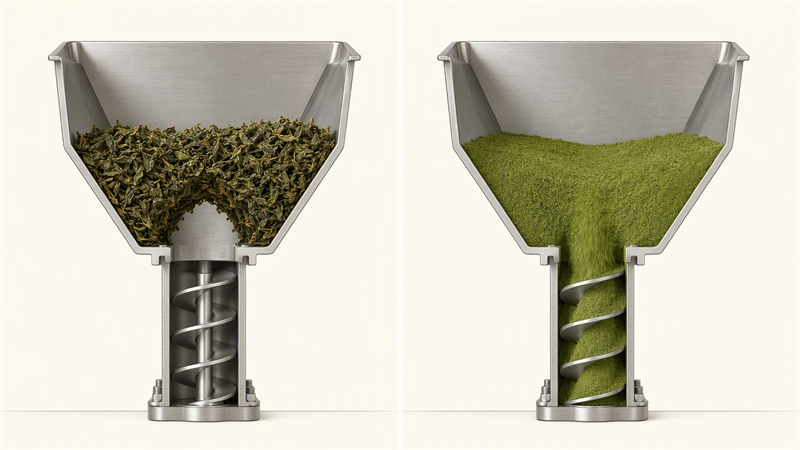
Dry leaves are light, bulky and poor-flowing. On a leaf grinding machine fed with whole dried leaves, they tend to bridge in a hopper or feed screw — particles lock together over the opening and stop flowing.
Bridging shows up on the line as unstable feed:
- Feed too low → lower output and coarser powder;
- A sudden collapse of the bridge → a spike in chamber load, which can choke or stall the mill;
- Someone has to stand there and keep knocking the material down — a real labour cost.
After pre-crushing to around 40 mesh, the material goes from “fluffy leaves” to a free-flowing coarse powder with higher bulk density. Feeding becomes steady, and bridging becomes far less likely.
3. Uneven Feed Size Shows Up as Unstable Motor Current
The material customers ship is usually a mix: whole leaves, torn pieces, and some already-broken fines.
Fed into an ACM like that, it causes a subtle but real problem — the main motor current keeps fluctuating.
The reason is simple: the weight of material entering the chamber per second is inconsistent (sometimes light whole leaves, sometimes dense fragments), so the load rises and falls. On the ammeter, it is visible as a needle that will not settle. In the short term it looks like “running a bit rough”. Over months, it is not good for:
- The motor and drive train;
- Bearings and the wear parts around them;
- Overall equipment stability.
Running the material through a hammer mill first makes the feed size uniform, so the load and the current stay steady. On a continuous line, that is real equipment protection — not a theoretical benefit.
4. Longer Residence Time Means More Heat — and Heat Is What Matcha Cannot Take
This is the point that matters most for matcha powder and moringa leaf powder.
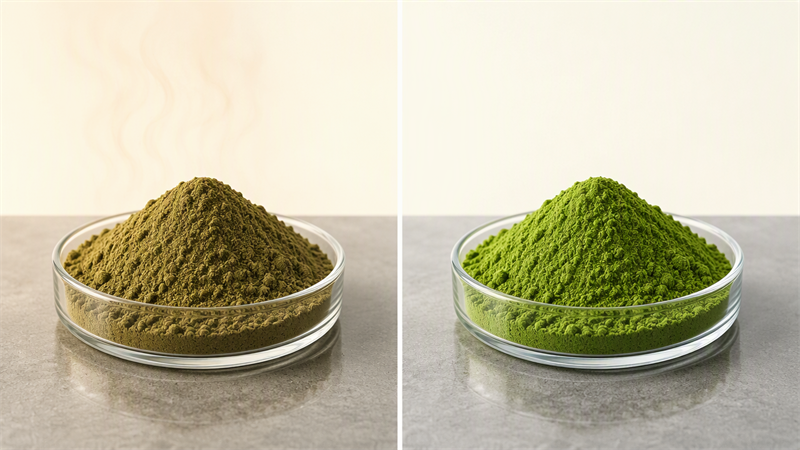
An ACM runs at high speed with internal air circulation. The longer a particle stays inside, and the more times it recirculates, the longer it is exposed to heat.
Matcha is particularly heat-sensitive. As temperature rises:
- The colour shifts — and colour is the single thing matcha buyers judge first;
- Aroma and flavour compounds are lost;
- For materials such as moringa leaf, active components are affected too.
Pre-crushing is what compresses that exposure:
| Feeding fluffy leaves directly | Pre-crushed to ~40 mesh | |
| How fast the chamber fills up | Fast | Slow — more working space |
| Residence time in the chamber | Long, many recirculations | Clearly shorter |
| Heat exposure and temperature rise | High | Lower |
| Colour and flavour of the finished powder | More affected | Better preserved |
So pre-crushing is not “one more process step”. It trades a fast, low-temperature coarse grind for a long, hot recirculation cycle inside the ACM.
5. The Same Advice Came From a Grain Processor
The strongest evidence we can offer comes from a customer in a completely different business: a grain processing plant.
He was not grinding leaves. Grain is denser and flows far better than leaf, so on paper he did not need pre-crushing at all. He asked for a hammer mill in front of the ACM anyway.
His reasoning was two points:
- Lower powder temperature — coarse-grinding first shortens the time the material spends in the classifier mill, so the powder stays cooler;
- Less moisture loss — moisture in grain is sold at the price of flour. Every extra minute in the grinding chamber evaporates part of it, and that evaporated moisture is money.
His conclusion: it looks like buying an extra machine, but the overall account is better — the equipment is protected, efficiency is higher, and less moisture is lost.
If a grain processor — with dense, free-flowing material — chooses pre-crushing voluntarily, then a light, fluffy, heat-sensitive leaf material needs it even more.
When Is a Pre-Crushing Hammer Mill Worth It?
| Condition | Recommendation |
| Material is fluffy with low bulk density (leaves, stems, fibrous material) | Pre-crushing needed |
| Feed size varies widely (whole pieces mixed with fines) | Pre-crushing needed |
| Target fineness is high (300–500 mesh class) | Strongly recommended |
| Material is heat-sensitive (matcha, moringa, spices, actives) | Strongly recommended |
| Continuous production with energy cost measured per ton | Pre-crushing needed |
| Material is already granular or crystalline, dense and free-flowing | Direct ACM feed can be evaluated |
| Small output, batch operation, test-scale production | Direct ACM feed can be evaluated |
The logic in one line: the ACM decides whether you can reach the fineness. The hammer mill decides whether you can reach it steadily and economically.
FAQ
Can an ACM reach 500 mesh on its own?
Yes — especially in small test batches. In continuous production, fluffy feed fills the chamber early, circulating load rises, and throughput, fineness stability and powder temperature all get worse. Test results should not be read as production figures.
Does an extra machine not mean higher power cost?
The coarse grind does consume energy. What it buys is higher output at the classifier mill, lower circulating load, lower powder temperature and less moisture loss. The grain processor above made his decision on exactly that total.
How fine should the pre-crushing be?
For leaf material such as matcha, we suggest around 40 mesh. The principle: make the material dense and free-flowing, without over-grinding — over-grinding adds power consumption and heat for no benefit.
Can bridging be solved without pre-crushing?
Vibration or knocking the hopper only relieves it. Pre-crushing addresses the cause, because it changes bulk density and flowability.
Which machine is used for pre-crushing?
For leaves and fibrous material, a hammer mill machine is the usual coarse grinder, with a hammer mill screen to control the top size. The model depends on your material and output.
Do I need a hammer mill screen, or can I run the pre-crusher without one?
For leaf and fibrous feed, keep the screen. It sets the top size going into the classifier mill, which is what keeps the circulating load and the powder temperature down. Removing it usually means sending oversized pieces into the ACM and losing the benefit of pre-crushing.
Can one line grind both matcha and moringa leaves?
Yes — both are dried leaf materials that behave the same way in a two-stage line: light, fluffy and heat-sensitive. A hammer mill followed by a classifier mill handles matcha leaf and moringa leaf powder grinding with the same configuration; the screen size and target fineness are what change. The same matcha grinding machine configuration also serves as a leaf grinding machine for other dried material — moringa, tea leaf and similar.
Closing
An ACM is a good machine. Its strength is making powder fine and holding the fineness steady. But what you feed it decides whether it can do that well, continuously and economically.
For a material like matcha leaf — light, fluffy and heat-sensitive — passing it through a hammer mill to about 40 mesh first looks like one extra machine. In practice it protects output, fineness, equipment stability and finished-product quality at the same time.
Tell us about your material — form, target fineness, output and heat sensitivity — and we will quote the whole line rather than a single machine. Whether you are starting with a hammer mill machine, adding an air classifier mill, or specifying a complete matcha grinding machine or leaf grinding machine line, the sizing calculation starts from your material.