

Sugar is one of the easiest food materials to grind and one of the easiest to get wrong. The crystal is brittle, it flows well, and almost any impact mill will turn it into powder. The problem is not “can it be ground” — it is whether the powder you produce is the powder your customer actually specified.
In practice, three questions decide whether a sugar grinding line works or becomes a rebuild:
- Is the customer asking for powdered sugar or icing sugar? They are different products with different fineness targets, and the English names are routinely mixed up.
- How is fineness controlled on the machine being proposed — by a screen in the grinding chamber, by an air classifier, or by rotor speed?
- Is the requirement a single maximum mesh, or a range with both a top and a bottom limit? The second one is a completely different engineering problem.
This guide walks through all three, and ends with the specification checklist worth completing before you request a quotation from any supplier.
1. Powdered sugar vs icing sugar: get the terminology right first
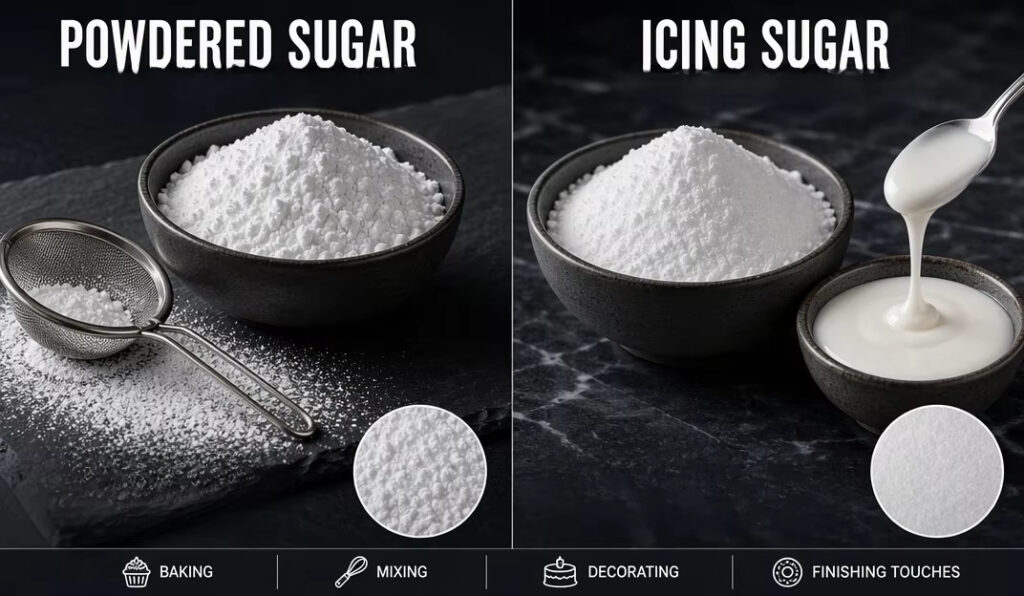
The single most common sourcing error in this category is treating “powdered sugar”, “confectioners’ sugar” and “icing sugar” as synonyms for one product. In commercial trade they describe two different fineness bands:
| Product | Typical fineness | Typical use |
| Powdered sugar (US), confectioners’ sugar | 20–120 mesh (roughly 850–125 µm); 60–80 mesh is the most requested band | Bakery dusting, fillings, beverage mixes, general food processing |
| Icing sugar (UK/Commonwealth) | 200–300 mesh (roughly 75–48 µm); ultra-fine grades reach 400 mesh (≈38 µm) | Icing and fondant, chocolate panning, delicate glazes |
Both are white sugar; the difference is particle size distribution. If a buyer in the UK asks for “icing sugar” and receives 60 mesh powder, the delivery will be rejected — and if a US buyer asks for “powdered sugar” and is quoted an air-classified 300 mesh mill, the line is over-specified and over-priced.
Write the mesh number into the enquiry, not just the product name. That single habit prevents most sugar grinding disputes.
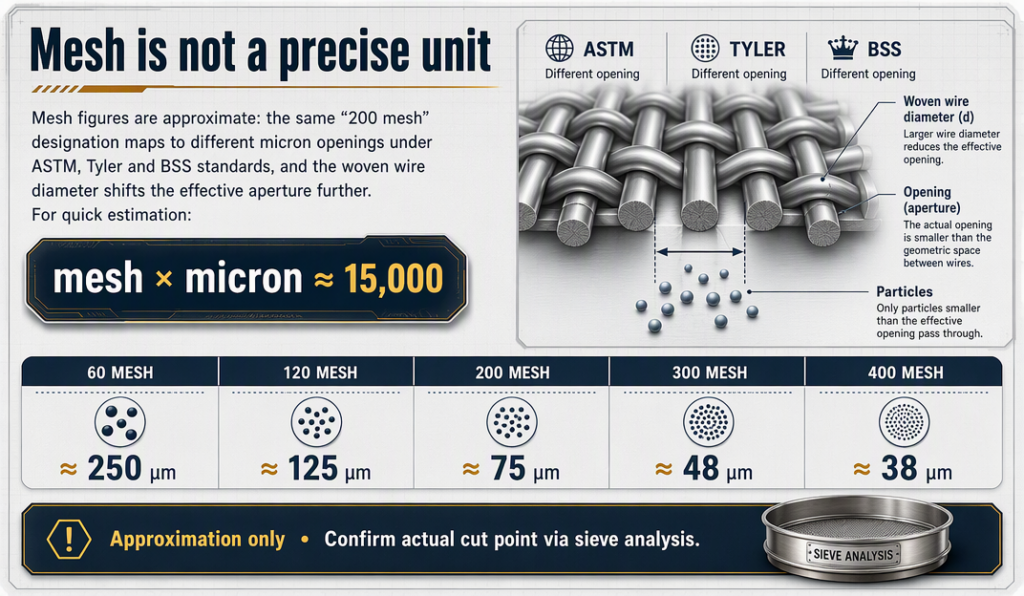
Mesh is not a precise unit
Mesh figures are approximate: the same “200 mesh” designation maps to different micron openings under ASTM, Tyler and BSS standards, and the woven wire diameter shifts the effective aperture further. For quick estimation:
mesh × micron ≈ 15,000
So 60 mesh ≈ 250 µm, 120 mesh ≈ 125 µm, 200 mesh ≈ 75 µm, 300 mesh ≈ 48 µm, 400 mesh ≈ 38 µm. Treat all of these as approximations and confirm the actual cut point with a sieve analysis on your own material.
2. How fineness is actually controlled (the part that decides the machine)
There are three mechanisms in commercial sugar mills, and they behave very differently.
2.1 Screen in the grinding chamber — BSU / BSG
A woven or perforated screen holds the material in the chamber until it is fine enough to pass. Change the screen, change the fineness — simple, robust, and inexpensive to run.
- Typical working range: 20–120 mesh
- Fineness changes in discrete steps, one screen at a time
- Best fit for powdered sugar at 60–80 mesh
In the Brightsail range: this is the design used by the BSU and BSG universal mills.
2.2 Dynamic air classifier — BSP (ACM)
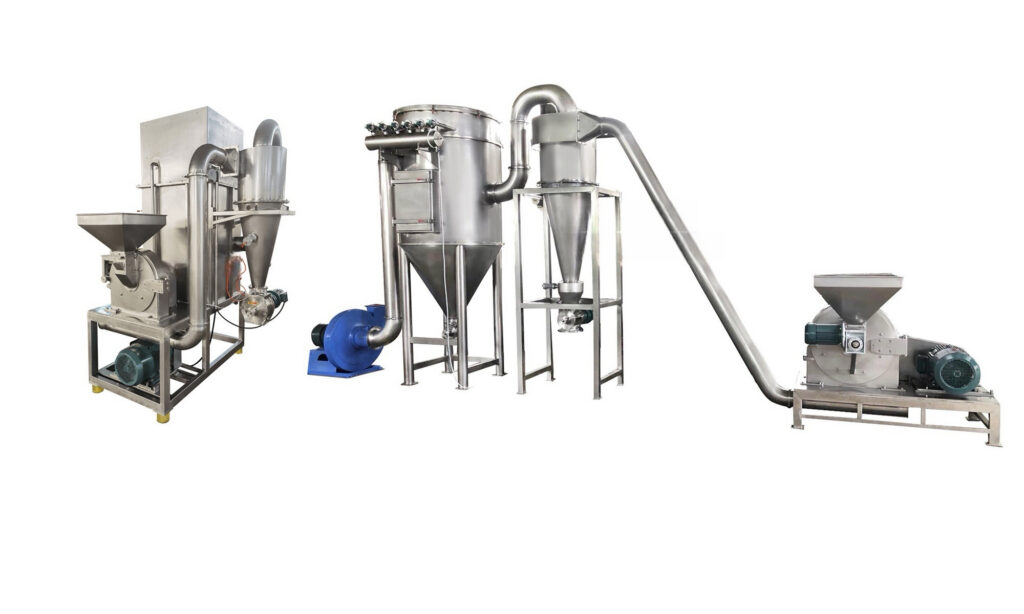
In an air classifier mill (ACM), the mill is paired with a rotating classifier wheel. Particles are carried in an air stream and only leave when they are fine enough to pass the wheel; coarse particles are rejected back into the grinding zone. No screen in the chamber.
- Typical working range: 120–1000 mesh, depending on wheel speed and airflow
- Fineness is adjustable continuously by wheel speed — no screen changes
- Best fit for icing sugar at 200–300 mesh, and for 400 mesh and finer
In the Brightsail range: this is the BSP air classifier mill.
2.3 Rotor speed — BSZ pin mill
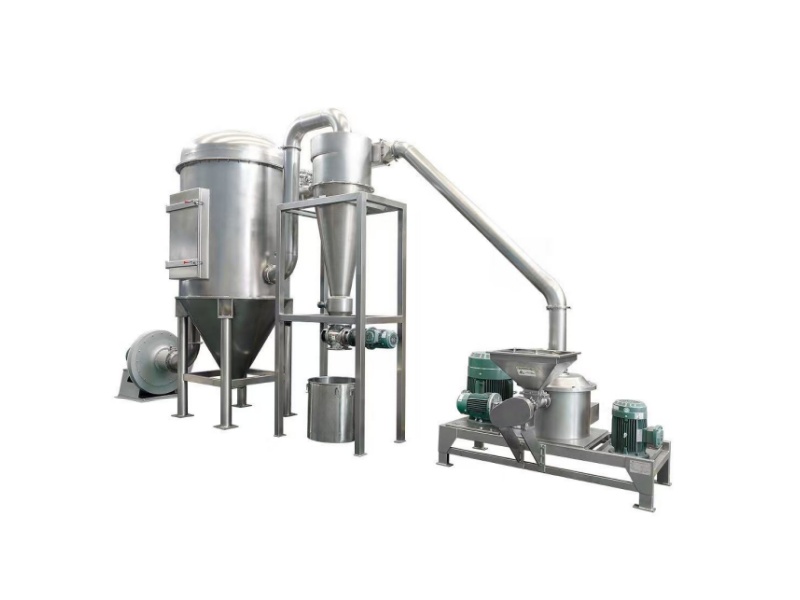
In a pin mill unit, a high-speed pin rotor does the grinding, and tip speed plus residence time set the particle size. This design is chosen when the priority is throughput at moderate fineness — typically for powdered sugar produced in large volumes.
In the Brightsail range: this is the BSZ pin mill unit.
The takeaway for buyers: if a supplier quotes a screen-type mill for a 300 mesh icing sugar job, or an air-classified mill for a 60 mesh bakery job, one of the two is wrong. Ask which mechanism the proposal uses and what range it covers.
3. Matching machine type to product
Four machine families cover almost every sugar application:
| Series — machine type | Fineness mechanism | Best for |
| BSU — universal / hammer-type mill | Screen in chamber | Powdered sugar 20–120 mesh, multi-product plants, moderate batches |
| BSG — high-efficiency mill with cyclone and dust collection | Screen in chamber, continuous discharge | Powdered sugar where dust control and continuous running matter |
| BSP — air classifier mill (ACM) | Dynamic classifier wheel | Icing sugar 200–300 mesh, ultra-fine and tight distributions |
| BSZ — pin mill unit | Rotor speed | Powdered sugar at high output, where fineness is not the constraint |
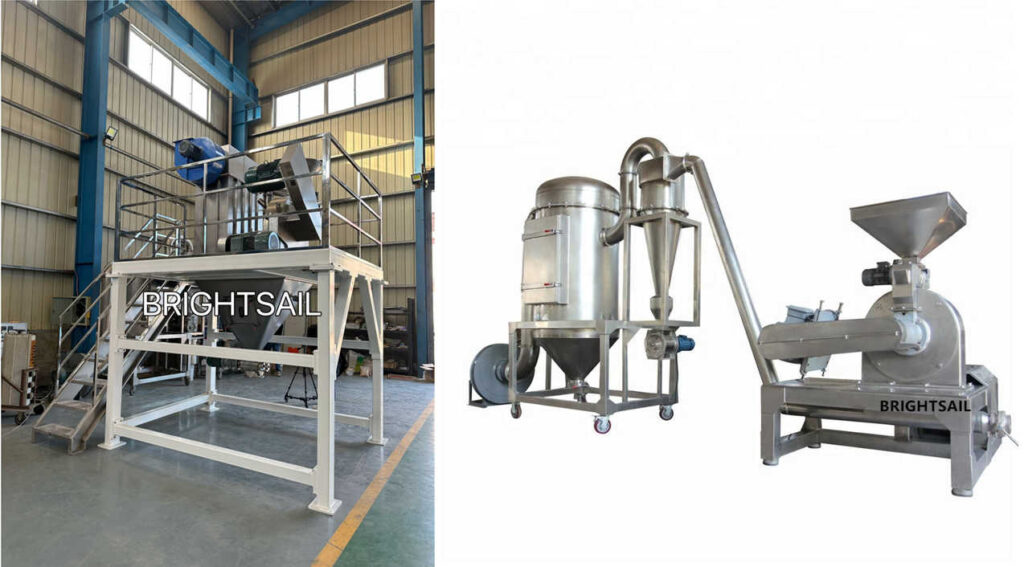
A sugar mill is never just the mill. A complete line typically adds a feeding screw, a cyclone, a pulse-jet dust collector and a fan. Dust collection is not optional: sugar dust is combustible, and fine sugar is heat-sensitive, so the pneumatic circuit also has to keep the product cool.
4. Blade geometry: the second decision most buyers skiphttps://brsmill.com/video/
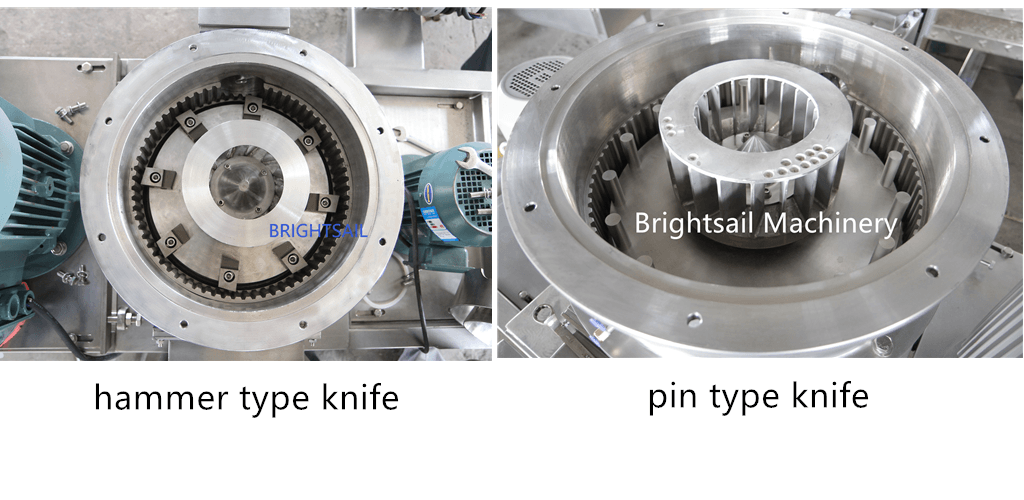
On air classifier mills — the BSP series — the rotor blade shape changes both the achievable fineness and the efficiency of the grind:
- Cylindrical blade — cleaner impact, less over-grinding on brittle crystalline material such as sugar. On the same model it generally runs more efficiently on sugar than a square blade does.
- Square (bar) blade — stronger shear, produces a finer powder, and handles fibrous or tougher materials better. The right choice when the target is 400 mesh and above, or when the same mill must grind several different products.
If one mill has to cover sugar plus spices, herbs or other materials, plan for a square blade set — or budget a second rotor so blade changes do not stop production.
5. Integrated or split layout
Small and mid-size sugar mills are commonly built as a mono-block: mill, cyclone and pulse collector on one frame, which keeps the footprint small and installation simple.
As throughput grows, the mono-block stops being practical — the duct runs, filter area and fan sizing no longer fit a single frame. Larger lines are built split: mill on one frame, cyclone and filter bank on a separate structure, connected by ducting.
Two consequences for project planning:
- A split layout needs noticeably more floor space and a taller building than a mono-block of the same nominal size.
- Before committing to a large sugar grinding line, confirm the available clear height and free floor area of the customer’s building. Height is the constraint that most often forces a redesign after the order is placed.
6. The hardest brief: a fineness range, not a maximum
This is the case that separates experienced suppliers from optimistic ones.
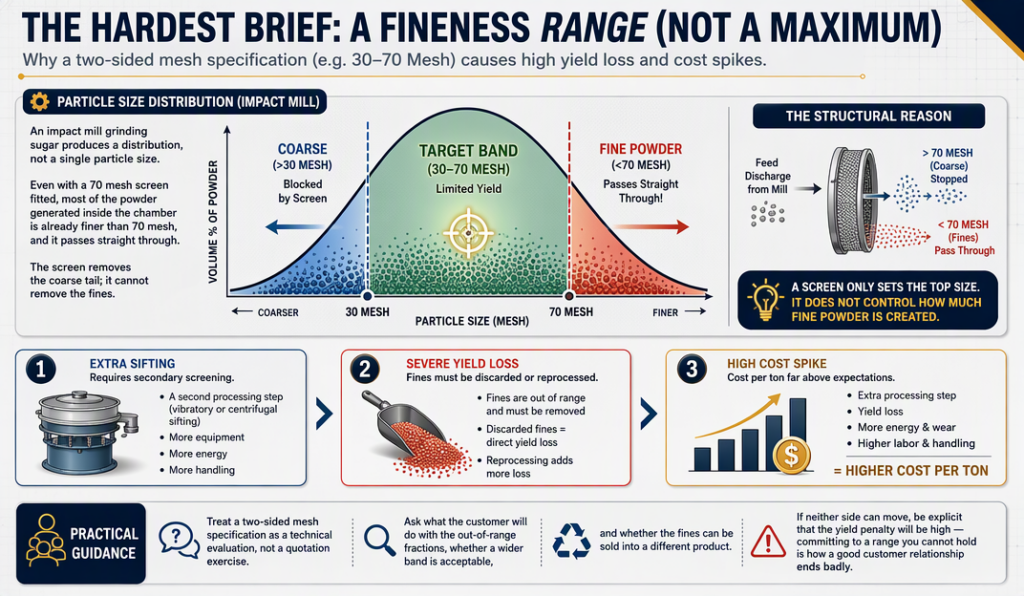
A buyer asks for sugar powder that is “not too coarse and not too fine” — for example, nothing coarser than 30 mesh and nothing finer than 70 mesh. It sounds reasonable. It is extremely difficult to deliver economically, for a structural reason:
A screen only sets the top size. It does not control how much fine powder is created.
An impact mill grinding sugar produces a distribution, not a single particle size. Even with a 70 mesh screen fitted, most of the powder generated inside the chamber is already finer than 70 mesh, and it passes straight through. The screen removes the coarse tail; it cannot remove the fines.
The only way to cut the bottom of the range is to sieve the finished powder and discard or reprocess the fines. That means:
- a second processing step (vibratory or centrifugal sifting),
- a significant yield loss, and
- a cost per tonne that is usually far above what the buyer expects for sugar powder.
Practical guidance: treat a two-sided mesh specification as a technical evaluation, not a quotation exercise. Ask what the customer will do with the out-of-range fractions, whether a wider band is acceptable, and whether the fines can be sold into a different product. If neither side can move, be explicit that the yield penalty will be high — committing to a range you cannot hold is how a good customer relationship ends badly.
7. Anti-caking: the additive that decides the whole line
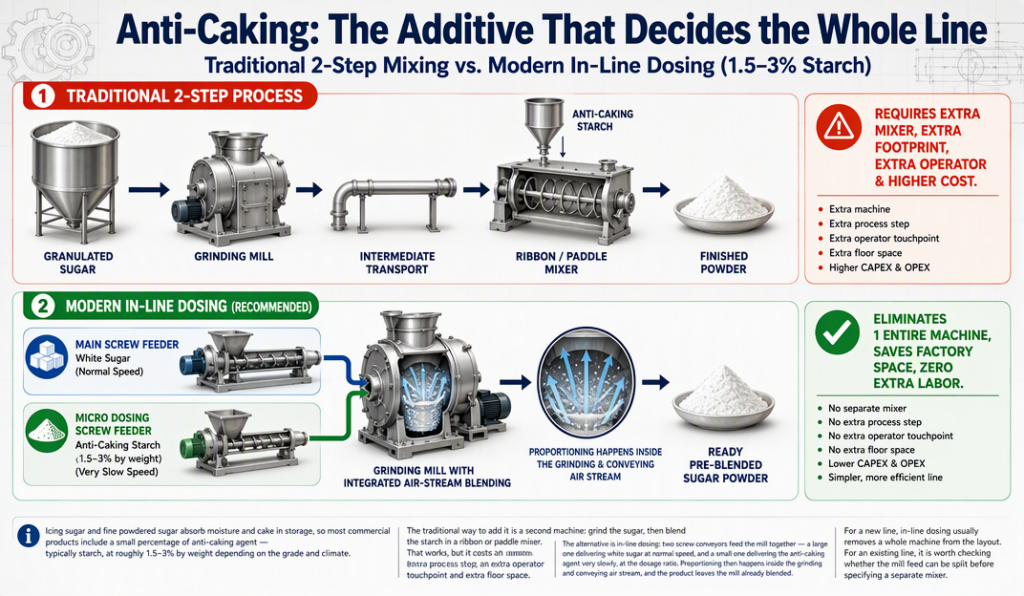
Icing sugar and fine powdered sugar absorb moisture and cake in storage, so most commercial products include a small percentage of anti-caking agent — typically starch, at roughly 1.5–3% by weight depending on the grade and climate.
The traditional way to add it is a second machine: grind the sugar, then blend the starch in a ribbon or paddle mixer. That works, but it costs an extra machine, an extra process step, an extra operator touchpoint and extra floor space.
The alternative is in-line dosing: two screw conveyors feed the mill together — a large one delivering white sugar at normal speed, and a small one delivering the anti-caking agent very slowly, at the dosage ratio. Proportioning then happens inside the grinding and conveying air stream, and the product leaves the mill already blended.
For a new line, in-line dosing usually removes a whole machine from the layout. For an existing line, it is worth checking whether the mill feed can be split before specifying a separate mixer.
8. Material of construction and food safety
Standard food-grade sugar mills are built in SS304, which is adequate for white sugar. Two situations call for an upgrade to SS316:
- corrosive additives blended into the same line (salt, citric acid, some acidulants), and
- plants where washdown with chlorinated or acidic cleaning agents is routine.
Also confirm, before ordering: contact-part surface finish, whether the grinding chamber can be opened for cleaning without tools, guard and interlock arrangement, and the dust collector’s filter media rating. These details decide whether the machine passes a customer audit two years from now.
9. Specification checklist before you request a quotation
Send these nine points with any enquiry and most of the back-and-forth disappears:
- Product name and mesh number — powdered sugar or icing sugar, with the actual mesh, not just the trade name.
- Single maximum, or a range? State both limits if the customer has a lower bound.
- Required output per hour, and hours per shift.
- Feed material — crystal size, moisture, any additives already present.
- Additive plan — is starch or another anti-caking agent required, and at what percentage?
- Building constraints — clear height and free floor area.
- Material of construction — SS304 or SS316, and why.
- Utilities — available power, compressed air for the pulse-jet filter.
- Destination market — food-contact and electrical standards differ by country.
Frequently asked questions
What mesh is powdered sugar?
Commercial powdered sugar is usually 20–120 mesh, with 60–80 mesh the most common band. Retail products often contain a small amount of starch to prevent caking.
What is the difference between powdered sugar and icing sugar?
Fineness. Powdered sugar is the coarser product (20–120 mesh); icing sugar is typically 200–300 mesh and is used for icings, fondant and chocolate work.
Can one sugar grinding machine produce both powdered and icing sugar?
Only if it spans both ranges. Screen-type mills work up to roughly 120 mesh; icing sugar at 200–300 mesh normally needs an air classifier mill. A single machine covering 20–300 mesh is possible but is specified around the finest requirement, which affects cost and throughput.
Why does my sugar powder cake in storage?
Fine sugar absorbs moisture from the air. The usual fix is an anti-caking agent (typically starch, 1.5–3%) blended into the powder, combined with moisture-barrier packaging.
Why can’t a supplier guarantee sugar powder between 30 and 70 mesh?
Because the screen sets only the maximum particle size. An impact mill always produces a spread of sizes, most of it finer than the screen opening, so holding a lower limit requires post-grinding sifting and a substantial yield loss.
Is sugar dust a hazard?
Yes. Fine sugar dust is combustible and sugar is heat-sensitive, so a sugar grinding line needs proper dust collection, grounding and bonded ducting, not just a mill.
What is the difference between the BSU, BSG, BSP and BSZ series?
BSU and BSG are universal hammer mills with a screen in the grinding chamber, used for powdered sugar up to about 120 mesh. BSP is an air classifier mill (ACM) for icing sugar from roughly 200 mesh upward. BSZ is a pin mill unit for powdered sugar, where output matters more than fineness.
Choosing a supplier
Ask any sugar grinding machine supplier three questions before comparing proposals: which fineness mechanism the machine uses, what mesh range it actually covers, and how the dust collection and product cooling are handled. A supplier who can answer those in specifics — and who tells you when a requested mesh range is uneconomical — is worth more than a lower headline number.
Brightsail builds sugar grinding lines across four series — the BSU and BSG universal mills, the BSP air classifier mill and the BSZ pin mill unit — together with feeding, dust collection and in-line additive dosing. If you are specifying a powdered sugar or icing sugar line, send us the mesh number, the hourly output and your building constraints, and we will tell you which configuration fits — including when a requested range is not worth the yield loss.