
Let me start with something that actually happened.
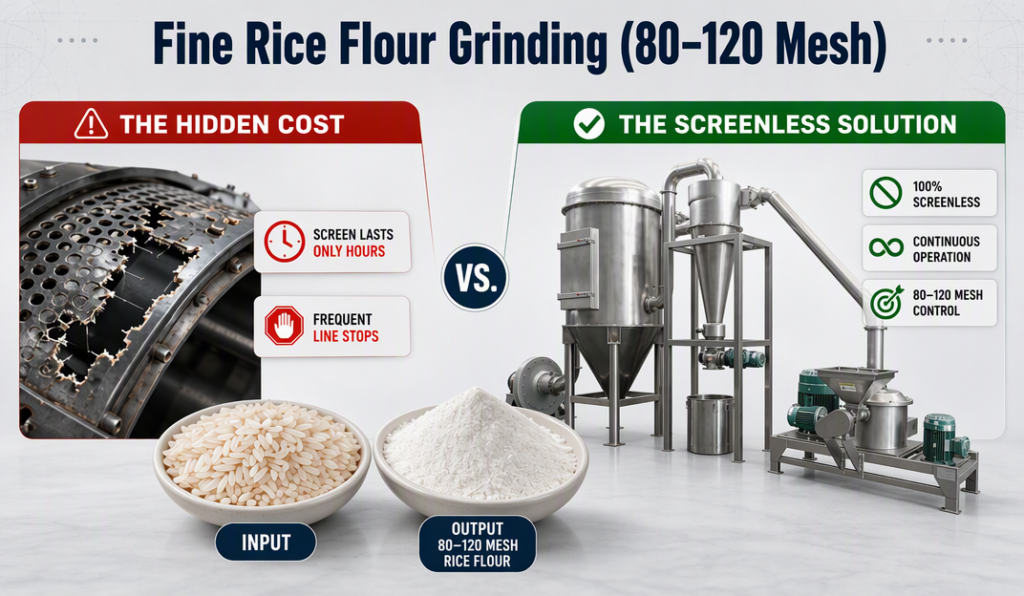
A customer needed to grind dry rice flour — 80 mesh, 100 mesh, 120 mesh, depending on the order. Before he came to us, he had bought a universal pulverizer with a screen from another company. Coarse powder was fine. But the moment he pushed for fine rice flour, the hammer mill screen could not take it — it lasted only a few hours.
Not months. Not weeks. Hours.
Several screen changes a day, each one meaning stop the line, open the machine, fit a new screen, reset. Eventually he said — roughly translated — that he had had enough. Then he made a decision: the next machine would have no screen at all.
He bought our air classifier mill — also written air classifying mill, and usually shortened to ACM.
Two questions hide inside that story, and most buyers never ask either one at the trial stage:
- Why does a “cheaper” machine end up costing more to run?
- With no screen, what holds the fineness?
That is what this article is about.
1. On Fine Grinding, a Screen Stops Being a Spare Part
Let us be clear about one thing first: the universal pulverizer is not a bad machine.
For coarse grinding, multiple products and small batches, it makes a lot of sense — simple structure, easy product changeover, low purchase price. It is the workhorse in plenty of spice and seasoning plants.
Fine grinding is a different job.
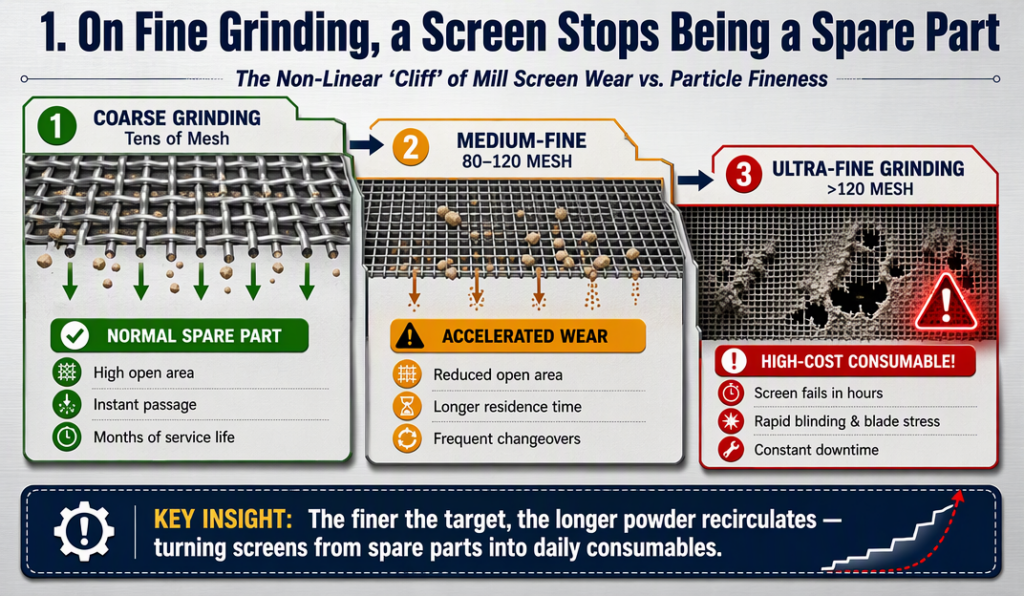
The screen’s purpose is to cap the top size. Anything bigger than the aperture stays inside and gets hit again — which is also hard on the hammer mill blades, because they keep striking material that cannot leave. The finer the target, the smaller the aperture and the lower the open area — so material stays in the chamber longer. Longer residence means more abrasion on the screen, and more chance of blinding.
The result is not a gentle slope. It is a cliff:
| Target fineness | What happens to the screen |
| Coarse (tens of mesh) | Passes freely, normal life, replaced like a spare part |
| Medium-fine (80–120 mesh) | Passage slows, residence time rises, wear accelerates |
| Finer still | The screen stops being a spare part and becomes a consumable |
This is exactly where the rice flour customer was. The screen was no longer something he replaced twice a year. It was something he replaced by the hour.
There is a physical limit nobody mentions: finer aperture means thinner screen
This is not suppliers cutting corners. Below a certain aperture, the screen has to be made thinner — otherwise the open area is so low that material simply cannot pass. And thin means poor impact resistance.
So the same fine screen can meet two very different fates:
| Feed condition | What the screen sees |
| Crystalline material (sugar, salt) | Brittle, breaks up quickly on entry, low impact on the screen — relatively tolerant |
| Large, hard feed | A single impact can punch through it — not worn out, knocked out |
In other words, many screens that “die in a few hours” are not worn through. They are punched through. And the two failures have completely different fixes: wear calls for a better material, punch-through calls for controlling feed size.
The worse problem: when the screen fails, the machine keeps running
This matters far more than the cost of the screen itself.
When a screen fails, powder still comes out. The machine still runs. The current looks normal. But oversize particles from the damaged area are already in the product — the powder is out of spec, and nobody on the line knows.
By the time QC catches it in a spot check, a batch has usually already shipped. Best case, it is reworked. Worst case, it comes back — and in food or flavour production, add a customer complaint on top.
So the real cost of a failed hammer mill screen was never the screen:
| Visible | Invisible |
| The screens you keep buying | A batch of out-of-spec powder that may already be gone |
| The downtime to change it | Rework, returns, customer trust |
| The labour to fit it | The cost of QC tracing it back |
The first two can be counted. The third cannot — and the one you cannot count is usually the most expensive.
How long does a screen change take? A few minutes at best. Stop the machine, open it, fit the new screen, reset — with practice it is minutes, not hours. So “changing screens eats your day” is not really true.
The real problem is not those minutes. It is that nobody knows when the screen breaks.
Those are two different costs. Change time is fixed and budgetable: three changes a day is still three times a few minutes. The time from the screen failing to somebody noticing is neither fixed nor budgetable — the machine keeps running, powder keeps coming out, bags keep being filled, and several tonnes of out-of-spec product may already exist. The later you find it, the less those few minutes matter, because they were never the main cost.
So when you fill in cost per ton, do not put the screen-change time in the downtime line — it badly understates the loss. Put in what came out between the failure and the discovery.
2. Three Parts, Three Different Failure Modes
Crusher wear parts cannot be lumped together. Blades, screens and toothed rings fail in completely different ways.
| Part | Wear mechanism | The real problem once it degrades |
| Blades | Impact wear + abrasive wear | Cutting efficiency drops → fineness falls, output falls, power draw rises. “Not broken” does not mean “not worn” |
| Screen | Abrasion + blinding + rupture | Aperture opens up or the mesh tears → fineness goes out of control. It is the last gate on fineness — once it gives, every setting upstream is meaningless |
| Toothed ring | Shear wear | Worn teeth lose shearing action, most visible on fibrous material. It also has many crevices — harder to clean, more sensitive to oily feed |
Remember one line: of these three, only the blades degrade gradually. A screen usually fails suddenly. Gradual degradation can wait. Sudden failure cannot.
3. Six Variables Set the Life
Customers ask, “How often do I change the blades?”
There is no standard answer. The same set of hammer mill blades grinding sugar and grinding mineral can differ by an order of magnitude. Six variables decide how long crusher wear parts last:
| # | Variable | How it affects life |
| 1 | Abrasiveness of the material | Hardness plus particle shape. “Powder” covers a huge range |
| 2 | Feed cleanliness | Food materials often carry small stones and grit. Their hardness is far above the product itself, and the damage to the blades is on a different scale — a few stones can scrap a set |
| 3 | Target fineness | Finer means longer residence, more repeated impacts, and a smaller aperture under more pressure |
| 4 | Rotor speed / tip speed | Higher speed means more impacts per unit time. Ultra-fine targets force high speed, so wear cost is inherently higher at fine grinding |
| 5 | Feed size | Large, hard lumps concentrate the impact. Screens get punched through and blades take extra load — this one is more lethal than wear because it is sudden, not gradual |
| 6 | Feed consistency | Uneven feed creates local overload; a few blades wear flat first and the whole set is scrapped early |
Before you quote a life, define the duty
This is why we are reluctant to answer “how many months” straight away.
“Months” is a meaningless unit on its own. The same set of blades:
- A plant running three days a week, day shift only: three months might be 400 hours
- A plant running two shifts, 24 hours: one month can be 700 hours or more
Both say “three months”. The actual wear differs several-fold.
So the industry convention is to fix a duty first:
5–6 days a week, 8–12 hours a day.
Only against that baseline does “a few months” mean anything. Run below it and life stretches; run above it — especially continuous 24-hour operation — and you have to scale it down.
This is also why we always ask how many hours a day you run before quoting a life. Not being difficult — without it, any number we give is wrong.
So the right question is not “how long does it last”, but: “For my material — at this cleanliness — at this fineness and this duty, what is the wear cost per ton?”
Cost per ton neatly removes the duty variable — the hours you run are already inside the tonnage. That is why we would rather work in cost per ton than hand out a “few months”.
4. The Math: Why the Trial Price Misleads
This is the part we most want to make clear.
At the trial, the customer compares purchase price. That number is easy to see: the universal pulverizer is much cheaper than an air classifier mill.
In production, what lands in the cost sheet is wear cost per ton:
`
Cost per ton = (blade price ÷ tons per blade set)
+ (screen price ÷ tons per screen)
+ (toothed ring price ÷ tons per ring)
+ downtime cost ÷ tons between changes
`
There is one item missing from that formula: a whole batch reworked or returned because a screen failed. It does not happen often, but one event can wipe out everything you saved. Leave an allowance for it — not a precise figure, a contingency.
And the downtime line itself: if you fill in the screen-change time, you get a small number — because a change really does take minutes. The number is not wrong, but it measures changing a screen, not running with a broken one. The real downtime happens during the period you do not know about, and it cannot be filled in. It can only be shortened, with a change log and scheduled inspection.
Now apply the formula to the rice flour customer:
- Universal pulverizer: cheap machine, but the hammer mill screen is changed every few hours. Screen price divided by a few hours of output means a tiny denominator — cost per ton explodes. Add the downtime for every change.
- Air classifier mill: expensive machine, but there is no screen to consume. Fineness is set by the classifier wheel, so “change the screen every few hours” simply does not exist.
That is the answer to “why are you recommending the more expensive machine”: not because expensive is better, but because in continuous fine grinding the consumable structure is different.
One qualification: this conclusion applies mainly to harder materials such as grains and herbs — they punish the screen hardest, so the price gap gets eaten fastest. The easier the material grinds, the slower that equation turns.
The reverse also holds: for coarse grinding, multiple products and small batches, the universal pulverizer is the better choice, and we say so. Paying more in the wrong direction and paying more in the right direction are two different things.
Want a wear-cost-per-ton figure for your material?
One more thing on pricing: we do not quote the alloy upgrade as a percentage. The same percentage lands on very different absolute amounts across models, and publishing one only hands you an anchor to negotiate against. The number that matters is payback: price difference ÷ difference in cost per ton = months to break even. That can be calculated for your material and shift output; it cannot be read off a model list.
Send us your material, target mesh and shift output. We will run the numbers for your duty — screen consumption and downtime included. Then decide which machine, instead of comparing a trial price.
5. Material: Stainless Steel Is Not Wear-Resistant
Even after moving to a screenless air classifier mill, there is one more trap: what the blades and toothed ring are made of.
Many customers assume “stainless is better”, because food production is about hygiene. Two different concepts get mixed up here:
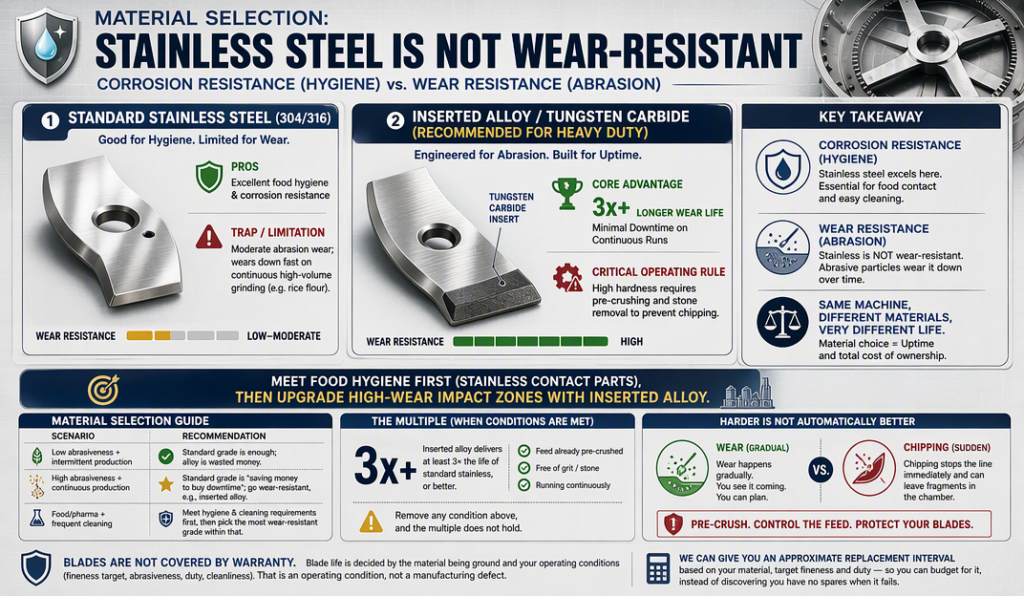
- Stainless resists corrosion — good for food contact and cleaning
- Stainless is not necessarily wear-resistant
Rice flour is a good example. Rice is not hard, but volumes are large and runs are continuous, so abrasion accumulates. With ordinary stainless blades, grinding rice at the 5–6 days, 8–12 hours duty, life can be only a few months. At 24-hour operation it is shorter still; running two or three day shifts a week, it lasts longer.
The same applies to the toothed ring — its shearing faces wear continuously too.
This is also why the same model and the same capacity can come in at very different prices: material is not a yes/no option, it is a gradient from standard steel, through stainless, to inserted alloy.
How to choose? The same two conditions:
| Scenario | Recommendation |
| Low abrasiveness + intermittent production | Standard grade is enough; alloy is wasted money |
| High abrasiveness + continuous production | Standard grade is “saving money to buy downtime”; go wear-resistant, e.g. inserted alloy |
| Food/pharma + frequent cleaning | Meet hygiene and cleaning requirements first, then pick the most wear-resistant grade within that |
On the multiple: budget inserted alloy at three times the life of standard stainless, or better. That is a floor, and it comes tied to one condition — feed already pre-crushed, free of grit, running continuously. It is not a promise of exactly 3×; it means when you order spares, order on at least 3×. With abrasive-dominated wear and steady feed the real number comes out higher. Take the condition away and the number does not hold.
But harder is not automatically better. Inserted alloy is hard and not tough. Feed large pieces straight in, or let grit through, and it can chip. A chipped blade is far worse than a worn one: wear costs you output gradually and you still have time to order a replacement; chipping stops the line on the spot and can leave fragments inside the chamber. That is why the two rules in the previous section — pre-crush, control the feed — are not optional. They are the condition under which the multiple exists at all.
One more thing, said upfront: blades are not covered by warranty.
Not because we doubt the material, but because blade life is decided by the material being ground. The same set, on clean rice versus rice carrying grit, gives two completely different lives. That is an operating condition, not a manufacturing defect.
What we can do is give you an approximate replacement interval based on your material, target fineness and duty, so you can budget for it — instead of discovering you have no spares when it fails.
6. So: Pre-Crush — Screen or No Screen
The feed-size variable deserves its own section.
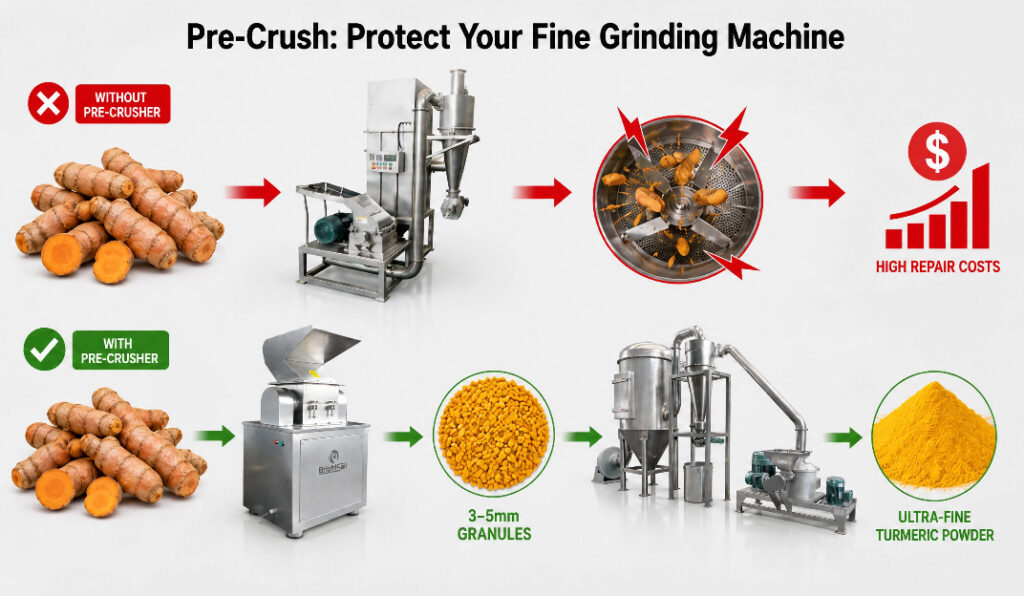
Turmeric is a good example.
Feed large pieces of turmeric into a hammer mill and two things happen at once: the screen breaks quickly, and the blades wear faster.
Not because turmeric is especially hard. Because the feed is too large. Big lumps are struck repeatedly inside the chamber, and the impact concentrates on the screen and the blades. The chance of punching the hammer mill screen through rises sharply; the blades carry extra load.
Pre-crush the same turmeric into small particles first, and both the screen and the blades last noticeably longer.
That is the value of coarse crushing: it produces no finished powder, but it protects the machine that does.
Customers often ask: since an air classifier mill has no screen, can anything go straight in?
Answer: it can, but it should not be run that way.
An air classifier mill has no screen — it has a high-speed rotor and a classifier wheel. Large hard lumps go straight at the rotor and blades. When that damage happens, the repair costs far more than a screen, and the downtime is far longer.
So our advice is consistent: whether the customer ends up with a screen-type machine or a screenless air classifier mill, pre-crush the feed first.
At purchase time it looks like an unnecessary extra: one more machine, more power, one more operator. What it actually does is turn sudden damage into predictable wear.
Customers often push back at this point: “The hammer mill handles it directly — why do I need to buy a coarse crusher as well?”
Fair question, and we do not dodge it.
The answer: we are calculating your total cost, not this one machine’s cost.
| Without a coarse crusher | With a coarse crusher | |
| Purchase | One machine saved | Extra purchase |
| Screen | Easily punched through by large lumps; counted in hours or weeks | Smaller feed, longer life |
| Blades | Extra impact load, replaced sooner | Less impact, slower wear |
| Downtime | More screen and blade changes | Fewer changes |
A coarse crusher is a simple, low-priced machine — not the most expensive item on our quote. We raise it every time precisely because it is cheap: a cheap machine protecting the expensive parts, and the far more expensive downtime.
Recommending pre-crushing is not about selling one more unit. It is about bringing the total cost of the line down.
One line to keep in mind:
Equipment is not bought to run grinding tests. It is bought to run production.
A trial run will make powder from almost anything. Three months of continuous operation is a different contest — not “can it grind”, but “what is left of it after grinding”.
Coarse crushing looks redundant when you buy it. You learn it was insurance when you run it.
7. The Other Item That Always Gets Cut: the Conveyor
Like the coarse crusher, this is a decision that looks like extra spending and turns out to be savings.
When customers build a budget, the conveyor is usually the first line item crossed out — “we can feed it by hand, why add another machine”.
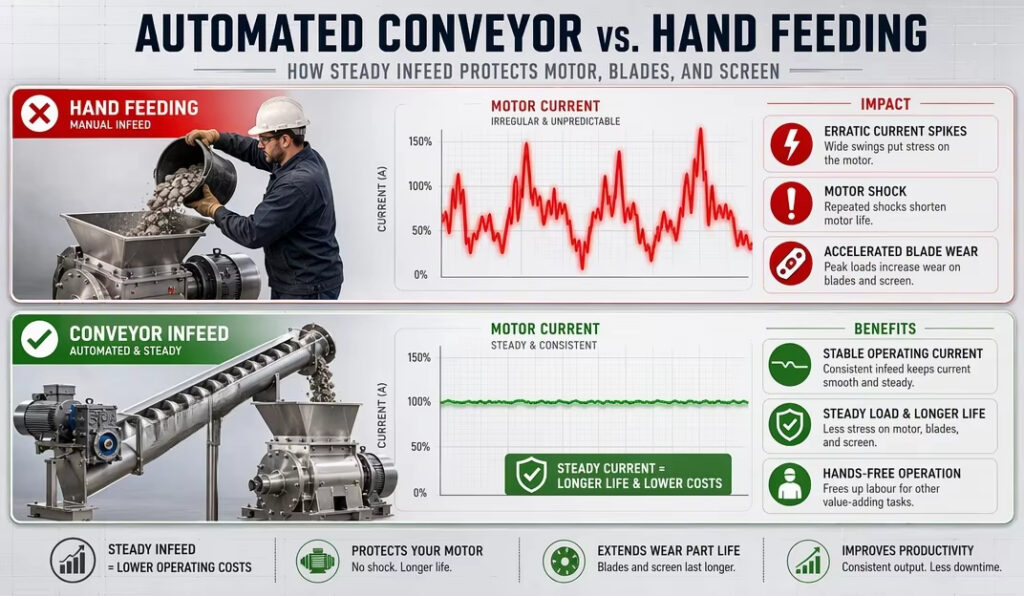
At small capacity, hand feeding is fine. But once capacity reaches the medium range, hand feeding creates a new problem: the feed rate swings.
Mill current follows the feed rate. Feed too much and the current spikes; feed too little and it drops. Hand feeding is hard to keep even, so you get:
- Current swinging continuously → the motor takes repeated shocks, which is exactly what motors dislike
- When feed runs heavy, material builds up in the chamber, the blades and hammer mill screen take extra load, and wear accelerates
- When feed runs light, the machine idles and capacity is wasted
A conveyor turns those swings into a steady value:
| Hand feeding | With a conveyor | |
| Feed consistency | Depends on the operator | Continuous and adjustable |
| Motor current | Wide swings | Stable |
| Blades / screen | Faster wear under peak load | Steady load, longer life |
| Labour | Someone tied to the feed point | Freed up |
That is why, above small capacity, we almost always recommend a conveyor.
The reason is not “more automation”. It is that steady current means less shock to the motor and no peak loads on the blades and screen — and it frees up the labour as a side benefit.
Same arithmetic as before: the conveyor is paid for out of motor life, wear-part life and labour.
8. Some Customers We Actively Tell to Buy a Second Mill
The last two sections were about adding auxiliary equipment. There is a case where we tell the customer to buy a second mill outright.
Two conditions: the product has a strong colour or odour, and the business is growing — because growth means more frequent product changes.
The reason is practical. A thorough clean of a mill is not a blow-down with an air gun:
- Remove the screen, remove the blades, clean the crevices in the toothed ring
- Clean the discharge, the ducting, the cyclone, the dust collector
- On some designs, open an inspection door and clean by hand
A thorough clean is routinely 1–2 hours. On a larger machine with ducting and a cyclone, half a day to a full day happens.
If the customer changes product two or three times a day, cleaning alone eats the capacity. Worse than the capacity is cross-contamination — in food and flavour production, one batch carrying the previous batch’s taste can mean a whole shipment rejected.
In that situation, a second machine is not “one more unit sold”. It is taking cleaning time out of production time.
| One mill, changing products | Two mills, split by product | |
| Cleaning | 1–2 hours every change, minimum | Fewer changes per machine |
| Cross-contamination | High risk | Essentially eliminated |
| Capacity | Eaten by cleaning | Runs continuously |
| Investment | Lower | Higher — but it buys back time |
Not every customer should buy a second machine. Small output, infrequent changes, no strong colour or odour: one mill is enough, cleaned properly. We only raise it when cleaning time has started to affect delivery.
Sections 6, 7 and 8 are really one idea:
A coarse crusher, a conveyor, a second mill — none of them is mandatory.
What they share: none of them makes the machine run. All of them make it run longer, steadier, and without stopping.
9. Three Common Misconceptions
Misconception 1: change the blades when they are blunt.
By the time they feel blunt, output and fineness have already been dropping and power draw has risen. When you “feel” it is time, you have been losing money for a while.
Misconception 2: change the screen when it breaks.
The moment it breaks, fineness is already out of control, and a batch usually needs reworking. Log the hammer mill screen by hours or by tons — not by “it still looks fine”.
Misconception 3: a cheaper machine is cheaper.
Purchase price is a one-off. Wear parts are continuous. In fine grinding, the second number routinely exceeds the first.
10. Three Things to Do Every Week
- Check the screen regularly — not only for tears, but for distortion and for apertures that have worn larger. It is the last gate on fineness, and nothing alarms when it fails.
- Log the tons per part — blades, screen and ring separately. Keep a replacement record. Only then do you know your real life, and only then can you judge whether a material upgrade pays.
- Stock spares against the wear cycle, not against a breakdown. A part counted in hours, like a fine screen, going out of stock means a day lost.
Want a wear-part replacement log template?
Record by material and by tons; after three months you will see your real life. Contact us and we will send one over.
11. FAQ
Q1: How often do I change the blades?
There is no single answer, but the convention is 5–6 days a week, 8–12 hours a day. Against that baseline, “a few months” means something — run three day shifts a week and life stretches; run 24 hours and scale it down. Anyone else’s number needs the same question asked first, or better still, keep your own log by tons.
Q2: Can a damaged screen be repaired?
We would not recommend it. A repaired screen has unstable strength and unstable apertures, and the edge of the repair becomes a new stress point — it fails again quickly. And since the screen is the last gate on fineness, running it damaged is gambling with the batch.
Q3: Is inserted alloy worth the extra cost?
Start from the floor: budget 3× the life of standard stainless or better, under pre-crushed, grit-free, continuous running. We do not publish a percentage premium — the same percentage lands on very different absolute amounts across models, and a published figure only becomes an anchor. What matters is payback: price difference ÷ difference in cost per ton = months to break even. Low abrasion plus intermittent production does not need alloy at all; there it is wasted money.
Q4: Can we change blades and screens ourselves?
On standard designs, yes — we supply instructions and spares. Run a small batch afterwards and confirm fineness and current before going back to full production.
Q5: Without a screen, how is fineness controlled?
By the classifier wheel. Its speed decides which particles leave and which are thrown back for more grinding. The adjustment is continuous, and does not depend on swapping screens of different aperture.
Q6: Are the blades covered by warranty?
No. Hammer mill blades are a wear part; life depends on material abrasiveness, feed cleanliness (grit and stones), target fineness and duty — none of which is a manufacturing defect. What we do instead is give an approximate replacement interval for your conditions so you can stock and budget accordingly.
Q7: The hammer mill handles the material directly — why add a coarse crusher?
Because what you save is not the purchase price but the monthly screen, blade and downtime cost. Turmeric is the clearest case: large pieces straight into the mill punch the screen through and wear the blades faster; pre-crushed, both improve noticeably. A coarse crusher is simple and inexpensive — its job is to protect the parts downstream that are not.
Q8: Why do you not recommend the cheaper universal pulverizer at the trial?
Because the trial compares purchase price and production pays cost per ton. This reasoning applies mainly to harder materials such as grains and herbs — they punish the screen most, and on long runs at 80 mesh and finer the screen consumption and downtime eat the price difference. For coarse grinding, multiple products and small batches — or for material that grinds easily and puts little load on the screen — we recommend the universal pulverizer instead.
12. Closing
Back to the customer we started with.
It was not that he could not afford a cheap machine. He had already bought one. He replaced it because that cheap machine stopped his line every few hours.
Wear parts come down to arithmetic:
Purchase price is one-off; wear parts are continuous. The trial compares the first; production pays the second.
So next time you compare quotes, do not only ask “what does the machine cost”. Ask one more question:
“What material are the hammer mill blades, the screen and the toothed ring? Roughly how many tons before replacement? How long does a change take?”
A supplier who can answer those four numbers is the one doing the same arithmetic you are.
Want a wear-part recommendation for your duty?
Send us your material, target mesh and how many hours a day you run. We will send back a written recommendation: which material for the blades, screen and toothed ring, and an expected replacement interval in tons.