
Three separate enquiries came to us in the past few weeks, all about the same material: cocoa shells. And all three asked for the same target fineness — 200 to 300 mesh.
They also asked the same first question: “Can one machine do it?”
The honest answer is that one machine can produce the powder, but holding fineness, output and consistency at the same time in production is a different problem. The reason is not the machine. It is the material.
1. Cocoa Shells Are Not “Just Cocoa Powder”
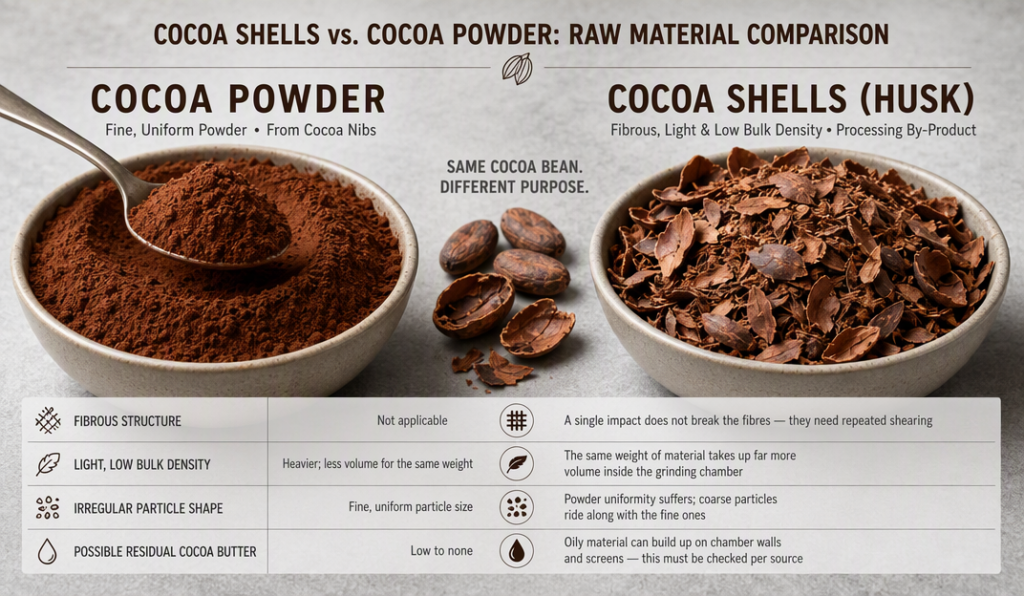
Cocoa shell powder and cocoa powder come from the same bean, but as feedstock they behave nothing alike. Cocoa shells are a by-product of cocoa processing, and they arrive at the mill with four characteristics that matter:
| Property | What it means for grinding |
| Fibrous structure | A single impact does not break the fibres — they need repeated shearing |
| Light, low bulk density | The same weight of material takes up far more volume inside the grinding chamber |
| Irregular particle shape | Powder uniformity suffers; coarse particles ride along with the fine ones |
| Possible residual cocoa butter | Oily material can build up on chamber walls and screens — this must be checked per source |
In short: cocoa husk powder is not a finer version of cocoa powder. It is a fibrous, light, adhesion-sensitive material.
2. What 200–300 Mesh Actually Demands
Both 200 mesh and 300 mesh sit in the fine-grinding range, and they are not “more or less the same”. As the fineness target rises, output falls. This is physics, not a question of machine quality.
It is also where buyers most often misjudge: in a small test batch the powder looks right, and then on the production line either the output drops sharply or the fineness becomes unstable.
3. Three Stages, Three Jobs
For a 200–300 mesh target, our standard approach is a three-stage line.
Stage 1 — Pre-crushing: hammer mill
The job here is not to make powder. It is to make the material feedable and stable:
- Reduce bulk volume so the fine-grinding chamber is not filled with fluff
- Keep discharge flowing, avoiding bridging and clogging
- Even out the feed particle size so the motor current stays steady downstream
Cocoa shells are fibrous, so a toothed-ring hammer mill is the right choice for this stage — the teeth add the shearing action that breaks fibres down. (The principle is explained in our earlier article on toothed-ring versus screen-type hammer mills.)
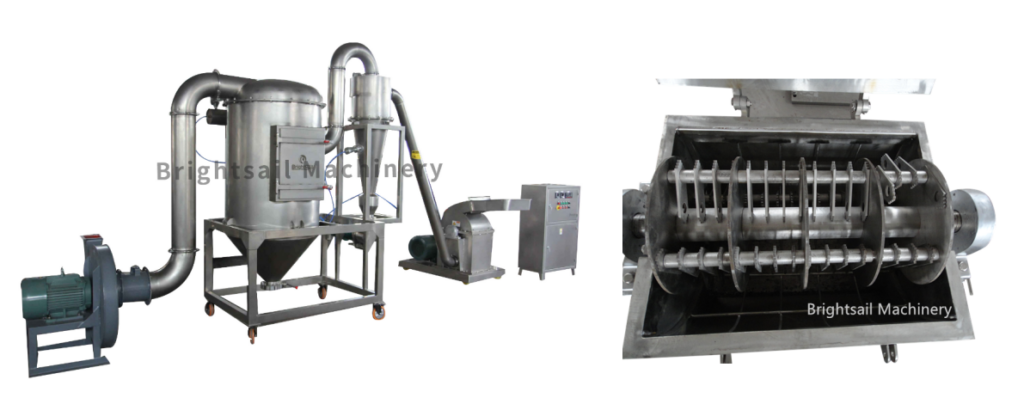
Stage 2 — Fine grinding: air classifier mill or pin mill
At 200–300 mesh, the powder has to be classified: the classifier wheel selects particles that are fine enough and returns the rest for more grinding. Whether an air classifier mill or a pin mill fits better depends on your material condition and output target — we compared the two in detail in Cocoa Powder Grinding: Pin Mill or Air Classifier Mill?
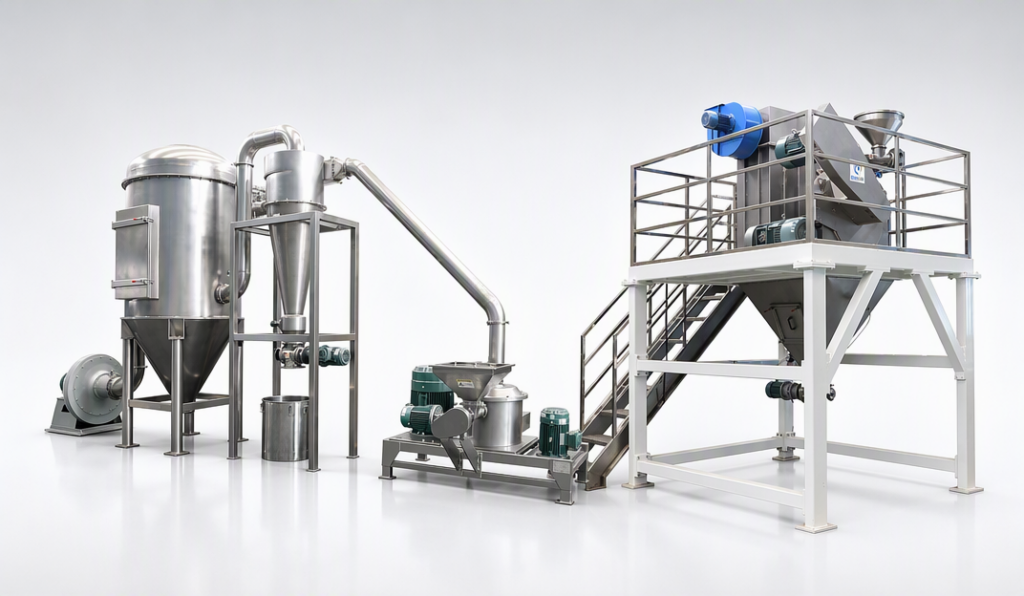
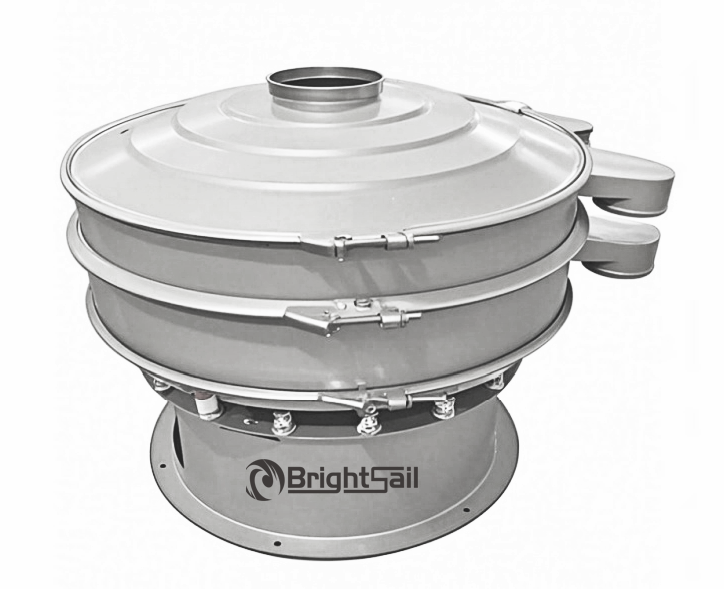
Stage 3 — Screening: vibrating sifter
A vibrating sifter after grinding does two jobs: it cuts the top size and evens out the distribution, catching the few under-ground coarse particles before they end up in a 300 mesh shipment.
4. How Fineness Is Actually Controlled
| Adjustment | What it does |
| Classifier wheel speed | Primary control of final fineness |
| Air flow | Affects conveying and classification efficiency |
| Feed rate stability | An uneven feed makes both fineness and current fluctuate |
| Pre-crushed particle size | The steadier stage 1 is, the easier stage 2 is to control |
The point: fineness is not a single setting. It is the combined result of feed condition + classification parameters + screening. That is why pre-crushing stability directly determines fineness stability.
5. Selection Checklist
Before quoting, we confirm five things:
| # | Question | Why it matters |
| 1 | Source of the shells and residual oil content | Decides whether anti-sticking design is needed |
| 2 | Target fineness: 200 mesh or 300 mesh | Directly drives output and model selection |
| 3 | Required capacity (kg/h or t/h) | Sets machine size |
| 4 | Continuous operation or batch | Affects temperature control and auxiliary equipment |
| 5 | End use (food ingredient, extraction, feed) | Decides hygiene class and fineness range |
6. Three Common Misconceptions
- “One machine can reach 300 mesh.” It can produce the powder, but holding output, uniformity and stability in production is the hard part.
- “Cocoa shells are more or less cocoa powder.” They are not. Cocoa powder is a defatted powder; cocoa shells are fibrous shell material.
- “The finer the screen, the better.” A screen that is too fine strangles output. The right approach is to keep continuity with a suitable screen and let classification and sifting hold the fineness.
7. FAQ
Do cocoa shells have to be pre-crushed?
Weighing it up, yes. They are light, bulky and fibrous; fed straight into a fine grinder they fill the chamber, feed unevenly and make the current fluctuate — costing you both output and fineness.
Is the equipment the same for 200 mesh and 300 mesh?
The structure is the same; the classification settings, screening setup and output expectations differ. As with any material, a finer target means lower output.
Does cocoa shell powder need sifting?
We recommend it. Sifting cuts the top size, improves uniformity and removes under-ground coarse particles.
Will the residual oil cause sticking?
It depends on the source, and it should be confirmed before selection. Oily material can build up on chamber walls and screens — worth settling before the machine is specified.
Can we test our material first?
Yes. Send us the material and your target fineness and we will run a grinding test and propose a configuration.
8. Closing
Turning cocoa shells from a by-product into a saleable powder is less about picking one machine and more about getting all three stages right — pre-crushing, fine grinding and screening.
Tell us your material condition, target fineness and capacity, and we will quote a line rather than a single machine. If your interest is on the product side, see our guide to cocoa shell powder uses.