
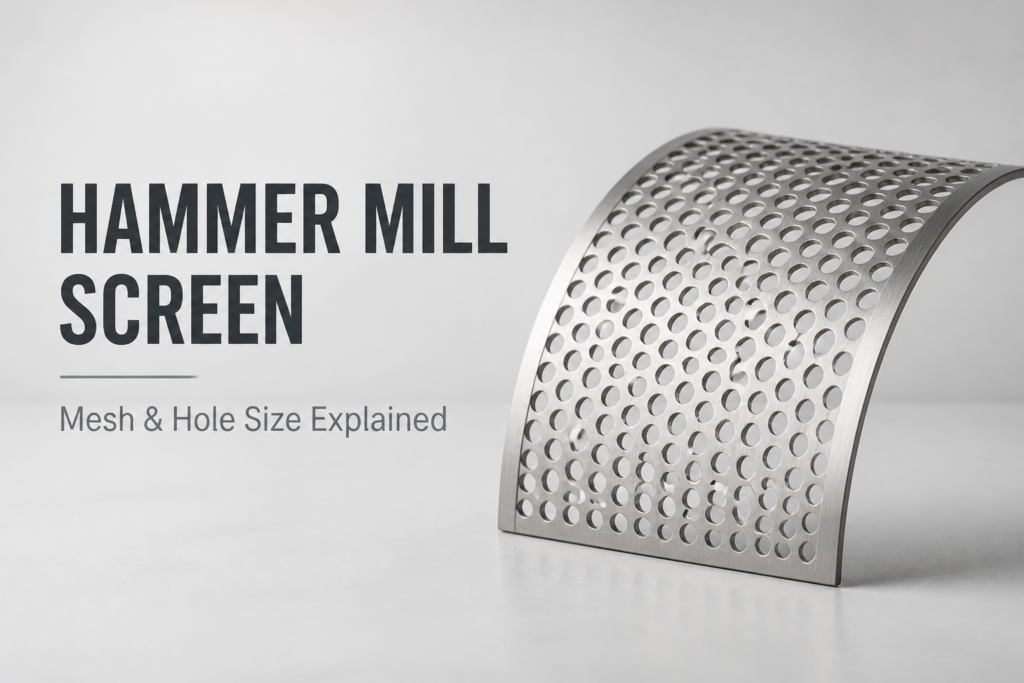
Every few weeks the same email arrives. It says something like: please quote a hammer mill with an 80 mesh screen — we need 80 mesh powder.
We quote it. Then we ask two questions that decide whether the machine will do what the buyer expects: what is the material, and how dry is it.
Because “80 mesh” is not one thing.
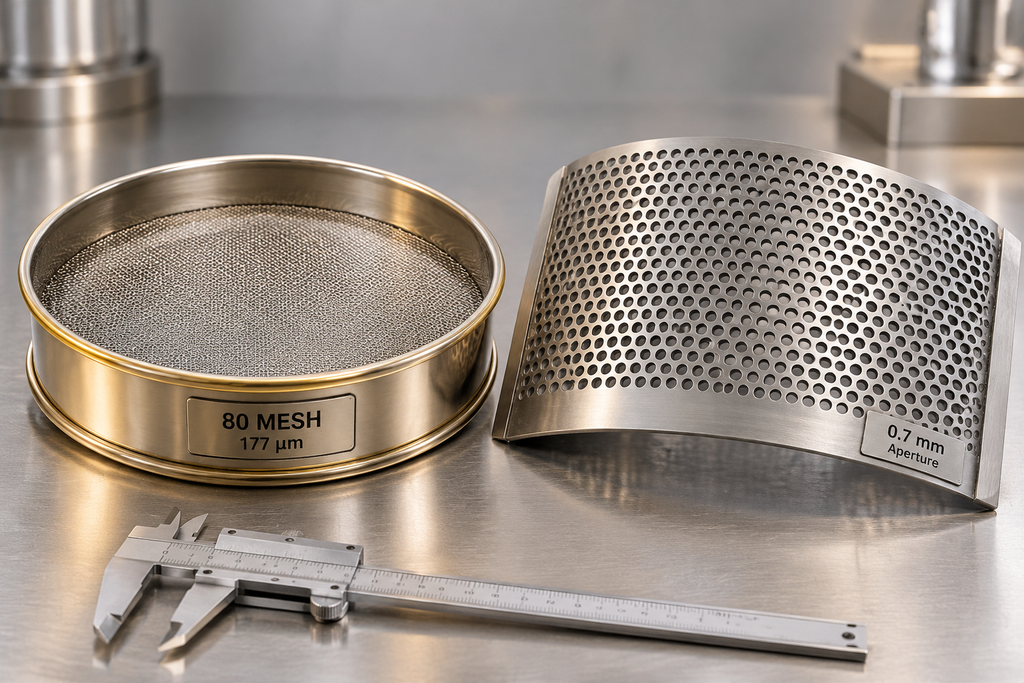
Pick up a laboratory sieve marked 80 mesh and look at the openings: 177 microns. Now pick up the screen plate we fit inside a hammer mill, also stamped 80 mesh: 0.7 mm. Four times wider. Put the two side by side on a bench and you do not need a micrometer to see it — you can see it with your eye.
Both numbers are right. Both are called 80 mesh. And the space between them is where most of the arguments in this trade begin: the buyer specifies a sieve number, the machine is built to a plate number, and the powder gets judged against a third expectation entirely.
That is what this article is about. Two charts, one for the sieve and one for the plate — and the reason a plate with 0.7 mm holes can still fill a bag with powder that passes 100 mesh.
1. Two things called “mesh”
A standard sieve is woven wire cloth. Its aperture is fixed by the mesh count and the wire diameter, and it is standardised internationally. A 60 mesh sieve has 250 µm openings whether you buy it in Shanghai, Lagos or Manchester. This is the language of specification sheets, certificates of analysis and buyer QC reports.
A hammer mill screen is a plate with holes punched through it. The number stamped on it — 60 mesh, 80 mesh, 120 mesh — is a trade name, not a measurement. What it actually tells you is which hole size the workshop has agreed to call by that name.
The two systems run in parallel and almost never meet. Leaf powder, spice powder, and anything else ground on a screen mill lives in the space between them.
2. The standard chart: mesh to micron
This is the one your buyer is using. It is worth memorising the middle of it, because it is where most orders are specified.
| Mesh | Aperture | Typical use |
| 20 | 840 µm | coarse crush, tea bag cut |
| 30 | 590 µm | |
| 40 | 420 µm | pack and sachet grade |
| 60 | 250 µm | standard food powder |
| 80 | 177 µm | fine retail powder |
| 100 | 149 µm | capsule and extract grade |
| 120 | 125 µm | fine capsule grade |
| 200 | 74 µm | premium and cosmetic grade |
Two things to note. First, the steps get smaller as you go finer: 20 to 40 nearly halves the aperture, but 100 to 120 removes only 24 µm. Second, this table says nothing about which machine can reach which line — that comes later.
3. The screen chart: what is actually in the mill
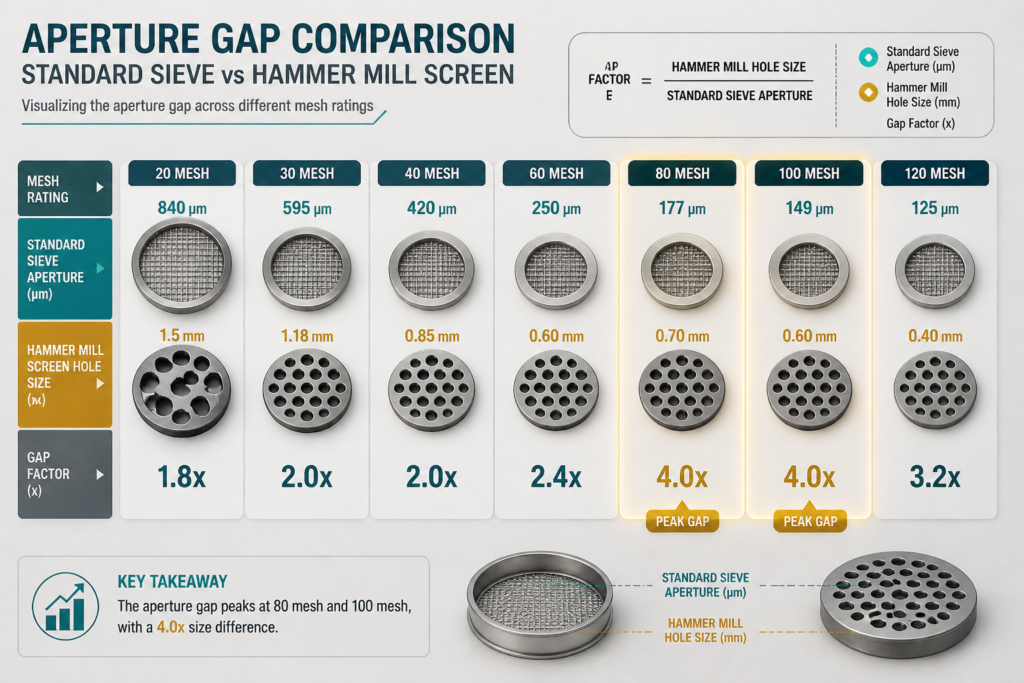
Here is the same set of numbers, measured on the perforated plates we fit to hammer mills.
| Nominal mesh | Standard sieve | Mill screen aperture | Difference |
| 20 | 840 µm | 1.5 mm | 1.8× |
| 30 | 590 µm | 1.2 mm | 2.0× |
| 40 | 420 µm | 1.0 mm | 2.4× |
| 60 | 250 µm | 0.8 mm | 3.2× |
| 80 | 177 µm | 0.7 mm | 4.0× |
| 100 | 149 µm | 0.6 mm | 4.0× |
| 120 | 125 µm | 0.4 mm | 3.2× |
Read the last column carefully, because it contains the answer to a question buyers ask constantly: what factor do I multiply by?
There isn’t one. The gap runs from 1.8× at the coarse end to 4.0× in the middle, then back to 3.2× at 120. It is not linear, it is not a conversion, and anyone quoting you a single multiplier is guessing. The only reliable method is the table.
And notice where the gap peaks: 80 and 100 mesh, at four times. Those are precisely the two grades buyers ask for most often. The confusion is not spread evenly across the range — it is concentrated exactly where the commercial pressure is.
4. Why the plate cannot simply be drilled finer
If a 60 mesh sieve is 250 µm, why is the mill screen 800 µm? Because a screen is not a sieve, and the constraint is mechanical.
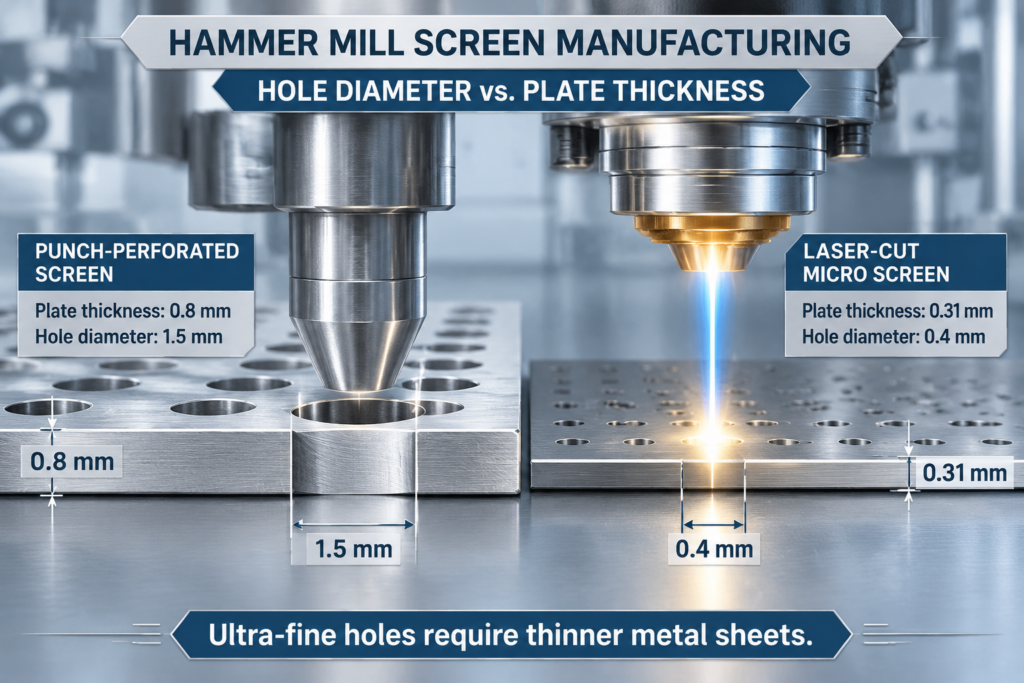
Hole size and plate thickness move together. Punch a small hole through thick plate and the punch cannot clear the material cleanly; the hole distorts, the plate cracks, or the die simply cannot take the load. So the smaller the hole, the thinner the plate has to be.
Below a certain hole size, punching stops being an option. Very fine holes are cut by laser, one at a time, and the cost per screen climbs sharply. This is why fine screens are not just “a bit more expensive” — they are a different manufacturing process.
Thin plate wears out faster. A screen is a wearing part, and a thin one has less material to give. This is the same mechanism we describe in our article on hammer mill blades, screens and toothed rings: fine screens do not usually wear through, they get punched through by a large hard particle the plate was never thick enough to resist.
You can see the process change in our own specification table:
| Nominal mesh | Aperture | Plate thickness |
| 20 | 1.5 mm | 0.8 mm |
| 30 | 1.2 mm | 0.8 mm |
| 40 | 1.0 mm | 0.8 mm |
| 60 | 0.8 mm | 0.55 mm |
| 80 | 0.7 mm | 0.51 mm |
| 100 | 0.6 mm | 0.41 mm |
| 120 | 0.4 mm | 0.31 mm |
Two things stand out.
At the coarse end, 20, 30 and 40 mesh share the same 0.8 mm plate. Thickness there is chosen for strength, not for aperture — the plate has to survive the impact of whatever is being fed in, and a 1.5 mm hole in a 0.8 mm plate is a strong screen. Only below 60 mesh does thickness start tracking hole size.
And between 100 and 120 mesh both numbers fall at once: the aperture drops from 0.6 mm to 0.4 mm — a 33% step, where every previous step was 10 to 20% — and the plate thins from 0.41 mm to 0.31 mm. A 120 mesh screen is therefore the finest hole on the thinnest plate in the range, which is precisely the combination that fails first. That is why these screens cost what they cost, and why they wear the way they wear.
5. So how does a 0.8 mm screen make 100 mesh powder?
This is the part that makes the whole system look impossible until you see it running.
The screen does not make the powder. The blades make the powder. The screen decides what is allowed to leave.
Inside a hammer mill, blades or hammers rotate at high speed and strike the material many times per second. A brittle material — salt, sugar, a crystalline mineral — shatters on impact. One strike can take a 3 mm crystal down to a few tens of microns. The fine powder is created in the chamber, in the air, before anything reaches the plate.
The screen then does two jobs, and neither of them is “grinding to a number”:
- It caps the top size. Anything that will not pass keeps circulating.
- It forces repeat impact. A particle that stays in the chamber gets hit again, and again, until it is small enough to leave. Longer residence means a finer average, which is why feed rate changes your result.
So a 0.8 mm screen can produce a powder that is 65% below 149 µm, because most of that powder was already fine when it hit the plate. The plate was a gate, not a cutting tool.
This is why “buy a hammer mill, fit an 80 mesh screen, get 80 mesh powder” fails as a rule — and it fails differently depending on what you are grinding.

6. Three materials, three honest ranges
Machines are advertised as “12 to 120 mesh”. That claim is true, but only for part of the material spectrum. In our experience the realistic bands look like this:
Crystalline and brittle — 12 to 120 mesh genuinely achievable. Salt, sugar, minerals, some chemicals. These shatter on impact, fines form immediately, and the screen only limits the oversize.
Low-fibre herbaceous material — leaf, and most dried leaves, reach the fine end. Moringa leaf, henna leaf, tea leaf. The leaf blade is thin and the fibres are short, so impact does most of the work and the fines fraction is large. In our own sieving test on dried moringa leaf powder from a hammer mill, 65% passed 100 mesh — which is why a leaf producer can reach 100 mesh on a screen mill, and why 120 mesh is plausible for this class rather than fantasy.
High-fibre and tough — 12 to 60 mesh is the realistic claim. Ginger, licorice root, barley grass, and most rhizomes and stems. Here the fibre does not shatter. It bends, tears and elongates, and much of it simply will not pass a fine plate no matter how long it stays in the chamber. A 120 mesh screen on ginger produces heat, dust and a lot of returned oversize — not 120 mesh powder.
One warning that saves a lot of arguments: do not classify by whether the material is a leaf. Barley grass is a leaf, and it behaves like ginger. Moringa leaf is a leaf, and it behaves closer to a crystal. Fibre content decides the outcome, not botanical appearance.
That single distinction explains most of the disappointed emails we receive about “12 to 120 mesh” machines.
7. If the classifier mill is out of reach
For high-fibre material, the correct answer above roughly 60 mesh is an air classifier mill. We say that plainly, and we say it before a purchase rather than after.
But a first-time producer with one room and one generator often cannot buy a second machine. In that case there is a transitional route we do quote: hammer mill plus a vibrating sifter, with the coarse fraction returned to the mill.
It works like this. The mill grinds to the finest it can run continuously. The sifter makes the cut. What passes is product; what stays on the sieve goes back for another pass, sometimes two or three. Each pass adds a little more fines, and the accumulated product eventually meets the order.
It does work. It is also a compromise, and the compromise has a price:
- Yield falls. You are re-grinding material you already paid power to grind once.
- Batch consistency drifts. Powder from the first pass and powder from the third are not identical.
- Labour goes up. Someone is handling the oversize, and hand feeding swings the mill current, which shows up in the powder.
- The ceiling is real. On ginger or barley grass, extra passes do not turn 60 mesh into 120. They turn 60 mesh into slightly more 60 mesh.
We recommend it as a way to start selling, not as an equivalent to a two-machine line. If a supplier tells you the extra passes remove the difference, ask them how many tonnes of oversize per tonne of product that implies.
8. It is not a screen decision, it is a machine decision
The most expensive mistake in this category is believing the screen sets the fineness. It does not.
The order of decisions is:
- What is the material? Brittle, low-fibre, or high-fibre. This is answered by the material, not by the buyer’s preference.
- What fineness does the market actually require? Not the finest number the buyer hopes to sell — the grade that the order specifies.
- Which machine reaches that combination, at what yield?
- Only then, which screen and which sieve.
Run those four in order and the screen choice becomes obvious. Run them backwards — pick a screen and hope — and you get a machine that runs, produces powder, and does not make the product.
9. Even an air classifier mill needs a sieve
There is a persistent belief that a screenless mill removes the need for screening. It does not, at least not on fibrous material.
An air classifier mill separates by air and centrifugal force rather than by a plate, which solves the wear and blinding problems of fine screens. But it cannot break what will not break. On ginger, licorice or barley grass, a fraction of the fibre survives every pass as long, light strands. They are small enough in cross-section to travel with the air stream and large enough in length to be visible in the bag.
So a vibrating sifter still goes after the mill — not to make the cut, but to remove the fraction that no amount of grinding will reduce. Producers who skip it find the complaint comes from the customer, not from the machine.
10. Which route for which material
| Material class | Examples | Realistic on a screen mill | Next step |
| Crystalline / brittle | salt, sugar, minerals | 12–120 mesh | screen mill is enough |
| Low-fibre herbaceous | moringa leaf, henna leaf, tea | fine end reachable, 100 mesh demonstrated at 65% yield | screen mill, or ACM above that |
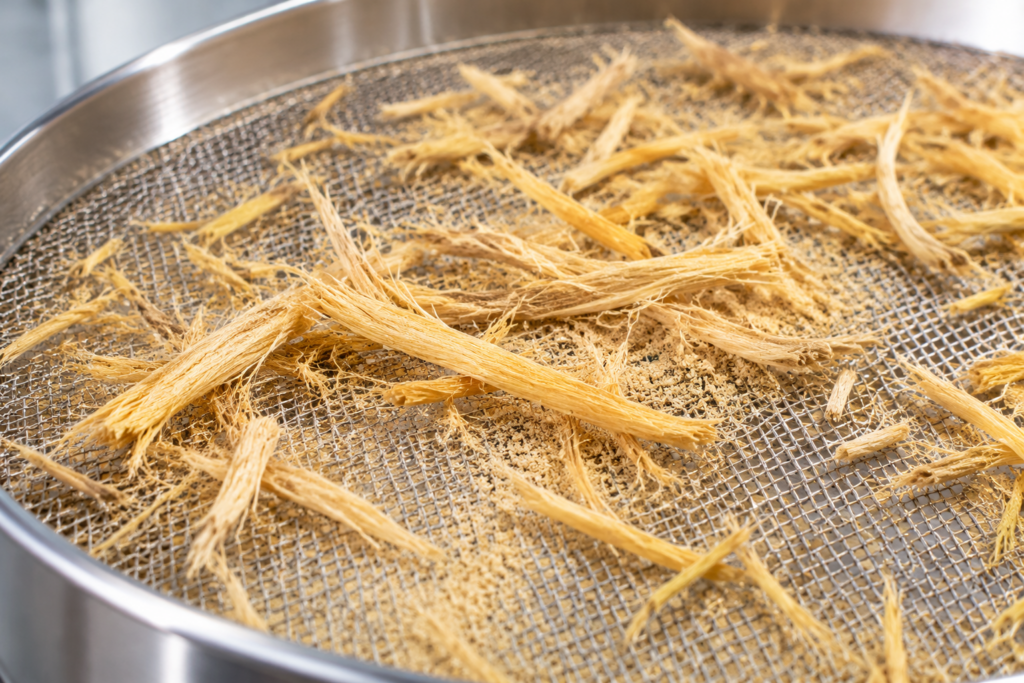
| High-fibre / tough | ginger, licorice, barley grass | 12–60 mesh | ACM above 60 mesh |
| High-fibre, budget-limited | same | 12–60 mesh, plus re-grinding | sifter + coarse return as a bridge |
11. FAQ
Can I get 80 mesh powder from an 80 mesh screen?
Only if the material cooperates. On salt or sugar, yes — easily. On ginger, an 80 mesh plate will give you a coarse powder and a lot of oversize. The screen sets the ceiling, the material sets what you actually reach.
How do I convert mesh to micron?
Use the standard sieve chart in section 2. Never convert a mill screen number with a formula — the relationship runs from 1.8× to 4.0× and is not linear. If a supplier quotes you a “mesh to micron factor”, ask them which mesh range it applies to.
Is a thinner screen better?
It has more open area, so it passes more powder per hour, and it wears out sooner. On abrasive or coarse feed, the thinner plate is usually the wrong trade.
Which screen material should I choose?
Stainless for food and for corrosion. Hardened or surface-treated plate where abrasion is the dominant wear mechanism. On very abrasive feed, the plate grade matters more than the thickness.
How often should a screen be changed?
There is no honest calendar answer. It depends on the material, the aperture and the feed cleanliness. What you can do is inspect on a schedule and watch the mill current — a rising trend at constant feed often means a partially blinded screen before anyone notices the powder.
Can you tell me which screen to buy for my material?
Send the material, the target mesh and the throughput. We will tell you two things: which aperture and plate to fit, and whether a screen mill is the right machine at all.
12. The chart is the easy part
Everything above fits on one page, and that page is worth more than any single number in it.
The reason buyers get this wrong is not carelessness. It is that two industries — laboratory sieving and machine building — use the same word for different things, and nobody puts the two tables side by side.
If you take one thing from this article: the screen number is a name, the aperture is the fact. Ask for the aperture in millimetres, and the conversation gets short and useful.
One question worth asking before you buy
Before you accept any quotation for a screen mill, ask this: which material did you size this screen for?
If the answer is “all of them”, the quotation is a guess. The same 80 mesh plate is right for salt, marginal for leaf, and wrong for ginger.
Send us your material and your target
If you are specifying a new machine — or trying to work out why the last one did not deliver what the catalogue promised — send us three things:
- the material — what it is, and how dry it is
- the mesh you need to hit — the grade your buyer actually specifies, not the finest number in the brochure
- the throughput — the kg per hour you need to produce
We will reply with the aperture and the plate we would fit, and with an honest answer to the bigger question: whether a screen mill is the right machine for that material at all. If it is not, we will tell you what we would use instead. That costs you nothing and can save you a machine.
Send us your material, target mesh and throughput →
Only want the chart? Ask for the PDF version and we will send the full table — mesh, aperture, plate thickness, and the material class each size suits. No obligation, and no sales call.