
A buyer in Lagos wants 100 mesh moringa leaf powder. A buyer in Cairo wants henna at 80. A third wants to know what he can sell — 40 mesh for tea bags, 120 for capsules, and whatever falls in between. And behind all three, a fourth kind of email: someone comparing leaf powder making machine prices on a marketplace listing, with no idea which of the four grades he actually needs.
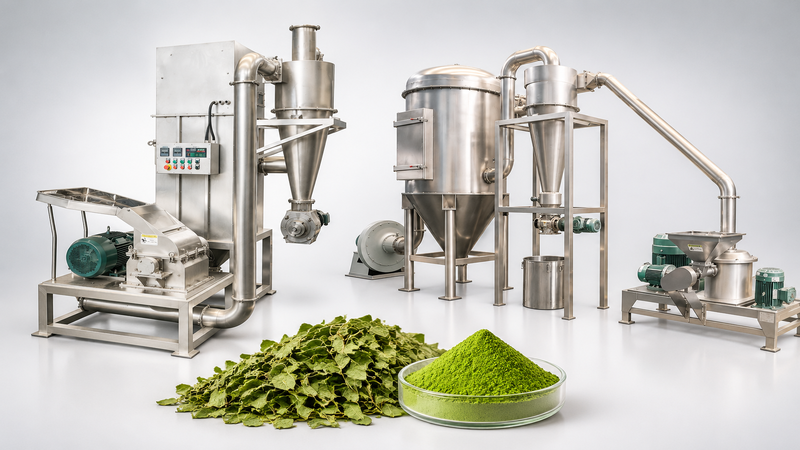
For a long time we answered all three the same way: a hammer mill to pre-crush, then an air classifier mill to take it to the target fineness. That is still the answer we believe in. It gives the tightest particle size distribution, the most stable output, and the least heat damage to a leaf that is mostly protein, chlorophyll and volatile oil.
It is also a two-machine line with two motors, two foundations and two spares lists. And a large share of the people who write to us are not building a factory. They are building a first production run in one room, with one generator, and a customer waiting.
So we now quote a second option. It is not as good. It is good enough to start — and nothing in it has to be thrown away later.
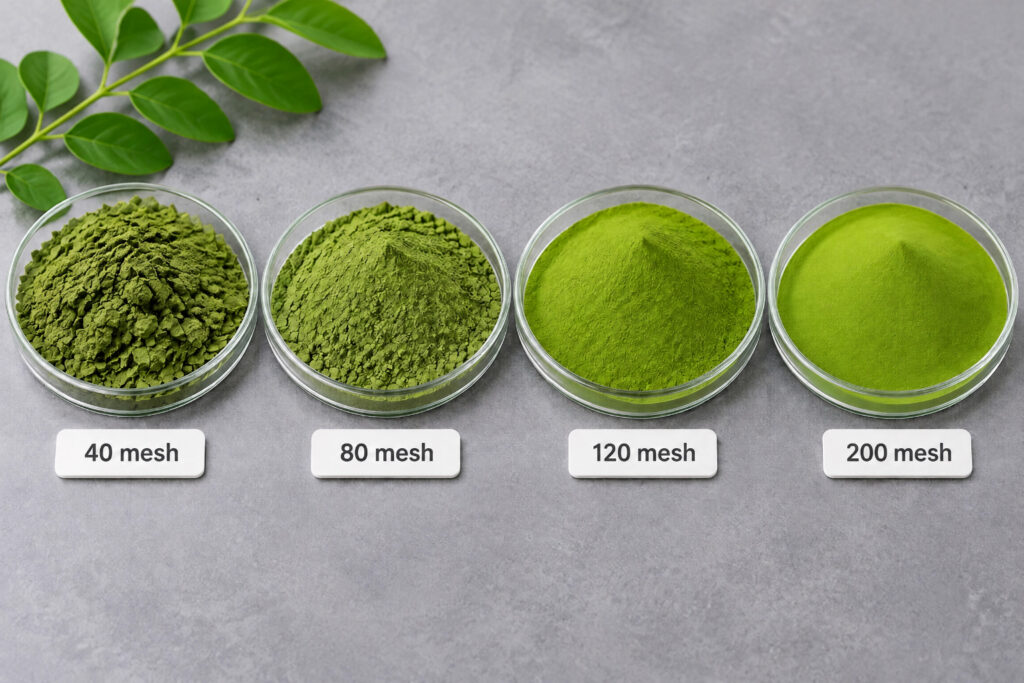
1. The mesh number is not a preference. It is a market.
Before talking about machines, it helps to separate what the four common requests actually buy.
| Target | What it is used for | What the buyer is really asking for |
| 40 mesh | Tea bags, traditional medicine packs, bulk blending | A clean cut with no dust — dust makes the bag cloudy and the pack look cheap |
| 80 mesh | Blended drinks, seasoning mixes, retail sachets | Even colour and no grit on the tongue |
| 120 mesh | Capsules, tablets, extracts, cosmetic clay blends | Smooth mouthfeel, good flow, no separation in the capsule |
| 200 mesh | Premium supplements, cosmetic grade, export contracts | A specification on paper, often audited by the buyer’s QC |
A leaf grinding machine that hits 200 mesh can obviously make 40. The reverse is not true, and that asymmetry is where most first-time buyers get stuck: they buy for the finest number they hope to sell one day, and then cannot run the machine they bought.
If your first orders are tea bags and sachets, you are buying 40 to 80 mesh. The 200 mesh contract may never arrive. Buy for the order you have.
2. Leaf is a difficult material, and it is difficult in a specific way
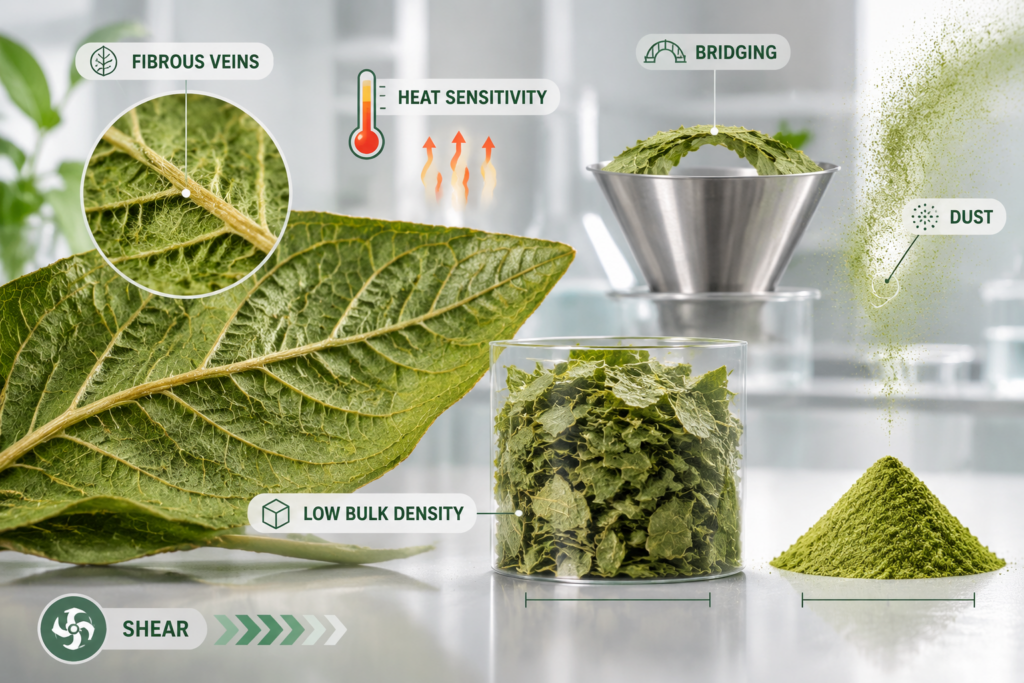
Every leaf inquiry — whether the buyer arrives searching for a moringa leaf grinding machine, a henna powder making machine or a plain leaf pulverizer machine — behaves the same way in a mill. Moringa, matcha, henna, cassia, neem, baobab:
- Light and fluffy. Bulk density is low, so a given volume of feed weighs almost nothing. The grinding chamber fills with air and light material long before it fills with work.
- Fibrous. A single impact does not break a leaf vein. It takes repeated shear, which means residence time, which means heat.
- Heat-sensitive. Chlorophyll darkens, volatile oil escapes, protein can denature. A powder that is chemically fine but heat-damaged is a rejected lot.
- Prone to bridging. Light material arches over the feed inlet instead of falling in. Output becomes uneven, and uneven feed shows up as uneven fineness.
- Dusty. Fine leaf powder is difficult to contain, and lost powder is lost product.
None of this is unusual. It is simply the reason a leaf line is not the same as a grain line.
3. The textbook answer: two machines
The configuration we recommend when the budget exists:
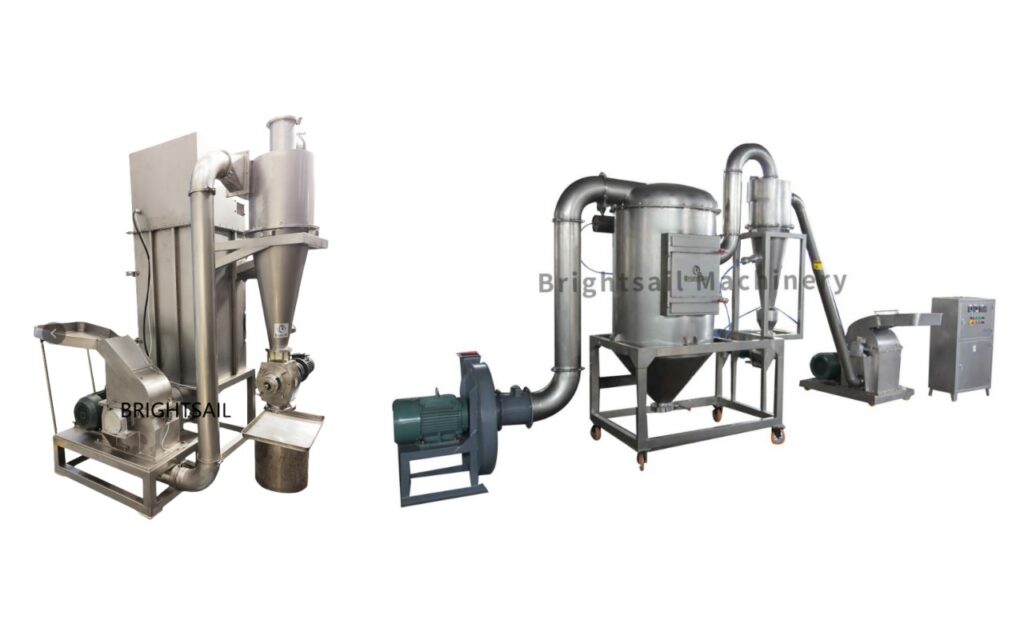
Hammer mill (coarse) → air classifier mill (fine)
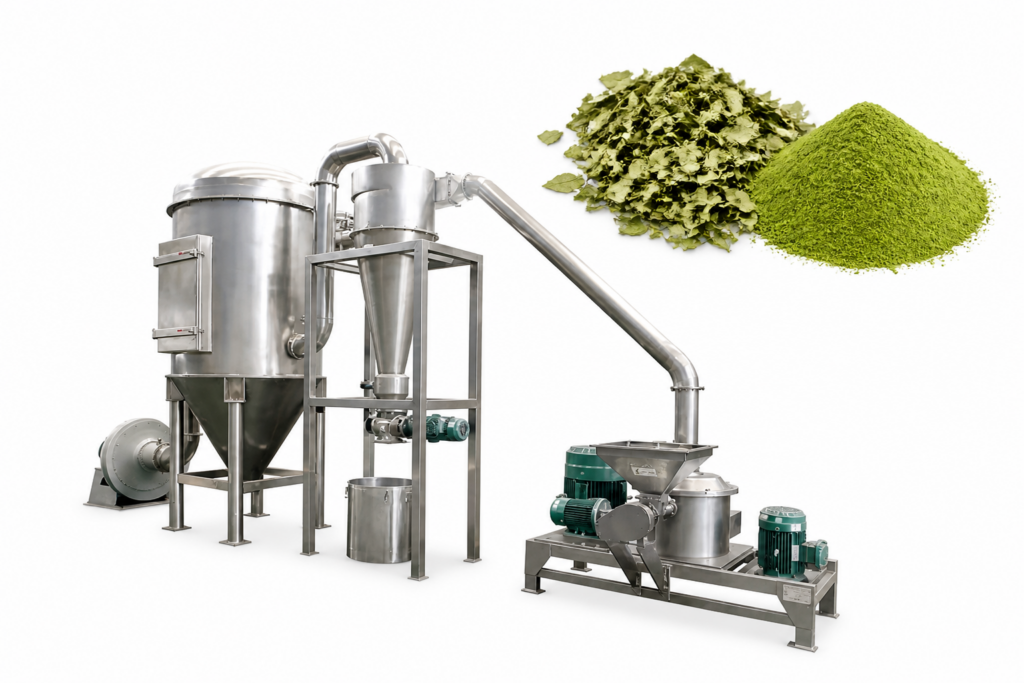
The hammer mill does not try to make powder. It takes whole or cut leaf down to roughly 40 mesh, which changes the material from fluffy and bridging into something dense and free-flowing. In search results this stage is often called a leaf crushing machine, which is a fair description — what comes out is a crush, not a powder. From there the air classifier mill can do its job: the classifier wheel sets the top size, and the powder leaves the chamber only if it is small enough to pass.
That arrangement solves all five problems in section 2 at once. The chamber is not filled with air. The classifier does the cut instead of a screen, so there is no screen to tear. Residence time is short, so the powder stays cooler. And the output holds a D97 you can put on a certificate.
It is also, honestly, a line for someone who already sells powder.
The version we are asked for most — and the one that costs the most to run
Some buyers do not want two machines at all. They want the air classifier mill on its own: one machine, one motor, one footprint, and in their reading, roughly half the money.
On dry leaf, that is the most expensive of the three configurations.
Leaf is fluffy. Its bulk density is low, so the same weight of feed occupies far more volume. Fed straight into a classifier mill, the grinding chamber fills with air and light material long before it fills with work. Three things follow, and they compound:
- The chamber is occupied by air rather than by material. A machine rated for a certain throughput spends much of its time circulating fluff instead of grinding leaf.
- Circulating load rises. Material that should have been reduced in one pass keeps going round, and every extra circuit adds heat. On a leaf that is mostly chlorophyll and volatile oil, heat is the damage you cannot undo.
- The machine runs below its rating. This is the part that never appears on a quotation: a large classifier mill fed whole leaf can end up producing what a much smaller machine would have produced — if that smaller machine had been fed properly.
Which is why the two-machine line is not an upsell. The hammer mill is cheap relative to what it protects. It converts fluffy leaf into dense, free-flowing material at around 40 mesh, and everything downstream improves because of it — throughput, fineness stability, powder temperature, moisture loss. That extra motor is not extra cost. It is what lets the expensive machine earn its price.
So the honest comparison is not “one machine versus two”. It is cost per kilo of powder that actually meets the specification. On dry leaf, the single classifier mill usually loses that comparison, because of all the output it never reaches.
4. Why a first-time producer refuses it
We hear the same three objections, and they are all rational:
“I cannot buy two machines.” Not stubbornness — capital. Two machines means roughly double the equipment budget before the first kilo is sold, and most first-time producers are financing this from savings or a small family loan.
“I cannot fit a machine that size.” A classifier mill needs its cyclone, ducting, fan and filter. It needs headroom. Many of our buyers are working in a rented unit where the ceiling is the limit.
“I cannot run it.” A classifier mill has a second motor and a classifier speed to set. That is a skill. A hammer mill is a motor and a screen.
There is a fourth reason nobody says out loud: if the 200 mesh order never comes, a two-machine line is a very expensive way to make tea-bag powder.
5. The budget route: one hammer mill, one sifter
The alternative does the same two jobs, but separates them in time instead of in equipment.
Hammer mill → vibrating sifter → fine product out, coarse back in
- The hammer mill grinds the leaf to the finest it can run continuously, with a screen in the chamber setting the top size.
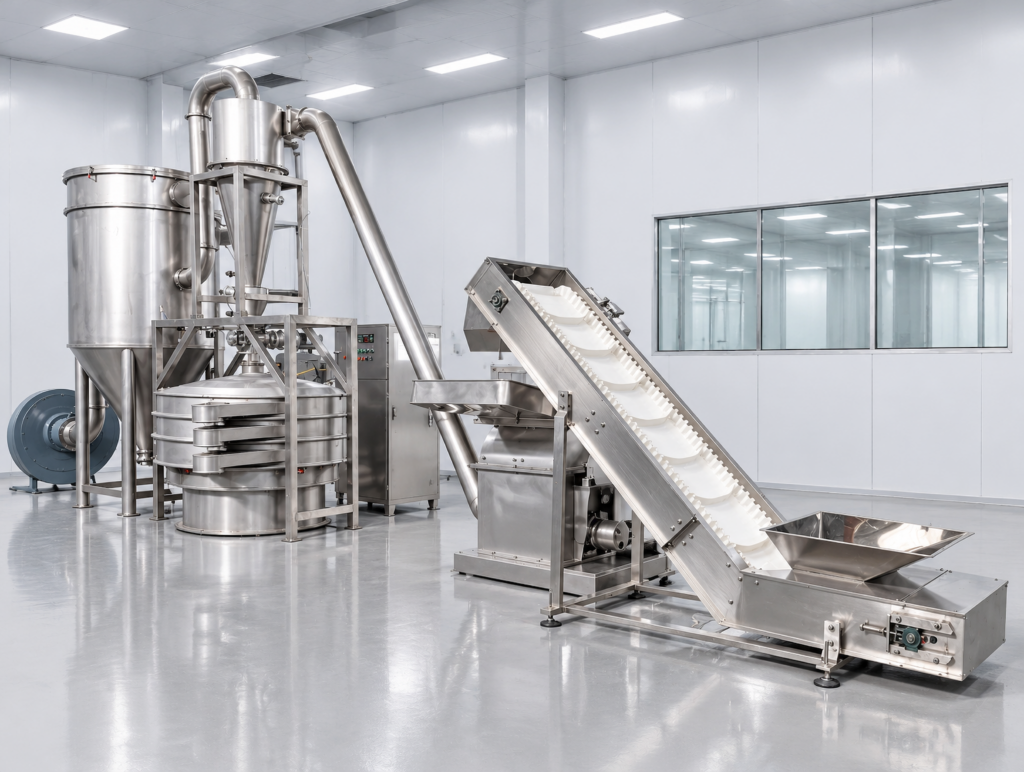
- The output goes to a vibrating sifter machine — often sold as a vibro sifter — a separate unit, usually small, round or linear, with one or two decks.
- What passes the sieve is finished product.
- What stays on the sieve is not waste. It goes back to the mill.
Two screens, two jobs. The hammer mill screen size inside the mill sets what leaves the mill; the sieve on the vibrating sifter machine decides what you sell. Confusing them is the most common commissioning problem on this route — a buyer orders a fine sieve, leaves a coarse screen in the mill, and then wonders why almost everything comes back as oversize.
The insight is simple: you do not need a classifier to make a cut. You need a cut. A sieve makes a cut too — it just makes it outside the machine instead of inside it, and it makes it in a batch rather than continuously.
For 40, 80 and 120 mesh work, that is enough to get product out of the door.
6. The number that makes this route work
This is the part that decides whether the route is sensible or a waste of labour.
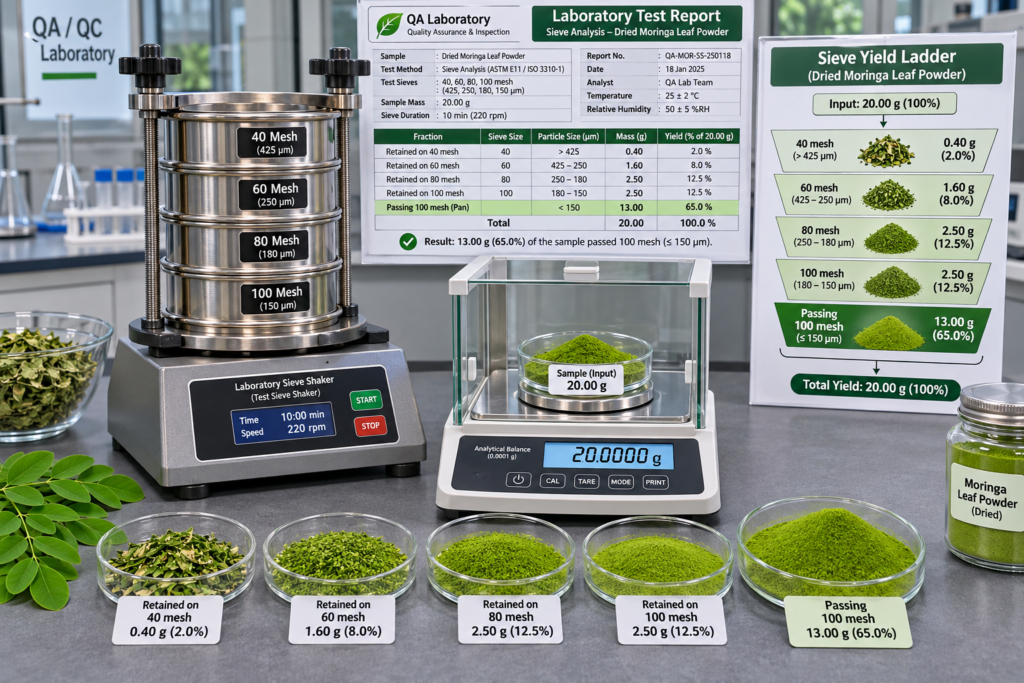
Here is the actual test. Dried moringa leaf, ground on our hammer mill — the dry leaf grinding machine most of our leaf customers start with — then a 20 g sample sieved through a stack of 40, 60, 80 and 100 mesh.
Our sieving test: dried moringa leaf powder from a hammer mill, 20 g sample. 13 g passed 100 mesh; 7 g was retained — 2 g on 40 mesh, 1 g on 60, 2 g on 80, 2 g on 100.
13 g of 20 g passed 100 mesh. That is a pass rate of about 65% at 100 mesh.
And because every fraction was weighed, the test gives you more than one number — it gives you the whole ladder:
| Cut-off | Passing | What it means for a buyer |
| 40 mesh | 90% | Almost the whole batch sells as tea-bag and pack grade; almost nothing to re-grind |
| 60 mesh | 85% | Still a very comfortable yield for retail sachets |
| 80 mesh | 75% | One quarter goes back to the mill — manageable, plan for it |
| 100 mesh | 65% | One third re-grinds; this is the practical limit of the single pass |
| 120 mesh | not covered by this test | Expect materially less than 65% — measure before you promise it |
That ladder is the commercial argument for the whole route. The same mill, the same powder, four different products — the sieve alone decides which one you are selling, and the table tells you what each choice costs you in yield.
If only 20% passed, you would be grinding four kilos to sell one, and the labour and power would eat the margin. At 65% and above, you are selling most of what you mill on the first pass, and the rest is a re-grind, not a loss.
Three cautions on the figure:
- It is a bench sample. 20 g, sieved by hand. A production run moves with moisture, feed rate and screen condition. Treat 65% as the right order of magnitude, not a contract figure.
- It is material-specific. This is moringa leaf. Henna leaf behaves differently, and stem content raises the oversize fraction quickly — which is why buyers who tip whole branches into the mill get a worse ratio than buyers who feed leaf only.
- It is screen-specific. A coarser screen in the hammer mill pushes more material into the oversize fraction. The numbers above belong to a configuration, not to the machine family.
Ask us for the test on your own material before you size a sifter around a number from a blog.
7. The 30–40% that does not pass
Here is where most budget lines are actually lost — not in the grinding, in the handling.
If the oversize is carried back by hand, three things happen. It sits in a bag and waits. It gets fed at a different rate than fresh material, so the mill runs unevenly. And in a dusty room, some of it simply disappears.
The fix is mechanical, not technical: a vacuum loader that picks up the oversize from the sifter outlet and returns it to the mill inlet, at a steady rate, sealed.
We recommend it once you are handling a few hundred kilos an hour. At that rate the coarse return stops being an occasional bucket and becomes a continuous job: someone is carrying powder for a real part of the shift, and the mill is being fed in surges instead of at a steady rate. Both of those show up in the powder.
Below a few hundred kilos an hour, a bucket is cheaper, and you should not buy the loader. Above it, the labour and the uneven feed cost more than the loader does.
A loader does three things at once:
- it closes the loop, so oversize re-enters the mill at a constant rate instead of in surges
- it removes the dust that escapes every time a bag is tipped
- it removes the labour cost that quietly makes the “cheap” route expensive
It is also the one part of this line that transfers directly to the two-machine upgrade later. Nothing is wasted.
8. Choose the sieve for the order, not for the spec sheet
The most common mistake we see in this route is a buyer who installs a 120 mesh sieve because 120 sounds better than 80, and then finds that most of the output goes back to the mill.
The sieve is a business decision, and section 6 turns it into arithmetic:
- If you sell tea bags and packs, 40 to 60 mesh is the product. At 40 mesh you keep 90% of the batch — a finer sieve costs you yield and buys nothing the customer can see.
- If you sell retail sachets, 80 mesh at 75% is the sweet spot: fine enough to look premium, coarse enough that a quarter, not a third, goes back to the mill.
- If you sell capsules and extracts, 100 mesh at 65% is the product, and that 35% re-grind is a cost you should price in rather than discover.
- If a customer asks for 200 mesh, this route is the wrong route. See the next section.
Match the sieve to the coarsest specification you have actually been paid for, not the finest one you have been asked about.
9. Where this route stops
We are not going to pretend the sifter replaces a classifier mill.
In practice, we see the hammer mill plus sifter route being used up to roughly 120 mesh on leaf material. Beyond that, three things happen together: the pass rate falls, the re-grind load rises, and the powder that does pass is not consistent enough for a buyer who measures D97.
At 200 mesh, the answer changes completely. An air classifier mill is not the premium option here — it is the only option.
There is no hammer mill and sieve configuration that will hold 200 mesh in production at a yield that leaves a margin. The pass rate collapses, and whatever does pass is not consistent enough for a buyer who measures D97. A sieve can classify at 200 mesh in a laboratory; it cannot carry a production order at 200 mesh at a cost that makes sense.
So when a customer needs very fine powder — 200 mesh and beyond — the air classifier mill is not something we recommend when the budget happens to allow it. It is the route. The single-machine budget path ends at roughly 120 mesh, and we would rather say that plainly than sell a sifter that cannot deliver the specification.
If a buyer insists on one machine and 200 mesh at the same time, that conversation needs to happen before the purchase, not after.
10. And you cannot check 200 mesh with a sieve
There is a second reason this route ends where it does, and it is easy to miss: at that fineness, a sieve cannot verify the result either.
200 mesh is roughly a 74 µm aperture. Fine leaf powder at that size blinds the mesh, agglomerates into soft lumps that behave like coarse particles, and carries static. The number you get depends on how long you shake and how hard you tap — two operators can sieve the same powder and report different results.
So a 200 mesh figure on a certificate does not come from a sieve. It comes from a laser particle size analyzer, which reports a distribution — D10, D50, D97 — instead of a single pass-or-fail number. That is also what an export buyer’s QC department will use, and very often it is the method written into the contract.
Which means going to 200 mesh is two commitments, not one. You buy an air classifier mill to make the powder, and you adopt a measurement method to defend it. A producer who cannot measure D97 is not really selling 200 mesh — he is selling whatever passes his sieve on the day, and the first disagreeing lab report will end the relationship.
11. The upgrade path, and why nothing is thrown away
The reason we are comfortable recommending the budget route is that it is a stage, not a dead end.
When the volume justifies it, the buyer adds an air classifier mill downstream of the existing hammer mill, and the sifter either moves to a final safety check or is retired. The hammer mill, the loader, the ducting and the electrical work all stay.
That is the same two-machine line from section 3 — reached in two payments instead of one, with revenue in between.
The mistake is the opposite: buying a large classifier mill before there is an order book, and then running it at a fraction of its capacity, which is the most expensive way to make powder there is.
12. What you give up
To be fair to the people who will choose the two-machine line anyway:
| Air classifier mill alone | Hammer mill + sifter | Hammer mill + air classifier mill | |
| Capital | Looks lowest on a one-line quotation | Lower — one mill, one sifter | Higher — two machines, ducting, filter |
| Footprint | Smallest on paper, still needs headroom | Smaller, but the sifter needs floor area and access | Larger, needs headroom for cyclone and ducting |
| Operator skill | Higher — a classifier speed to set and hold | Lower | Higher — a classifier speed to set and hold |
| Output consistency | Poor on fluffy leaf — the chamber fills with air | Batch-classified, varies with feed and sieve condition | Continuous, holds a D97 |
| Best fineness band | Fine, but only if fed properly | 40–120 mesh | Fine to very fine, including 200 mesh and beyond |
| Labour | Lower | Higher — unless a loader closes the loop | Lower |
| Upgrade | Add a hammer mill later — the machine itself is unchanged | Add the classifier later | None needed |
The sifter route is a compromise. It is a good compromise when the alternative is not starting.
13. FAQ
Can one machine make 200 mesh leaf powder?
Not in a form we would put on a certificate for a production order. Small batches, yes. Continuous production with a stable D97 at that fineness, no.
For 200 mesh the air classifier mill is not an upgrade — it is the only machine that will hold that specification in production. This is the one point in this article where we will not offer a cheaper alternative, because there isn’t one.
Can I check 200 mesh myself with a sieve?
No, and this catches people out. At 200 mesh the sieve blinds, the powder agglomerates into soft lumps that read as coarse, and the result depends on how long and how hard you shake. 200 mesh is checked with a laser particle size analyzer, which reports D10 / D50 / D97 rather than a pass-or-fail figure. Agree the method with your buyer before the order — their QC will use one too, and two different methods will not agree.
Can I run the classifier mill on its own, without a hammer mill?
You can, and on dense or already-sized material it works well. On dry leaf it is the weakest of the three options: fluffy feed fills the chamber with air, circulating load climbs, and a large machine ends up delivering less than its rating while running hotter. If the budget only stretches to one machine, hammer mill plus sifter (section 5) will usually give you more saleable powder per dollar than a classifier mill fed whole leaf.
Is the 65% pass rate guaranteed?
No. It is one bench test: 20 g of dried moringa leaf, sieved at 100 mesh, 13 g passing. Stem content, moisture and the hammer mill screen all move it, and henna is not moringa. We will test your material before you commit to a sieve size.
Which is cheaper to run, sifter or classifier?
Per kilo of finished powder, the classifier mill is usually cheaper once volume is high, because it does not re-grind 30–40% of the output. At low volume, the sifter wins because the capital and the maintenance are smaller. The crossover depends on your volume and your power cost — this is a calculation, not an opinion.
Do I need the vacuum loader from day one?
No. Start without it if volume is small. Add it when someone is spending a significant part of the shift carrying powder, or when dust in the room becomes a problem.
Can I use the same hammer mill for moringa and henna?
Yes. Both are dried leaf. What changes is the screen, the sieve and the target fineness. The same unit fills a moringa leaf powder machine order and a henna powder making machine order — which is useful if you sell both.
Will the sifter handle sticky or high-oil leaf?
Leaf is usually low-oil, so this is rarely the constraint. If your material is high-moisture or has been stored badly, dry it first — a sifter will blind quickly on damp powder.
Can I add the classifier mill later to the same frame?
The hammer mill and loader carry over. The sifter is usually retired or kept as a final check. Plan the layout with the future classifier in mind — that costs nothing at the design stage and a lot afterwards.
14. If you are at the decision point
Tell us three things: the material, the mesh you are actually being paid for, and the kilos per hour you need.
We will tell you which of the two routes fits, and if the answer is the cheaper one, we will say so. We will also tell you where that route stops for your material, because a line that has to be replaced in eight months is not a saving.
And if 200 mesh is your product, put it in the first line. That answer is the air classifier mill — no sieve changes it, and we would rather tell you at the quotation stage than after the machine is on your floor.
If you want the data rather than the argument, send a sample. We will run it and send you the particle size distribution — measured on your leaf, at your target, not on a brochure.