
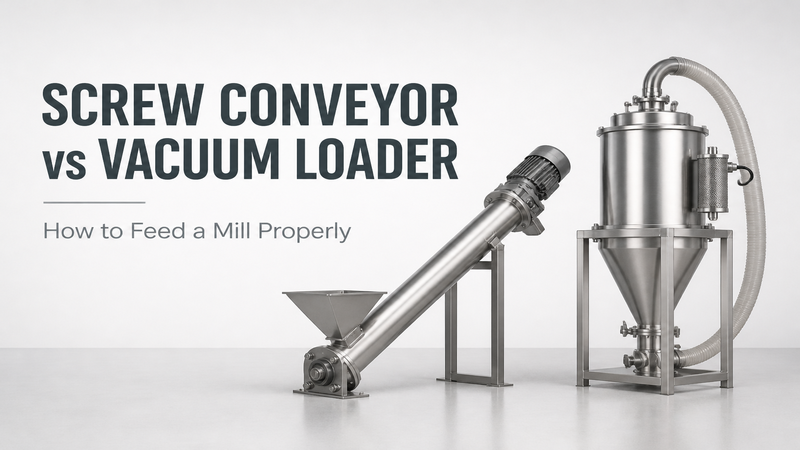
A question we hear often, right after a customer has chosen a mill: do I need a feeding machine, or can I pour the material in by hand?
The honest answer is that it depends — and not only on the price of the feeder.
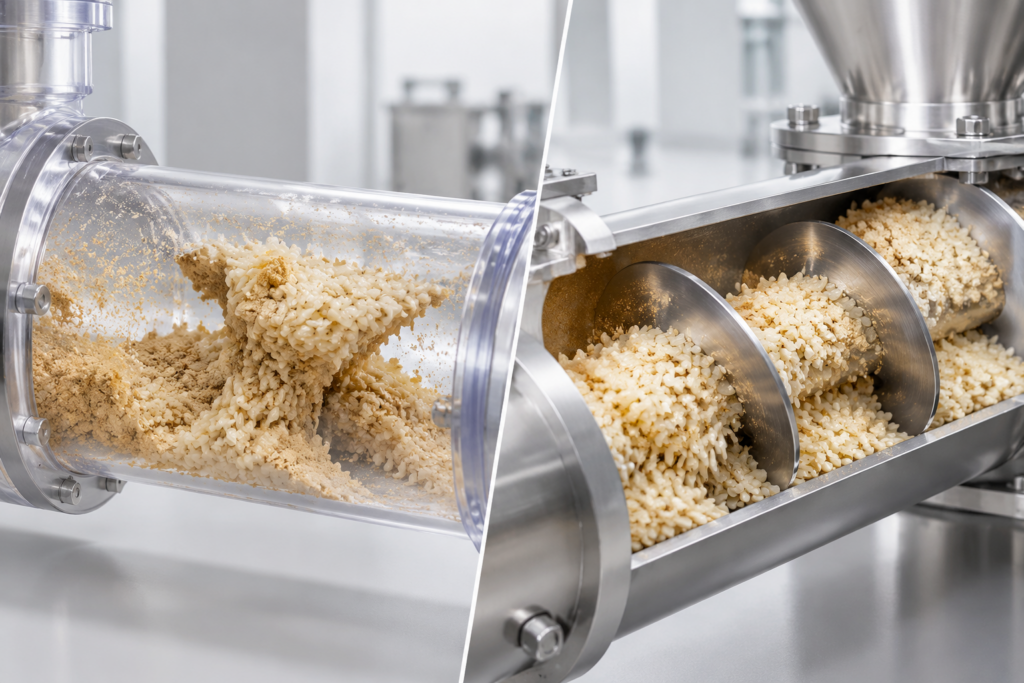
We have one customer who grinds rice that has been soaked and drained before milling. For him a vacuum loader is not an option at any price: the grain is wet, and it sticks to itself and to the pipe. Another customer has his mill on the second floor and the material on the ground. For him the screw conveyor is the awkward choice, because two to three metres of lift is already a long screw.
Same question, opposite answers. What separates them is three things: whether the layout will change, how high the material has to go, and whether the material flows freely on its own.
This article takes those three in order.
1. Two feeders, two different problems
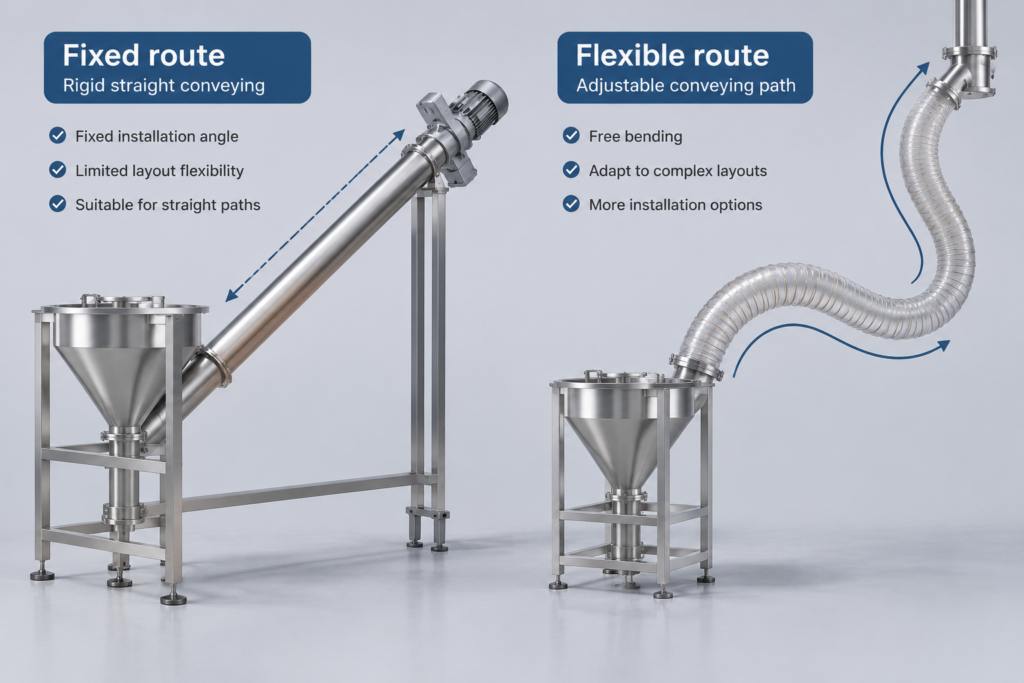
A screw feeder solves a known path. Material enters here, travels at this angle, arrives there. You decide the route once, and the machine follows it.
A vacuum loader solves an unknown path — or a path that will change. Material is picked up where it is, carried through a hose, and dropped where you need it. The route is soft, adjustable, and it can go up.
That is the whole distinction. Everything else follows from it.
| Screw conveyor | Vacuum loader | |
| Path | Fixed at order | Adjustable |
| Direction | Mostly horizontal, limited lift | Any direction, including up |
| If the mill moves later | Rebuild the feeder | Move the hose |
| Material tolerance | Wide | Narrow — cohesion and oil are a problem |
| Footprint | Grows with length and lift | A small skid on the floor, plus hose |
Physically, the difference is bigger than most people expect.
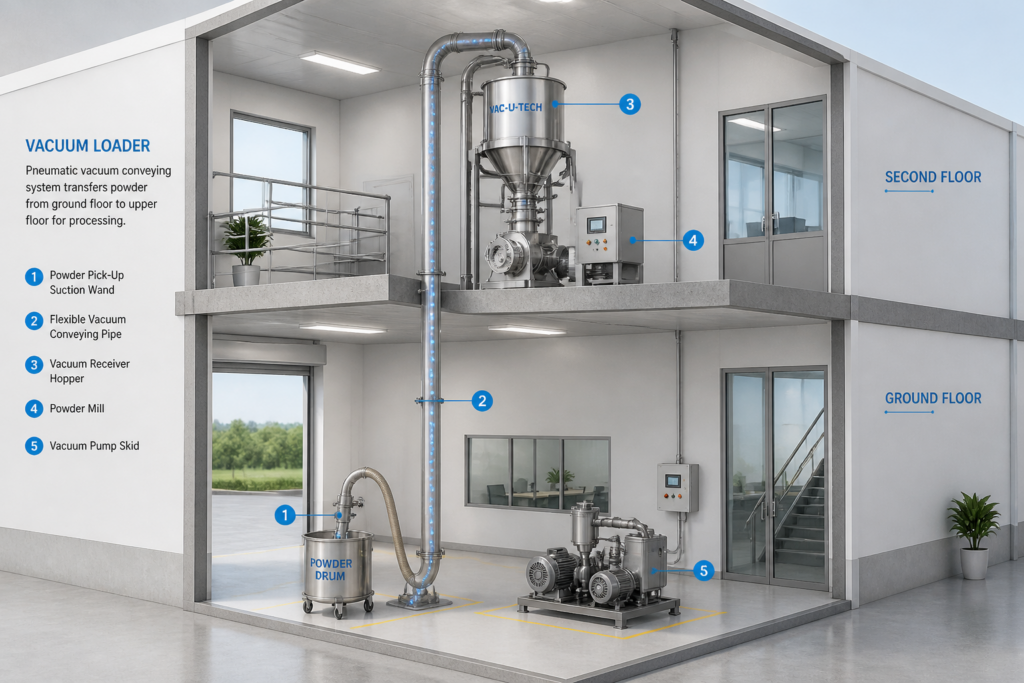
A vacuum loader is not a large machine standing in the room. What sits on the floor is a small skid — a Roots blower and the electrical controls — and that is all. The working parts are the receiver at the discharge end and the hose between them. In a building where a screw cannot be routed, that small footprint is usually what decides the project.
2. Why the screw is the default
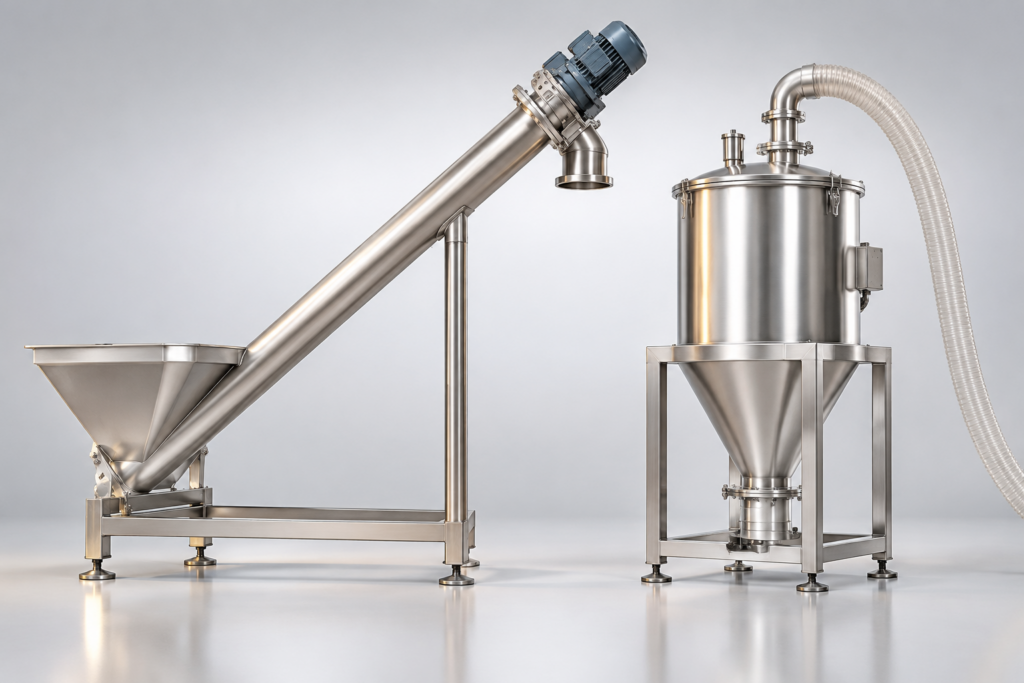
Ask ten buyers what a feeder looks like and nine will describe a screw. That is not an accident: for most installations it is the right answer, and it is the cheapest one to build.
A screw is simple in the way that matters. No air, no filter, no vacuum pump, no seals to fail. It pushes material through a tube with a turning flight, and if the material can be pushed, it works.
Three conditions have to hold, though, and buyers rarely check them before ordering:
- The layout is final. The inlet, the outlet, the angle and the lift are all built into that specific screw.
- The material flows. A screw tolerates sticky material better than air does, but it is not a conveyor for paste.
- The lift is modest. More on this in section 6, because it is the number that decides most projects.
Get those three right and you will never think about the feeder again. Get them wrong and you will rebuild it.
3. When the vacuum loader is the right answer
Three situations come up again and again. In all of them, the screw is not a bad machine — it is simply the wrong shape for the job.
The machine position is not settled, or the machine will move. A buyer who is still fitting out a building, or who expects to add a second mill next year, should not lock the feeder to a drawing today. A vacuum loader is a hose and a receiver: the mill can be moved, and the hose comes with it. A screw cannot. It was made for one layout and one layout only.
The mill is upstairs and the material is downstairs. This is the classic case, and it is where the numbers separate cleanly. A screw lift of two to three metres is already a long screw; a floor-to-floor height is more than that. So the moment the mill sits on an upper floor, the screw stops being sensible and the vacuum becomes the default. Going up several floors is not a problem for a vacuum system — we have installed them across multiple levels.
The material has to come from more than one place. A single mill fed from two or three different bins, or from a drum that gets wheeled around, is awkward for a fixed screw and easy for a hose. (If this is your case, tell us — it changes the sizing more than the choice of machine.)
In each of these, you are paying for flexibility. You are not paying for a better conveyor.
4. Large capacity, long distance: add a rotary valve
Air conveying is not a steady stream. It arrives in pulses — a slug of material, then air, then another slug. At small capacity nobody notices. At scale, the pulse becomes the problem: the discharge rate at the receiving end swings, dosing drifts, and anything downstream inherits the rhythm.
The fix is mechanical, and it is easy to leave out of a quotation: fit a rotary valve under the vacuum hopper.
The valve turns at a controlled speed and converts the pulsing arrival into an even discharge. Two things improve at once — the discharge gets faster, and it gets steadier.
We recommend it in two situations:
- When throughput is measured in tonnes per hour. At that scale the pulse has enough mass behind it to disturb everything downstream.
- When the conveying distance is long. Distance accumulates the pulse: by the end of a long run — we have built installations at 50 m — the surges are more pronounced than they were at the pick-up point, and the receiving end sees the worst of it.
If either applies to your project, ask for the rotary valve explicitly. It is a small component relative to the mill, and its absence is usually discovered in production rather than in commissioning.
5. Where the vacuum loader gives up
A vacuum loader moves material with air. That means it needs the material to behave like separate particles long enough to be carried.
Some materials do not. The pattern is consistent:
- Rice that is half dry. Not wet enough to be a slurry, not dry enough to flow. The surface still holds water, and the grains bind under pressure.
- Materials with high oil content. The oil films the particle surface and everything starts to stick — to the pipe, to the filter, to itself.
- Materials with high sugar or high moisture. Sugar turns tacky with a little moisture, and tacky means bridging in the hopper and blocking in the line.
The common factor is surface cohesion. If particles stick to each other before they are asked to move, air will not separate them.
The customer from the opening is the extreme version of that list. Rice that has been soaked and drained is wet on the surface of every grain, so the grains bind to each other and to the pipe wall, and the material arrives as lumps rather than particles.
On that feed a vacuum loader is not a marginal choice — it is the wrong machine. The screw carries it, because it pushes instead of lifting, and pushing does not require the material to behave like dust.
A screw conveyor is more forgiving here, because it does not rely on the material being airborne. It pushes. A screw will handle a much wider range of awkward material than a vacuum ever will — which is why the screw is still the default even in plants that could afford either.
If your material is in the list above, this section is the answer to the whole article: do not buy a vacuum loader to solve a flowability problem. It will not.
6. Where the screw gives up
The screw’s limit is not material. It is geometry, and it arrives sooner than most buyers expect.
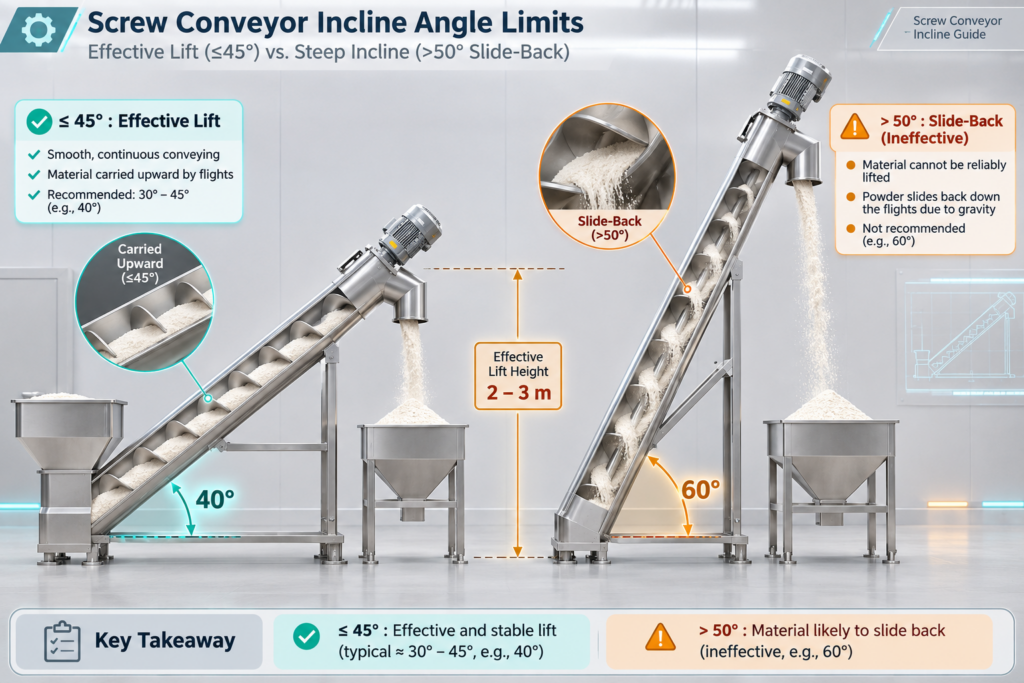
A lift of two to three metres is already a lot. Beyond that the screw has to be built long, and a long screw means a long machine on your floor: more footprint, more structure to support it, more to clean, and a price that stops looking cheap.
So the practical rule is simple:
- Under 2–3 m of lift: the screw is the right answer, and the vacuum is extra money for nothing.
- Above 2–3 m: we recommend the vacuum loader. Not because it conveys better, but because the screw at that height becomes a piece of structural engineering.
Keep the incline under 50 degrees. Past that point the material starts to slide back down the flight instead of being carried up, and the same screw moves less powder for the same motor. If your drawing needs a steeper angle to reach the hopper, that is usually a sign the mill should move — or that the vacuum is the better answer.
The second limit is the layout. Every screw is made for one geometry — inlet position, outlet position, incline, lift. If any of those changes after the machine is built, the feeder is scrap. That is the real price of “cheap”: you are betting that today’s layout is still the layout in three years.
This is why we ask for a drawing before quoting a screw, and why a buyer who cannot draw the room yet should be looking at a vacuum instead.
7. The third option: no feeder at all
Some buyers — especially those who have just bought a small mill — decide to skip the feeder and load the hopper by hand.
It is not unreasonable. For a small machine and short runs, a person with a scoop is cheaper than any conveyor, and it works.
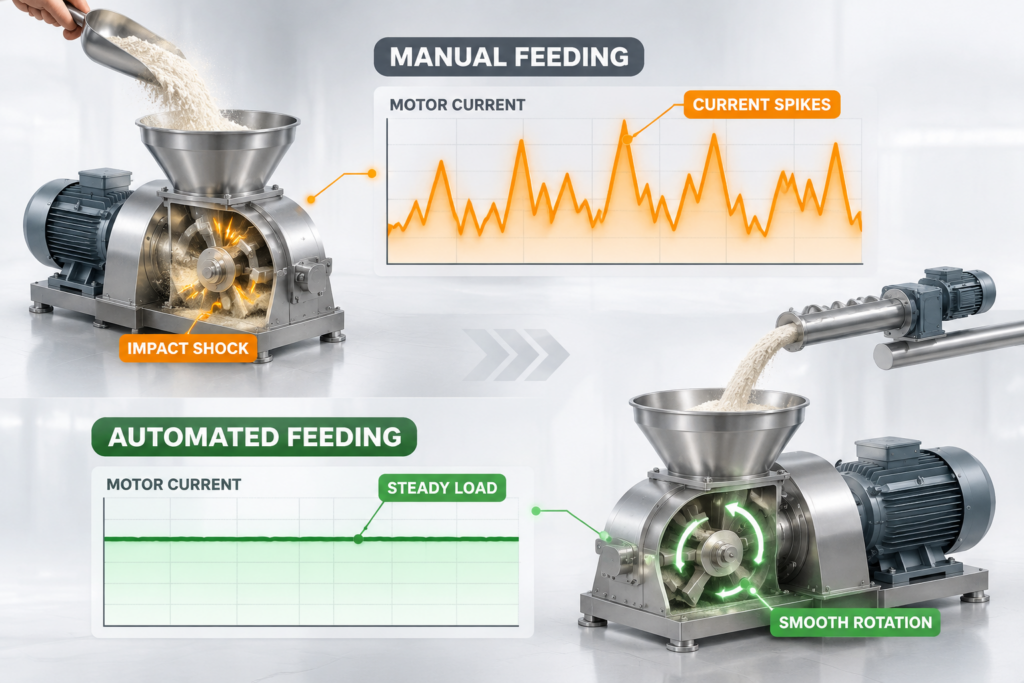
The cost is not the labour. It is the rhythm.
Hand feeding is uneven by nature: a full scoop, a gap, then two fast ones. The mill responds immediately — motor current swings with every change in feed rate. That swing does three things:
- It loads the motor with repeated peaks, which is the kind of duty that shortens motor life.
- It puts peak impact on the blades, because a slug of material hits a rotor that was running light a second earlier.
- It changes the residence time in the chamber, so the powder coming out is not the same powder minute to minute.
None of this shows up on the first day. It shows up as a motor that runs hot, blades that fail earlier than expected, and a fineness that drifts through the shift.
If you are feeding by hand today and the machine is running fine, you are probably at a small enough scale that it does not matter yet. The moment you go to a second shift, or a bigger mill, the feeder stops being an accessory and becomes part of the process.
8. The decision, in one table
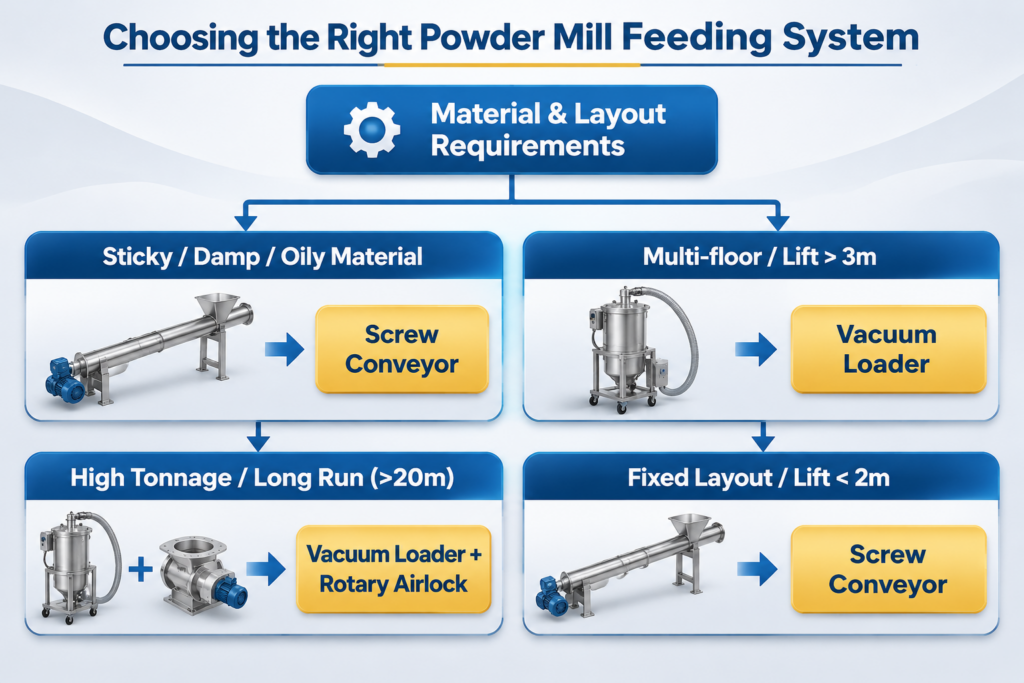
| If this is true | Then |
| The layout is not final, or the mill may move | vacuum loader |
| The mill is upstairs, or the lift is over 2–3 m | vacuum loader |
| Throughput is in tonnes per hour | vacuum loader with a rotary valve |
| The conveying run is long | vacuum loader with a rotary valve |
| Material is damp (even soaked), oily or sugary | screw conveyor — a vacuum will block |
| Small mill, short runs, one operator | manual is acceptable, with the caveats in section 7 |
| None of the above | screw conveyor |
Two rows deserve emphasis, because they are where money gets wasted.
A vacuum loader will not fix a material that does not flow. If your material is on the sticky list, the answer is a screw, regardless of how convenient a hose would be.
A screw conveyor is not flexible, whatever the quotation implies. If you cannot commit to the layout, the money you save on the screw is money you will spend again.
A note on the vacuum side
A screw conveyor is close to a catalogue item. Pick a diameter, a length, an incline and a motor, and what you get is predictable.
A vacuum loader is not. Throughput, pipe diameter, air velocity, filter area, receiver volume, the rotary valve and the route of every bend all interact — and they interact differently for a light fluffy powder than for a dense one. The same “two tonnes per hour” can be a compact unit or a much larger system, depending on how far it has to travel and what the material does in the air.
That is why we do not quote a vacuum loader from a description. We need the material, the distance, the height and the layout, and an engineer checks the combination before anything is confirmed. On the screw side a quotation is usually final. On the vacuum side it is a starting point.
9. FAQ
How high can a screw conveyor lift?
Two to three metres is already a long screw. Above that the machine becomes large and awkward, and we would quote a vacuum loader instead.
How far can a vacuum loader convey?
There is no single figure — it depends on the material, the pipe diameter, the number of bends and the pressure the system can hold. We have built systems that convey 50 m. But distance is not a number you can read off a table: send us the route on a sketch and we will check it against the material. Anyone quoting a distance without knowing the material is guessing.
How high can a vacuum loader lift?
Several floors. Height is far less of a constraint than it is for a screw — we have installed systems running up through multiple levels. The real limits are the pressure the system can hold, the number of bends and how the material behaves in the air, not the height by itself.
My material is sticky. Which one should I buy?
A screw. Damp rice, oily powders and anything with high sugar or moisture will bridge in a hopper and block a line. Mechanical pushing handles that far better than air.
Do I need the rotary valve?
If you are moving tonnes per hour, or conveying over a long distance, yes. It converts the pulsing arrival of air conveying into an even discharge. Below that scale it is optional.
Can I use both on one line?
Yes, and it is common on larger plants: a vacuum loader to bring material across the building, a short screw to meter it into the mill. The mistake is using a screw for the long flexible run and a vacuum for the sticky material.
10. Feed it the way the mill wants to be fed
The feeder is the part of a powder line nobody photographs. It is also the part that decides whether the mill you spent three weeks choosing runs like the machine you were promised.
So, back to the three questions:
- Will this layout still be the layout in three years?
- How high does the material have to go?
- Does the material flow?
Yes, low, yes — a screw conveyor is the right machine, and the cheapest one. Open layout or a lift above two to three metres — the vacuum loader earns its money. Wet, oily or sugary material — the screw wins regardless of height. And if the scale is still small, a scoop and one careful operator will beat both on cost.
What we would rather not do is sell you a vacuum loader to fix what is really a hopper design problem, or a screw for a building you are about to rearrange.
Send us the room.
A photo or a rough sketch — where the material sits, where the mill sits, the height between them — plus the material and the kg per hour. An engineer will look at the route and tell you whether a screw fits, where it would have to run, and whether a vacuum is the only option at that height.
Already fighting a feeder?
Tell us what the material is and how wet or oily it is. Sometimes the fix is a different feeder. Sometimes it is a different hopper, and you don’t need to buy anything from us.