
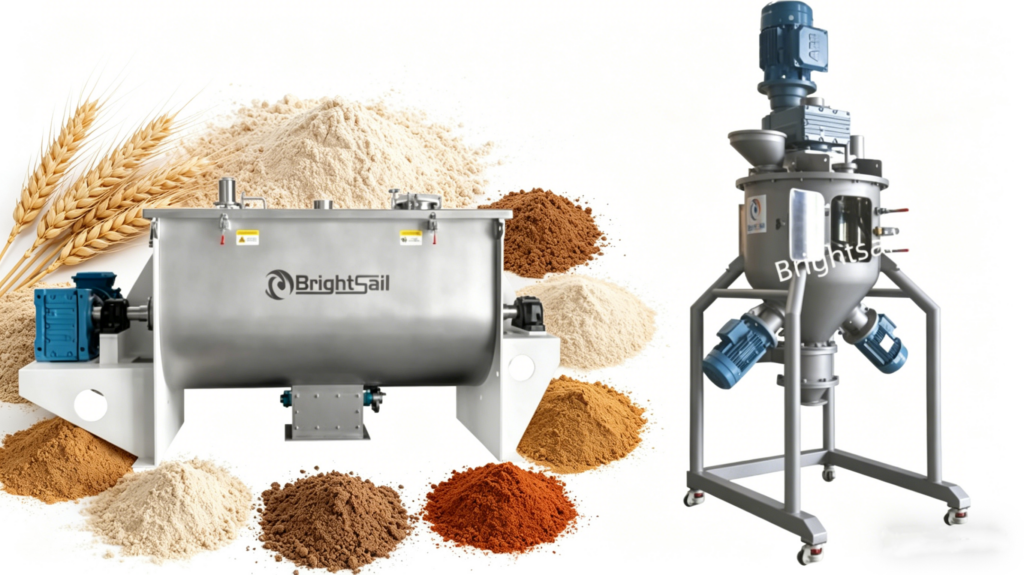
In the powder processing industry, ribbon mixers are widely used in food, pharmaceutical, chemical and other fields for their efficient mixing performance. However, many customers are confused when choosing between vertical ribbon mixers and horizontal ribbon mixers—what are their core differences? Which one is more suitable for their production needs? It should be noted that vertical ribbon mixers, also known as vertical cone mixers, powder blenders, conical mixers or vertical single shaft ribbon blenders, have unique advantages that are often overlooked. This blog will comprehensively analyze the differences between the two types of mixers, supplemented by practical application details and our own equipment advantages, to help you make accurate selection decisions and maximize production value.

I. Industry Background: The Underrated Value of Vertical Ribbon Mixers
Ribbon mixers have been widely used in the food and health product industries, but there is still a certain information gap in the market: although horizontal ribbon mixers are more well-known and widely used, many users in the food and health product industries do not know that vertical ribbon mixers (also called vertical cone mixer) exist, let alone their unique advantages in small-batch, high-hygiene and high-value-added product mixing. This information gap has led many customers to miss a more suitable mixing solution for their own production needs.
It is worth noting that although both vertical and horizontal ribbon mixers belong to the category of ribbon mixers, their structural design, application scenarios and cost performance are quite different. Especially for customers who focus on high-value-added products, choosing the right type of mixer can not only ensure product quality but also reduce unnecessary production costs and improve production efficiency.

II. Core Differences Between Vertical and Horizontal Ribbon Mixers
To help you better distinguish the two types of mixers, we have sorted out the key differences from the aspects of structural design, mixing principle, application scenarios and other core dimensions, and combined with practical cases to make the comparison more intuitive:
1. Structural Design & Discharge Residue
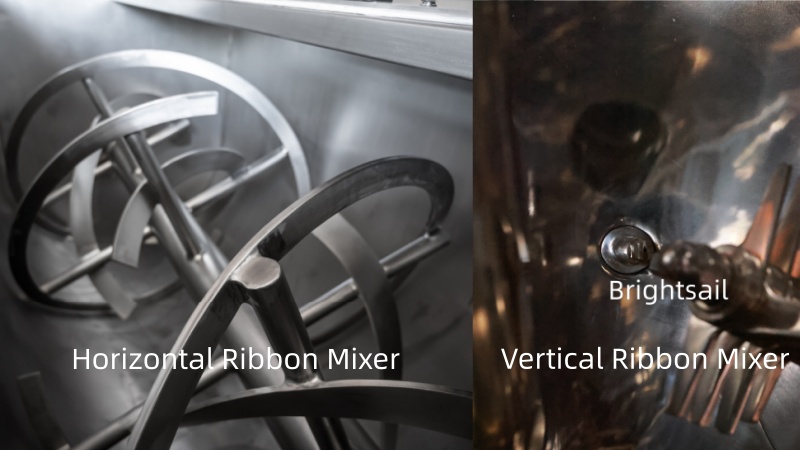
It should be emphasized that the traditional horizontal ribbon mixer has a gap between the mixing blades and the bottom—this is an inherent design feature of traditional horizontal ribbon mixers. For traditional horizontal ribbon mixers, a small gap between the mixing blades and the bottom is unavoidable. This design is to prevent friction between the rotating blades and the bottom wall of the mixer, which would otherwise cause severe wear to both the blades and the wall, thereby shortening the service life of the equipment. However, this inherent gap also brings an inevitable problem: it is impossible to discharge the material completely cleanly. It is easy to imagine that after each batch of mixing, a small amount of material will remain in the gap between the blades and the bottom of the traditional horizontal ribbon mixer, which is a common and unavoidable issue specific to this type of mixer. In contrast, our vertical ribbon mixer—also referred to as a conical mixer or Vertical single shaft ribbon blender—adopts a special structural design, which minimizes the gap between the blades and the bottom, effectively reducing material residue to a minimum.
Due to the different structural designs, the residual amount of the two types of mixers is quite different: our vertical ribbon mixer (or vertical cone mixer) minimizes the gap between the blades and the bottom, and the material falls downward under the action of gravity during the mixing process, which can further reduce the residual amount; while the traditional horizontal ribbon mixer has an inherent and unavoidable gap between the blades and the bottom. In addition, its horizontal U-shaped cylinder structure makes it easy for materials to accumulate in the gap and the corners of the cylinder, resulting in more residual material after discharge, which requires secondary cleaning to ensure no cross-contamination between batches.
2. Mixing Uniformity & Mixing Time
Mixing uniformity is the core indicator to measure the performance of ribbon mixers, and it is also the key factor that distinguishes high-quality mixers from ordinary mixers. Our vertical ribbon mixer has an obvious advantage in mixing uniformity: the mixing uniformity CV value is ≤2%, while the CV value of conventional ribbon mixers (including most horizontal ribbon mixers) is generally ≤6%. This means that our vertical ribbon mixer can ensure that the material is fully mixed, and the quality of each batch of products is stable, which is especially important for high-value-added products such as health care products and pharmaceutical raw materials.
In terms of mixing time, the vertical ribbon mixer takes only 3-5 minutes per batch. Although the mixing time of the horizontal ribbon mixer is similar or even faster in some cases, the mixing uniformity is far less than that of the vertical type. For example, when mixing protein powder, the vertical ribbon mixer can achieve uniform mixing in 3 minutes, and the CV value is stable at about 1.5%; while the horizontal ribbon mixer takes 2.5 minutes, but the CV value is 4.8%, which does not meet the high-quality requirements of high-value-added products.
3. Loading Volume & Practical Suggestions
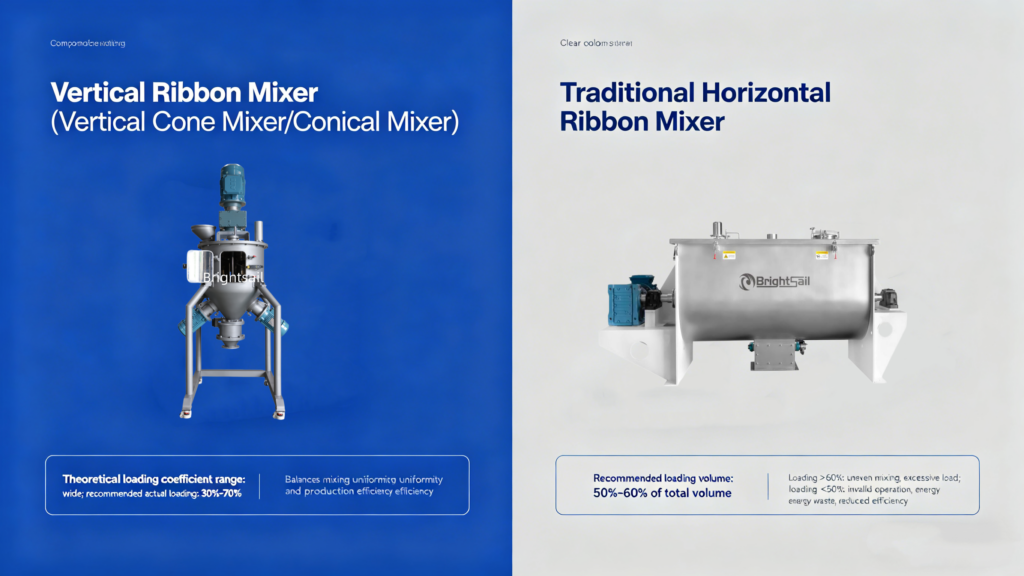
There is a significant difference in the loading coefficient range between vertical and horizontal ribbon mixers: our vertical ribbon mixer (also called vertical cone mixer or conical mixer) has a very wide loading coefficient range, which can adapt to different production needs flexibly. In contrast, the traditional horizontal ribbon mixer generally requires the loading volume to be controlled between 50% and 60% of the total volume of the mixer. For vertical ribbon mixers, although the theoretical loading range is wide, in actual production, we still recommend that customers control the loading volume between 30% and 70% to balance mixing uniformity and production efficiency. For horizontal ribbon mixers, if the loading volume is too high (more than 60%), it will lead to uneven mixing and excessive equipment load; if it is too low (less than 50%), it will cause invalid operation, waste energy and reduce production efficiency.
4. Cost & Application Scenarios: Vertical Ribbon Mixers Are More Suitable for High-Value-Added Products
It is an undeniable fact that vertical ribbon mixers are more expensive than horizontal ribbon mixers. The reason for the price difference is that the vertical structure requires higher precision in the design and manufacturing process, and the core components such as the vertical mixing shaft and the top bearing need to meet higher quality standards to ensure stable operation. However, this higher cost is worthwhile for customers who focus on high-value-added products.
Vertical ribbon mixers—also known as conical mixers—are more suitable for mixing high-value-added products such as health care products, pharmaceutical raw materials and high-end food additives. These products have high requirements for mixing uniformity, hygiene and residual amount, and the vertical ribbon mixer can just meet these needs; while horizontal ribbon mixers are more suitable for large-batch, low-value-added products such as feed and building materials, where the requirements for mixing uniformity and residual amount are not high.
5. Unique Advantages of Our Vertical Ribbon Mixer: Beyond the Industry Standard
Compared with ordinary vertical ribbon mixers (also called vertical cone mixer or Vertical single shaft ribbon blender) on the market, our vertical ribbon mixer has two unique advantages that are highly recognized by customers:
1) Steam Sterilization Function
Our vertical ribbon mixer, which can also be used as a vertical cone mixer, can be directly connected to steam, which enables the mixer to be used as a sterilization equipment while mixing. This is a function that most horizontal ribbon mixers do not have—horizontal ribbon mixers generally cannot directly pass steam into the mixing chamber, because their horizontal structure is easy to cause steam accumulation, leading to material moisture and agglomeration, and even affecting the service life of the equipment. The vertical design of our mixer (also a conical mixer) allows steam to circulate smoothly in the mixing chamber, realize uniform sterilization of materials, and ensure the hygiene and safety of products, which is especially suitable for the food and pharmaceutical industries.
2) Easy Cleaning Design
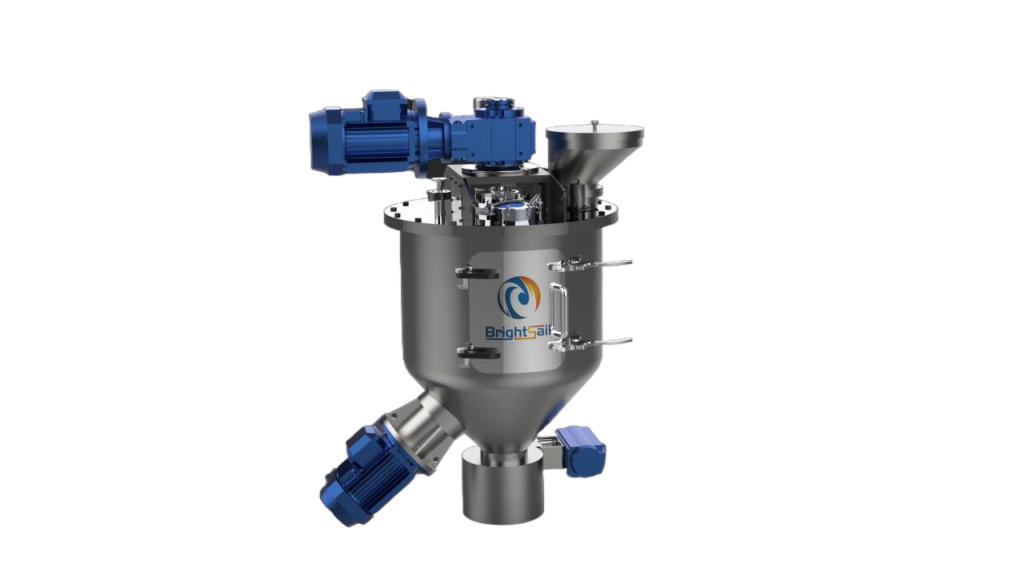
Our vertical ribbon mixer is equipped with a large side door on the side, which can be fully opened, making the cleaning of the inner wall of the mixer and the mixing blades very convenient. In contrast, the horizontal ribbon mixer has a closed horizontal structure, and the inner wall and blades are not easy to clean, which takes a lot of time and labor cost each time. For customers who need to replace materials frequently (such as mixing different types of health care product raw materials), this design can greatly save cleaning time and improve production efficiency.
III. Practical Application Cases
We have a long-term cooperative customer in the food health care industry. The customer mainly produces high-end protein powder and health care products, and the requirements for mixing uniformity and product hygiene are very high. At first, the customer chose a horizontal ribbon mixer, but encountered two problems: first, the mixing uniformity was unstable, the CV value often exceeded 5%, which could not meet the product quality requirements; second, the cleaning was time-consuming, and it took 2 hours to clean each time the material was replaced, which seriously affected the production progress.
After understanding the customer’s needs, we recommended our vertical ribbon mixer—also a conical mixer—to them. After half a year of use, the customer gave high praise: the mixing uniformity CV value is stably maintained below 2%, the product quality is significantly improved, and the cleaning time is shortened to 20 minutes each time, which greatly improves the production efficiency. At the same time, the steam sterilization function of the mixer ensures the hygiene of the product, which helps the customer successfully enter the high-end health care product market.

IV. Selection Guide: How to Choose Between Vertical and Horizontal Ribbon Mixers?
To help you make the most suitable choice according to your own production needs, we summarize the selection criteria for you, combining the characteristics of the two types of mixers and practical application scenarios:
- Choose vertical ribbon mixer (also called vertical cone mixer or conical mixer) if: you focus on high-value-added products (such as health care products, pharmaceutical raw materials), have high requirements for mixing uniformity (CV ≤2%) and hygiene, need frequent material replacement, and the workshop space is limited.
- Choose horizontal ribbon mixer if: you focus on large-batch, low-value-added products (such as feed, building materials), have low requirements for mixing uniformity (CV ≤6%), and the workshop space is sufficient.
V. Conclusion
In summary, vertical ribbon mixers (also known as vertical cone mixer or conical mixers) and horizontal ribbon mixers have their own advantages and applicable scenarios. The horizontal type is more suitable for large-batch, low-value-added production, while the vertical type is more suitable for high-value-added products with high requirements for uniformity, hygiene and easy cleaning. Although there is a certain information gap in the market, many users in the food and health product industries do not know the advantages of vertical ribbon mixers and their alternative name such as vertical cone mixer, we believe that with the continuous improvement of product quality requirements, vertical ribbon mixers will become the first choice for more high-end powder processing enterprises.
If you have more questions about the mixing uniformity, loading volume, steam sterilization function or cleaning methods of vertical ribbon mixers—also called vertical cone mixer or conical mixers—please feel free to contact us. We will provide you with customized solutions according to your specific material characteristics and production needs, helping you maximize production efficiency and product value.